Learning objectives:
While reading this book, you have accompanied us through geological time to the present state of Homo sapiens: connecting us with earlier life through 225 million years of mammalian evolution, 65 million years of primate evolution, 6 million years of hominin evolution, and 2 million years of evolution of the genus Homo. So what do you think now? Are we just another mammal—or just another primate? In most ways, of course, we are like other mammals and primates. But as we have emphasized throughout this book, modern human beings are the result of biocultural evolution. In other words, modern human biology and behavior have been shaped by the biological and cultural forces that operated on our ancestors. In fact, it would be fruitless to attempt an understanding of modern human biology and diversity without considering that humans have evolved in the context of culture. It would be like trying to understand the biology of fish without considering that they live in water.
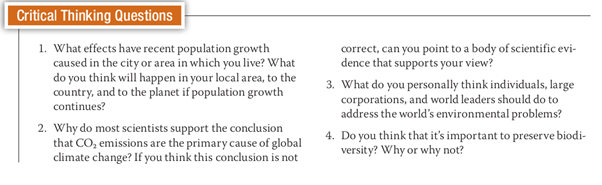
In the last few chapters, we saw how the choices we make as cultural animals have profound effects on human health. Although culture and technology have allowed us to adapt beyond our biological limits, they have also impacted other species and indeed the planet. Humans now have the ability to preserve or destroy a significant portion of the earth’s life-forms—the results of millions of years of evolution. Here we will briefly discuss some of the challenges that have emerged as a result of our own actions. Many people refuse to believe that the earth’s climate is changing, and of those who do, a large proportion think that this change is due to “natural” causes and not human activities. But the overwhelming consensus among climate scientists is that global warming is occurring, that the climate is changing more rapidly than anticipated, and that human activities are the cause. It is also a fact that the results of such rapid climate change are going to be more than simply “inconvenient.”
Although physical anthropology textbooks don’t usually dwell on the topics included here, we feel that it’s important to consider them, however brief and simplified our treatment must be. We are living during a critical period in the earth’s history. Indeed, the future of much of life as we know it will be decided in the next few decades, and these decisions will be irrevocable. It’s crucial that we, as individuals, cities, and nations, make wise decisions, and to do this we must be well informed. We also think that it’s important to consider these problems from an anthropological perspective. This is something not usually done in the media and certainly not by politicians and heads of state. But if we are truly to comprehend the impact that human activities have had on the planet, then surely we must consider our biological and cultural evolution. We must also emphasize our place in nature and focus on how, from the time we began to domesticate plants and animals, we’ve altered the face of our planet while also shaping the destiny of thousands of species, including our own.