The earliest attempts at the comparative study of kinship institutions were undertaken by 19th-century theorists of cultural evolution. The most prominent of these scholars combined legal studies with ethnology and included Henry Maine, Johannes Bachofen, John Ferguson McLennan, and Lewis Henry Morgan. They attempted to trace the historical evolution of family forms from the most “primitive” to the most “modern” and “civilized.”
According to Maine’s theory, the earliest form of kin organization was a state of “patriarchal despotism” in which society consisted of an aggregation of families, each under the rule of the father. The evolution of society was characterized by Maine as a movement from “status” to “contract” forms of relationship—in other words, a change from relations ordered by ascribed positions in a familial system to one in which relations were based on contractual obligations freely entered into by individuals.
In contrast, Bachofen, McLennan, and Morgan posited that the earliest societies were ruled by women and that the forms of kinship used by these societies were rather less regulated than Maine had suggested. Between what Morgan labeled a state of “primitive promiscuity”—in which sex and marriage were quite unregulated—and the patriarchal monogamous family form of “civilization” (the evolutionary stage in which he placed 19th-century European and Euro-American society) came a sequence of intermediate stages. These varied depending on the theorist but typically included variations such as group marriage, exogamy (outmarriage), matriarchy, and polygamy.
Theories of cultural evolution were conservative in the sense that they demonstrated that the mid-19th century bourgeois family was the most “civilized” of kinship institutions. They were also speculative in that there was no direct evidence for the various early stages posited by Bachofen, McLennan, or Morgan; group marriage, matriarchy, primitive promiscuity, and so forth were merely colourful projections of the 19th-century imagination.
The evidence that these early theorists did use was partly derived from the comparison of the legal institutions and kin terms found in different societies. Collections and analyses of linguistic data by philologists, among others, demonstrated that while some cultures differentiated “lineal kin” (those in a direct parent-child relationship) from “collateral kin” (such as cousins, aunts, and uncles), others did not. In some cultures, for example, father and father’s brother, or mother and mother’s sister, were denoted by the same term. In such systems the terms for cousins would be the same as those for siblings—in other words, father’s brother’s son, father’s son, and brother are classed together, as are mother’s sister’s daughter, mother’s daughter, and sister.
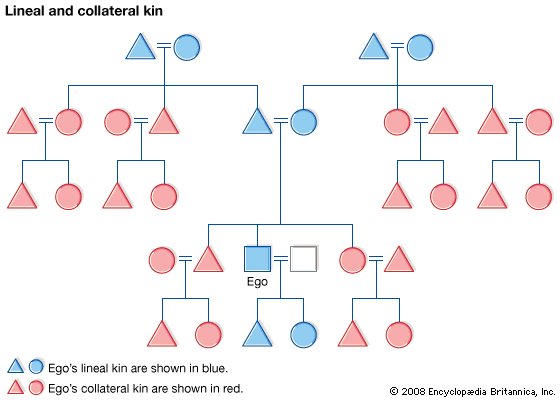
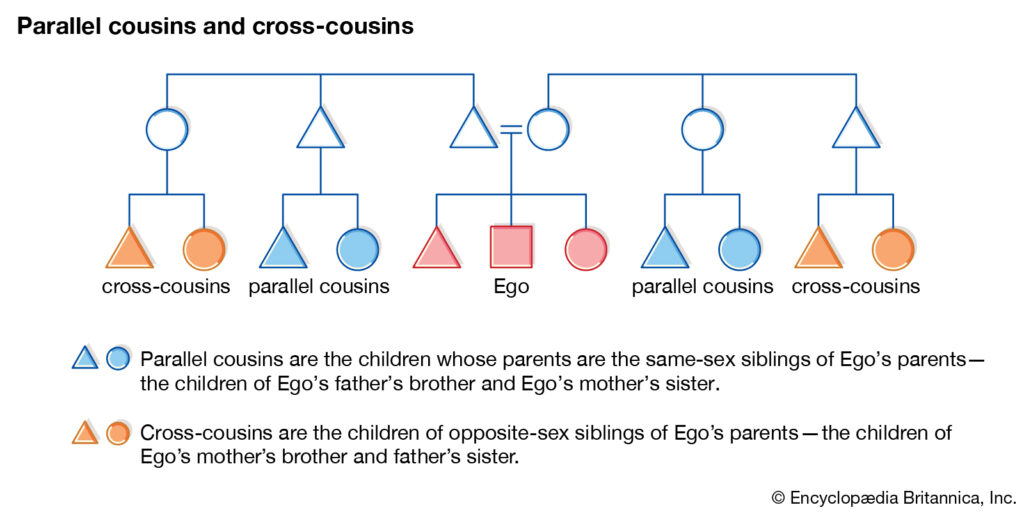
Morgan called kinship terminology that differentiated lineal kin from others “descriptive,” while systems that grouped lineal and collateral kin became known as “classificatory.” He posited that classificatory terminology reflected a system in which a group of brothers shared their sisters in marriage and that it was a cultural survival from an earlier time in which either father and father’s brother had been indistinguishable or the distinction held no social significance.
To Morgan this implied a system of marriage in which the identity of a specific father was unknowable while the identity of the mother was known but socially unimportant. The facts of pregnancy and birth appeared to differentiate motherhood from fatherhood in a crucial way. Motherhood was always recognizable—although not necessarily significant—whereas fatherhood required regulation to be identifiable. From this premise Morgan posited a hypothetical stage of “group marriage,” and it was but a small leap to suggest an even earlier era of “primitive promiscuity” during which sex and marriage were totally unregulated (in fact, modern anthropology has demonstrated that no human society exists nor has existed in which sex and marital relations are not regulated in some way).
These early attempts to systematize the study of human kinship institutions produced models that have since been discredited but that left an enduring mark on modern anthropology in at least two ways. First, kin terminology long continued to be an important aspect of kinship studies. Indeed, the questions these early studies raised about the relationship between language and culture—e.g., Are kin terms a direct reflection of marriage practices?—have occupied a central place in anthropology. Second, such studies made apparent an important distinction between motherhood and fatherhood, acknowledging the former condition as inherently recognizable and the latter as less obvious. This distinction marked out another crucial area of study for kinship—the cross-cultural study of beliefs about procreation. Both these topics are considered in further detail below.
For modern anthropology the most influential of the evolutionary theorists was Lewis Henry Morgan. While other 19th-century anthropologists generally based their work on library research, Morgan carried out fieldwork among the Iroquois and other Native American peoples. In Ancient Society (1877) he attempted to link the evolution of kinship institutions to technological changes and the evolution of property forms. He suggested a schema in which the earlier stages of kinship organization were linked to low levels of technology and to hunting, gathering, or fishing as modes of subsistence. In these early stages of human evolution, there was an absence of ownership of property. Later the development of pastoralism and settled agriculture—and, more importantly, the greater investments of time and energy that these activities engendered—fostered a vested interest in owning the products of labour, such as herds or cultivated land. A man would wish to pass on such products to his offspring, and it thus became more important to know who those offspring were. As a result, men attempted to exert greater control over women, thereby causing humanity to move sequentially through the stages of primitive promiscuity, group marriage, matriarchy, patriarchy, and polygamy, ultimately “achieving” monogamy.
Morgan’s theories thus suggested a mechanism for the evolution of the family: technological developments and the concomitant changes in the ownership of property drove the development of new kinship institutions. His pioneering work on kinship terminology, as well as his grand evolutionary scheme, has retained a niche in the modern study of kinship. Indeed, although anthropology has for the most part long abandoned any evolutionary ambitions, echoes of Morgan’s historical stages continue to crop up in some surprising places. This is partly through the historical coincidence that Morgan’s theories were taken up by German expatriates Karl Marx and Friedrich Engels in their work on precapitalist societies.
Marx and Engels were engaged in an ambitious project to analyze capitalist society and to demonstrate that the social institutions of capitalism were neither historically inevitable nor desirable. Morgan’s work was of major interest to them for two reasons. The first was historical: his evolutionary scheme linking kinship institutions to technology and the ownership of property suggested how the particular social relations of capitalism might have developed from earlier social and economic systems. The second was comparative: Morgan had provided ethnographic evidence that the private ownership and control of property, which was dominant under capitalism, was not the only possible form that property relations could take. Indeed, ownership by a group such as a clan or a lineage was by no means unusual in precapitalist societies that were organized through kinship.
Engels’s The Origins of the Family, Private Property, and the State (1884) was in fact largely based on Morgan’s Ancient Society. It traced the evolution of family forms, linking them, as Morgan had done, to changes in technology and arrangements for the ownership of property. Despite their similarities, however, the two works were set apart by a crucial difference—Morgan’s work was intended as a scholarly product, or an end in itself, while Engels’s was revolutionary in tone and spirit. Rather than regard mid-19th-century European society and family life as the apotheosis of civilization, Engels was highly critical of these institutions. He had some particularly acerbic observations to make about the position of women in the patriarchal European bourgeois family—which, he argued, compared unfavourably to that of prostitutes. Marx and Engels were particularly influential on the kinship studies of Soviet and Chinese anthropologists, which retained a heavily evolutionist flavour long after such theories had been abandoned elsewhere. Engels’s Origins of the Family was also taken up much later by feminists and inspired a number of studies of the position of women in so-called simple societies.