The Concept of Status and Roles
- Linton (1936) defines status as “a collection of rights and duties” . Each status has certain behavioural expectations attached to it which called as social roles . In Status and Roles Drawing the relationship between status and role, Linton writes: “a role represents the dynamic aspect of status…when he (an individual) puts the rights and duties which constitute a status into effect, he is performing a role…” (Linton 1936: 114). Therefore, statuses are occupied and roles are played. Social status and social roles are important concepts in understanding how social life is organized and activities are distributed.
- Status is also a basis of social stratification and individuals not just occupy a position but these positions are also placed in a hierarchy. Status and Roles Say for example, one occupation is not merely different from another in division of labour but also ranked in terms of prestige and differentially rewarded.
- Further, status is positively or negatively valued, each status has privileges/deprivileges attached to it. Having the status of a Dalit or former untouchable in India, for instance, prevented the individuals from having access to public wells, sharing food with other castes, or marrying someone from an upper caste family. Similarly, in United States of America, being a black became a basis for denial of right to employment and segregation in schools, housing and public places.
- However, honour or prestige assigned to a status is changing. In Status and Roles For example, societies where being a woman, disabled, black or ‘untouchable’ was considered inferior or stigmatized , these statuses and their roles are now positively seen owing to the struggles for rights and dignity that have been fought for years. Therefore, both statuses and roles are dynamic and keep changing.
Linton (1936) distinguished between two types of statuses:
Ascribed statuses are “those which are assigned to individuals without reference to their innate differences or abilities” . The universally used criteria for ascription of status are age, sex, kinship, and race. Birth of an individual in a particular social category such as class and caste also become criteria for ascription of statuses in several but not all societies.
- Achieved statuses: Status and Roles are achieved statuses are those that are “left open to be filled through competition and individual effort” . These are acquired over an individual’s lifetime. Occupation and education are thus called achieved statuses. Marital statuses of a wife or a husband are also achieved statuses.
- However, the line distinguishing between the two are not as clear as they seem. For example, although the ascribed statuses seem fixed at birth they are not immutable. Some people also undergo sex (gender) change later in life. For a long time gender was bifurcated into categories that is male and female however now a third broad category of transgender which includes homosexuals, transsexuals (to name a few) is also recognized in many parts of the as an outcome of struggle for recognition.
- Master Status : In every society there is always one status that tends to overshadow all other statuses or is given more importance by others. This is called the master status. Gender, race and caste for instance often become master statuses in highly stratified societies.
THE CONCEPT OF ROLE
Giddens and Sutton (2014) define roles as “socially defined expectations that a person in a given status (social position) follows” . For example, when there is traffic congestion, we expect the traffic police to manage the traffic and ease the flow of vehicles. Similarly, at a restaurant the customers expect the waitress to provide the menu, note down the orders and serve the food.
- Turner (2006) defines roles as a “cluster of behaviour and attitudes” and argues that roles help in organizing social behaviour both at individual and collective level.
- In Banton’s (1965) definition, roles are a “cluster of rights and obligations” and what is one individual’s obligation is his/her partner’s right . So in a restaurant a waitress is obliged to serve and the customer has the right to be served. This way, “the concept of role”, Banton writes, “provides one of the available means for studying elements of cooperation” .
- Roles help in maintaining some kind of social order and predictability in interactions.
- Role learning begins at a young age when children start observing how people in their surroundings behave with them and toward each other. In fact children often engage in role playing games where they enact the role of a mother, father, or teacher.
- Individuals also have role models in their lives whose certain pattern/ s of behaviour is incorporated in one’s own behaviour. A role model can be a person in the family, neighbourhood, school or even some distant, unrelated person whom we have seen in the social media.
- In our daily lives, we smoothly switch from one role to another without much effort and also play distinct roles at the same time. How one behaves as a daughter is different from how one behaves as a friend.
- Similarly, social situations also define roles we play. How we behave in a formal set up of workspace is different from how we behave at home. Thus we tend to compartmentalize our lives and roles. Status and Roles, So a criminal lawyer behaves differently at home from how she behaves in the courtroom. However, to say that everyone conforms to the socially laid expectations will be not be true.
- Individuals in their everyday lives are also constantly negotiating and redefining the roles they play.
- Roles assigned to a particular status are also challenged. For example, in India historically women were expected to perform domestic chores and confined largely to the private sphere of home. However, women are now taking up roles that were traditionally expected of men, particularly in urban India. It is important to keep in mind that social changes are slow and may take several years and sometimes even concerted struggles.
- Role Theory : Structural and Interactionist Approach Understanding of roles has been approached in two different ways or from two schools of thought.
- The structuralists (Linton, Banton, Parsons and Merton) view roles as norms and expectations associated with statuses in the social structure where individuals are socialized into “role taking”. Linton (1936) writes: “…the more perfectly the members of any society are adjusted to their statuses and roles the more smoothly the society will function” (Linton 1936: 115)Status and Roles. This way the functionalist also assume consensus on part of the individuals.
- The social interactionists (Mead, Turner) on the other hand argue that individuals though bound by the structure and its given expectations interpret and evaluate their roles and engage in negotiation. For interactionists this is a creative process of “role making” rather than just unquestioning internalization of given expectations.
- CLASSIFICATION OF ROLES : In Status and Roles 1) ascribed roles and achieved roles, 2) relational and non-relational roles, 3) basic, general and independent roles.
- Ascribed Roles : Like ascribed statuses, the ascribed roles are the ones that are given at birth. From the time an individual is born, role learning begins which is a part of what we know as socialization. These roles pertain to one’s sex (gender), age, kinship, caste, class, and so on.
- The achieved roles on the other hand are the ones that are largely acquired over a lifetime on the basis of merit such as occupational roles of a farmer, salesperson, banker, shopkeeper, driver, lawyer, professor et cetera.
- Relational Roles : There are certain roles which are complementary in nature and are conceived of and defined in relation to another. One good example of relational role is that of a wife which cannot be conceived of without the husband. Similarly, the role of a debtor cannot exist without the role of a creditor.
- Non-relational roles on the other hand are not dependent or complementary such as the role of a musician, researcher, and painter. Age and sex roles largely fall in the category of non-relational roles whereas kinship roles can be classified as relational.
- Banton (1965) developed a scale giving a comparison of the extent to which particular roles are independent of other roles (Basic, General and Independent Roles) Status and Roles
- a) Basic roles: Basic roles are mostly determined by sex and age, ascribed to individuals at birth and these roles shape conduct in a large number of social contexts.
- b) General roles: General roles are mostly assigned on the basis of merit of the individual.
- c) Independent roles: Independent roles are determined by merit and have very less implications for other roles and on the way people respond to the person who occupies the independent role. Examples of independent roles are leisure roles and many occupational roles.
- Usually an individual’s sex role shapes the individual’s conduct and the response of others towards him or her more than
ROLE SYSTEMS: SIMPLE AND COMPLEX SOCIETIES
In Status and Roles According to Banton (1965) one of the ways to understand variation in social organization is to study the criteria on bases of which roles are given to an individual. Roles allocation in simple societies differ from those in complex industrial societies.
In the simplest societies like that of Bushmen in Kalahari Desert in Southern Africa and Eskimo in Arctic Wastes, roles are allocated based upon the natural differences of age, sex and kinship. Let us see how roles were distributed as per
these criteria:
1) The division of roles on the basis of sex took place in the following manner.
A man is responsible for hunting, preparing skins for clothing, making weapons, building fire and sometimes helping the women in fetching wood and water. The wife on the other hand builds shelter for her family, takes care of the children, gathers and prepares food and keeps the residence clean.
2) The other basis of role allocation is age. A boy’s passage into manhood is marked when he kills his first buck and this passage is celebrated with rituals. Thereafter, he is allowed to marry. In case of a girl she can be married when a baby but she takes the role of a wife and a married woman only when she matures physically. Elderly people are treated with respect and as experts on traditions, myths and family lineages.
3) The third basis is of kinship. Mothers and fathers perform the important role of bringing up their children. When the children grow up as adults they have certain mutual obligations with their parents. Marriage between men and women can be dissolved but as they rarely quarrel divorce is rare. Marriages between close relations are avoided to keep kin ties clear Status and Roles.
Roles in Complex Societies
We discussed how roles (Status and Roles) are allocated on the distinction of age, sex and kinship in simple societies that have to survive in harshest environmental conditions. But as societies become complex new criteria has to be introduced for role division. Social stratum is one such criterion.
1) Social strata: Some societies are organized on the basis of ranks such as nobles, commoners, slaves, etc. People belonging to the same strata share a similar existence and have same privileges and duties towards the king. While this kind of social strata is more flexible than rigid role system of simple societies, social strata can become rigid and discriminatory to an
extent where birth in a particular category influences the life chances of individuals. In such rigid system of stratification leaving the category in which a person is born becomes difficult.
Take for example, the caste system in India (Status and Roles) where a person born in a particular caste is expected to adhere to the caste specific norms, customs, occupation and rules of interaction with other castes. Deviation from roles are often disapproved and also punished particularly when a lower caste individual does so. While these norms are not as rigid as they used to be earlier, due to continuous struggle and legal action, caste based rules of interaction and roles still prevail in the present day.
2) Diversification and specialization of tasks: In complex societies tasks are distributed based on specialization and skills. From largest to even smallest of organizations have role divisions.
DIMENSIONS OF ROLE
Multiple Roles and Role Set
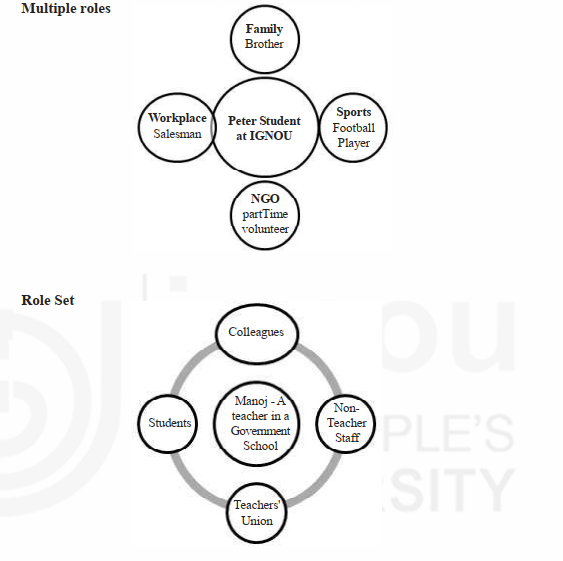
Sociologist, Robert K. Merton (1957) emphasized on the need to distinguish between the Status and Roles concept of multiple roles and role-set. In contrast to Linton’s theory that each status has a single, associated role, Merton argues that “each status has an array of roles” associated with it. This is what Merton calls role set. It is a “complement of role relationships in which persons are involved by virtue of occupying a particular status” . Each status has its own role-set. Merton offered the example of a medical student whose status as a student is not only related to teachers but to the roles of other status occupants like nurses, physicians, social workers and so on. Merton added that this kind of complex arrangement can also give rise to contradictory expectations of the role partners in the role set.
Multiple roles, on the other hand, refers to the roles associated with the various social statuses of an individual. The figures given below explain the difference between role set and multiple roles
Role Signs
Clothing often serves as one of the most important ways to distinguish between men and women in almost all societies. But it is important to ask why we must make this distinction. Status and Roles It is because it works as a sign to differentiate the male and female roles and helps others to anticipate their roles and shape their response accordingly. According to Banton role signs help in communication and control. Role signs act as ways of communication by shaping our relationship, expectations
and interactions. They also help in controlling behaviour and checking deviation from the role both for the individual playing the role and signalling others as well. If such distinguishing signs are totally abandoned, everyday life and activities
may become very chaotic.
In our day to day lives costumes help in defining the role of the individuals, whether it is a salesperson at a supermarket, ticket collector in a train or traffic police personnel at a red light. During a traffic jam we often anxiously look for the traffic police identified by a particular uniform and expect him/her to perform the role that is assigned to them. Similarly, in hospitals nurses and doctors each have their unique uniforms that help us in identifying them and setting our expectations.
Banton identified signs of various roles in terms of basic, general and independent roles.
a) Signs for basic roles: Signs for basic roles which are largely determined by sex, age and kinship include names, clothes and hairstyles. The first names of two sexes are mostly distinctive. Titles like Miss, Mrs, Mr, Master also help in identification of gender, age and marital status.
b) Signs for general roles: Signs for general roles often depend on the extent to which it is necessary to distinguish and communicate the distinctiveness and relevance of the role for a particular situation as well as for other role relationships. The case of a policeman and his uniform discussed above is an example of sign for a general role.
c) Signs for independent roles: Since independent roles have less implications for other roles, signs for them are limited. Signs for independent roles have relevance only in particular contexts and may lose relevance in most other social situations. For outsiders such signs often serve as prestige signs.
Role Changing
Roles never remain the same and keep evolving. Individuals move from one role to another and new roles are added to the old set of roles. When a person moves from one role to the other it is important to become familiar with the rights and
obligations of this new role. This is important not only for the person who undergoes role change but also for all others who are associated with the person to modify their behaviour and expectations as per the new role.
This is the reason why role changes are often marked by ceremonies. The first important change that individuals in every society experience is from childhood to adulthood. If you remember, in the tribal society of Bushmen a boy becomes a man when he first shoots his buck and this is celebrated with rituals. From this point he is also allowed to marry. Similarly, in many societies maturity of girls is marked by puberty rites.
When an individual is about to acquire the role of a wife or a husband it is followed by a ceremony where family, friends, neighbours and the community takes part. Ceremonies help in making this changeover a critical moment for the
individual as well as others. Similarly, when any person acquires an important position like of a chairperson of an organization, or Prime Minister or President of a country it is marked by oath taking ceremony.
The change in roles also occurs during the passage from adulthood to old age. Status and Roles In many societies the elderly are relieved of their labour intensive tasks and they assume new roles such as taking care of grand children. While in some societies old people are treated with respect for their experience and wisdom, and advice on important matters are sought from them there are some where elderly are treated like invalids.
Role Conflict and Strain
As a person occupies several statuses and there are multiple roles to be played, sometimes two different statuses of an individual may demand conflicting expectations placing the individual in a state of dilemma. In everyday life individuals are often confronted with similar or much more complex dilemmas pertaining to their roles. We have already discussed that an individual plays multiple roles in his/ her lifetime and therefore such incompatibility is bound to arise. A frequently cited example of role conflict is the one experienced by working women who are also married. In traditional societies the culturally accepted role of women were largely related to child rearing and household chores. However, in modern societies these roles are being challenged and women are increasingly entering full time salaried employment and sharing professional workspace with men. When such social changes take place a woman may experience a pull from both sides –her commitment to her work as a professional and her commitment towards the family and children as a wife or mother. Such conflicts arise when and especially because the role partners may not accept and reorient themselves to the fact that women are re-making their roles or adopting new ones.
While role conflict takes place between roles associated with two different statuses of an individual, role strain is experienced when different responsibilities associated within a single status are incompatible. For example, Rohit has to prepare for an exam that is next day but has to also represent his school in an inter-school chess competition on the same day. As a student he might experience stress and anxiety because he has to perform well in both the situations. People try to manage role conflict by role compartmentalization or separation where they try to keep what they do in one role distinct from what they do in another and giving priority to one role over the other. Concepts of role strain and conflict are important to understand role exit as they can also give rise to doubt about one particular role eventually lead to exit.