Various hypotheses have been proposed to explain the arboreal adaptationssuch as forward-facing eyes (which facilitate binocular vision), grasping hands and feet, and the presence of nails instead of claws observed in primates. These hypotheses focus on different aspects of primate evolution, such as dietary needs, predator avoidance, and locomotor efficiency. Each hypothesis has its own set of proponents and associated shortcomings. Here is an overview of the major hypotheses and their critiques:
1. Arboreal Hypothesis
Proponents:
- Grafton Elliot Smith
- Frederic Wood Jones
Hypothesis:
- Primates throughout the course of evolution, increasingly found food (leaves, seeds, fruits, nuts, insects, and small mammals) in the trees themselves and evolved their distinctive traits such as grasping hands and feet, binocular vision, and flexible limb joints. These are primarily as adaptations to an arboreal lifestyle. Living in trees required enhanced mobility and coordination to navigate the complex three-dimensional environment.
Shortcomings:
- This hypothesis does not fully account for the diversity of primate species that are not strictly arboreal and the variations in locomotion among arboreal species.
- It oversimplifies the evolutionary pressures and may not fully explain the development of traits such as enhanced vision or reduced snouts.
- Animals such as squirrels and raccoons are also arboreal, yet they haven’t evolved primate-like adaptations such as prehensile hands or forward-facing eyes.
- But visual predators, such as cats and owls, do have forward-facing eyes, and this fact may provide insight into an additional factor that could have shaped primate evolution.
2. Visual Predation Hypothesis
Proponents:
- Matt Cartmill
Hypothesis:
- Primates developed their key adaptations, particularly forward-facing eyes and grasping hands, to become efficient nocturnal hunters of insects in the lower canopy and understory. Enhanced vision helped in spotting prey, while grasping hands facilitated capturing insects.
Shortcomings:
- Many modern primates are frugivorous or folivorous, not insectivorous, which calls into question the primary focus on insect predation.
- The hypothesis does not adequately explain the presence of these traits in diurnal primates or those with diets that do not rely heavily on insects.
3. Angiosperm Coevolution Hypothesis
Proponents:
- Robert Sussman
Hypothesis:
- The evolution of primate traits was driven by the diversification of flowering plants (angiosperms). Primates evolved to exploit the new food resources, such as fruits and flowers, which required enhanced vision for spotting colorful fruits and flowers and grasping hands for foraging.
Shortcomings:
- This hypothesis may overemphasize the role of fruit and flowers and underemphasize other ecological factors such as insect predation or locomotor efficiency.
- Not all primates are frugivorous, so the hypothesis does not account for the dietary diversity among primates.
4. Terminal Branch Hypothesis
Proponents:
- D. Tab Rasmussen
Hypothesis:
- Primates evolved their unique traits to navigate and exploit resources at the ends of branches, which are more flexible and require better balance and precise movements. This includes adaptations for grasping and visual acuity for depth perception.
Shortcomings:
- While this hypothesis addresses some gaps in the arboreal hypothesis, it may still oversimplify the complex selective pressures that influenced primate evolution.
- It does not fully address the dietary and ecological diversity among different primate species.
5. Niche Expansion Hypothesis
Proponents:
- Various researchers with an integrative approach
Hypothesis:
- This hypothesis integrates aspects of the other hypotheses, suggesting that primates evolved their adaptations due to a combination of factors, including arboreal living, insect predation, fruit foraging, and navigating terminal branches. It posits that primates expanded into various ecological niches, driving the evolution of their unique traits.
Shortcomings:
- While more comprehensive, this hypothesis can be seen as too broad and lacking specific testable predictions.
- It may be challenging to disentangle the relative contributions of each selective pressure in driving primate evolution.
Diet and Teeth
Omnivory is one example of the overall lack of specialization in primates. Although all primates tend to favor some food items over others, most eat a combination of fruits, nuts, seeds, leaves, other plant materials, and insects. Many also get animal protein from birds, amphibians, and small mammals, including other primates. Others have become more specialized and mostly eat leaves. Such a wide array of choices is highly adaptive, even in fairly predictable environments.
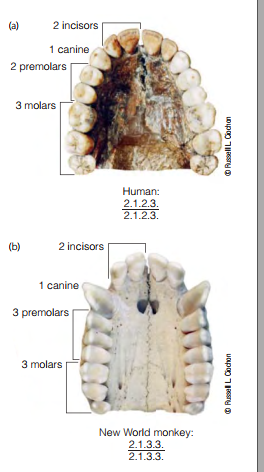
All primates have four kinds of teeth: incisors and canines for biting and cutting, and premolars and molars for chewing and grinding. Biologists use what’s called a dental formula to describe the number of each type of tooth that typifies a species. A dental formula indicates the number of each tooth type in each quadrant of the mouth . For example, all Old World anthropoids have two incisors, one canine, two premolars, and three molars on each side of the midline in both the upper and lower jaws, for a total of 32 teeth. This is represented by the following dental formula: 2.1.2.3 (upper) /2.1.2.3 (lower)
The dental formula for a generalized placental mammal is 3.1.4.3 (three incisors, one canine, four premolars, and three molars). Primates have fewer teeth than this ancestral pattern because of a general evolutionary trend toward fewer teeth in many mammal groups. Consequently, the number of each kind of tooth varies between lineages. For example, humans, apes, and all Old World monkeys share the same dental formula: 2.1.2.3. This formula differs from that of the New World monkeys in that there’s one less premolar.
The overall lack of dietary specialization in primates is reflected in the lack of specialization in the size and shape of the teeth, because tooth shape and size are directly related to diet. For example, carnivores typically have premolars and molars with high, pointed cusps adapted for tearing meat; but herbivores, such as cattle and horses, have premolars with broad, flat surfaces suited to chewing tough grasses and other plant materials. Most primates have premolars and molars with low, rounded cusps, a pattern that enables them to process most types of foods. So, throughout their evolutionary history, the primates have developed a dentition adapted to a varied diet, and the capacity to exploit many foods has contributed to their overall success during the last 50 million years.
Locomotion
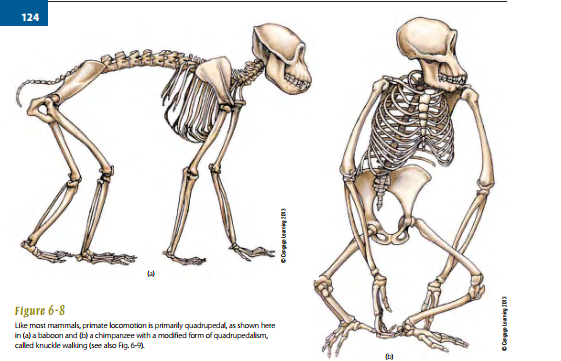
- Almost all primates are, at least to some degree, quadrupedal. However, most primates use more than one form of locomotion, and they’re able to do this because of their generalized anatomy.
- The limbs of terrestrial quadrupeds are approximately the same length . In arboreal quadrupeds, forelimbs are somewhat shorter.
- Vertical clinging and leaping, another form of locomotion, is characteristic of some lemurs and tarsiers. As the term implies, vertical clingers and leapers support themselves vertically by grasping onto trunks of trees or other large plants while their knees and ankles are tightly flexed. By forcefully extending their long hind limbs, they can spring powerfully away either forward or backward.
- Brachiation, or arm swinging, is a suspensory form of locomotion, and the body moves by being alternatively suspended by one arm or the other. Only the small gibbons and siamangs of Southeast Asia use this form of locomotion almost exclusively. Brachiation is seen in species characterized by arms longer than legs, a short, stable lower back, long curved fingers, and shortened thumbs. .
- Some New World monkeys, such as spider monkeys, are called semibrachiators, since they practice a combination of leaping with some arm swinging. Also, some New World monkeys enhance arm swinging by using a prehensile tail, which in effect serves as an extra hand. It’s important to mention that no Old World monkeys have prehensile tails.
- Lastly, all the apes, to varying degrees, have arms that are longer than legs, and some (gorillas, bonobos, and chimpanzees) practice a special form of quadrupedalism called knuckle walking. Because their arms are so long relative to their legs, they support the weight of their upper body on the back surfaces of their bent fingers.
Summary
Primates have diversified in arboreal and terrestrial habitats (trees, bushes and land) and retain many characteristics facilitating adaptations to these environments:
- Retention of the collar bone in the pectoral girdle.
- Shoulder joints with a high degree of movement in all directions.
- Possession of five digits on the fore and hind limbs with opposable thumbs and big toes facilitating them in grasping objects and climbing trees.
- Presence of nails on the fingers and toes in most species.
- Presence of sensitive tactile pads on the ends of the digits.
- Orbits encircled in a bony rim facilitating rotation of eyeballs in the socket.
- Trend towards a reduced snout and flattened face supposedly leading to the development of vision at the expense of olfaction.
- Complex visual system with stereoscopic vision, high visual acuity and color vision – all contributing to quicker movements on the trees.
- Large brain in comparison to body size especially in simians.
- Differentiation of the enlarged cerebral cortex.
- Reduction in the number of teeth compared to primitive mammals.
- Three kinds of teeth.
- Longer gestation and developmental period; and
- Trend towards holding the torso upright leading to bipedalism.
Primates exhibit a wide range of characteristics. Some primates, inclusive of some great apes and baboons, do not live primarily in trees. But all species possess adaptations for climbing trees. Their locomotion techniques include leaping from tree to tree, walking on twos or fours limbs, knuckle-walking, and swinging between branches of trees (known as brachiation). The three-color vision has developed in some primates.