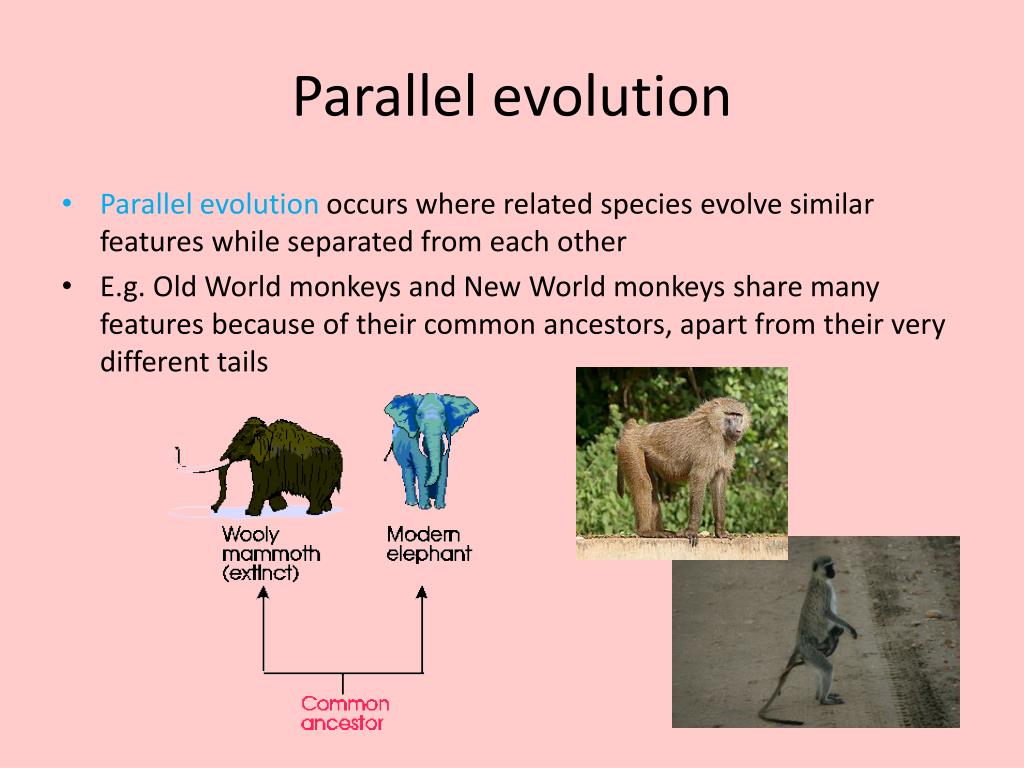
• Stein and Rowe ( 1990) defined that it is a “process in which two evolutionary lines derived form a common ancestor evolve in much the same way through time , parallel with each other in their adaptations “ is called parallel evolution.
• John Buettner – Janusch (1965) : it is a process that refer, to the evolutionary “development of similar traits and adaptive relationships and adaptive relationships from the same ancestral trait in two related groups of animals; development of evolutionary descent and divergence” is called parallel evolution.
The term parallelism is usually restricted to the development of similar adaptive features in animals that are related, such as animals belonging to the same order. The parallel resemblances are, most likely, the realisation of a genetic potential that is present in the entire group.
The evolution of two related species in the same direction so that they resemble each other more than their common ancestor is called parallelism. That means in parallelism two related species independently take comparable ways of life. So, they evolve in the same direction and resemble one another in many ways. In fact, they resemble one another more than their common ancestor. Their initial similarity is due to shared ancestral traits but their continued similarity is due to adaptation to similar conditions.
Examples : The old world monkeys and new world monkeys provide an excellent example of parallelism between groups living today, since they appear to have evolved in parallel from a prosimian ancestor that probably lived at least 35 million years ago.
The North American wolves and Tasmanian wolves is another example for the similar appearance and predatory behaviour. The North American wolves is a placental mammal and the Tasmanian wolves is an Australian marsupial. The common ancestor lived during the age of the dinosaurs some more than 100 million years ago and was very dissimilar from these descendants today.