- Co-dominance
- Incomplete Dominance
- Polygenic Inheritance
- Multiple Alleles
- Pleiotropy
- Gene Linkage
- Extra-nuclear Inheritance
- Mendelian inheritance patterns involve genes that directly influence the outcome of an organism’s traits and obey Mendel’s laws.
- Most genes in eukaryotic species follow a Mendelian pattern of inheritance. However, there are many that do not.
- Non-Mendelian inheritance is a general term that refers to any pattern of inheritance in which traits do not segregate in accordance with Mendel’s laws. These laws describe the inheritance of traits linked to single genes on chromosomes in the nucleus.
1. Co-dominance
- Co-dominance is believed to be a violation of the Law of Dominance.
- codominance, in genetics, phenomenon in which two alleles (different versions of the same gene) are expressed to an equal degree within an organism. As a result, traits associated with each allele are displayed simultaneously.
Example.
An example of codominance is seen in the MN blood group system of humans. MN blood type is governed by two alleles, M and N. Individuals who are homozygous for the M allele have a surface molecule (called the M antigen) on their red blood cells. Similarly, those homozygous for the N allele have the N antigen on their red blood cells. Heterozygotes—those with both alleles—carry both antigens. An example of codominance for a gene with multiple alleles is seen in the human ABO blood group system. Persons with type AB blood have one allele for A and one for B; the O allele is recessive (its expression is masked by the other alleles).
2. Incomplete Dominance
- Sometimes in a heterozygote dominant allele does not completely mask the phenotypic expression of the recessive allele and there occurs an intermediate phenotype in the heterozygote. This is called incomplete dominance.
- With co-dominant alleles, both traits are expressed at the same time. With incomplete dominance, the same thing occur but the traits are blended together rather than occurring in discrete patches.
- It thus refers to the condition in heterozygotes where the phenotype is intermediate between the two homozygotes.
Example.
Incomplete dominance examples include physical characteristics in humans, such as hair color, hand sizes, and height
3. Polygenic Inheritance
- Some traits are controlled by many genes such as the height, IQ, skin color, eye color etc.
- Polygenic inheritance occurs when one characteristic is controlled by two or more genes.
- Often the genes are large in quantity but small in effect.
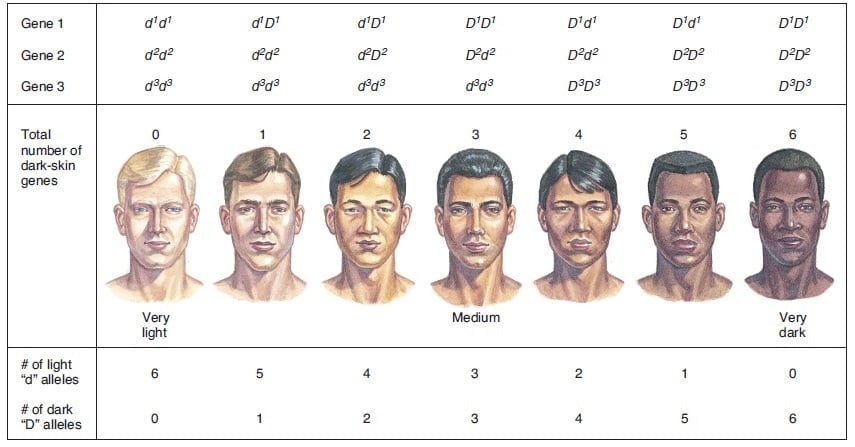
Example. Skin Colour in Man
Davenport (1913) in Jamaica found that two pairs of genes, A-a and B-b cause the difference in skin pigmentation between negro and caucasian people. These genes were found to affect the character in additive fashion.
Thus, a true negro has four dominant genes, AABB, and a white has four recessive genes aabb. The F1 offspring of mating of aabb with AABB, are all AaBb and have an intermediate skin colour termed mulatto. A mating of two such mulattoes produces a wide variety of skin colour in the offspring, ranging from skins as dark as the original negro parent to as white as the original white parent.
4. Multiple Alleles
- Mendel studied just two alleles of his pea genes, but real populations often have multiple alleles of a given gene.
a. An example is ABO blood type in humans.
There are three common alleles for the gene that controls this characteristic. The alleles IA and IB are dominant over i. A person who is homozygous recessive ii has type O blood. Homozygous dominant IAIA or heterozygous dominant IAi have type A blood, and homozygous dominant IBIB or heterozygous dominant IBi have type B blood. IAIB people have type AB blood, because the A and B alleles are co-dominant. Type A and type B parents can have a type AB child. Type A and type B parents can also have a child with Type O blood, if they are both heterozygous (IBi, IAi).
- Type A blood: IAIA, IAi
- Type B blood: IB IB, IBi
- Type AB blood: IAIB
- Type O blood: ii
5. Pleiotropy
- Some genes affect many different characteristics, not just a single characteristic.
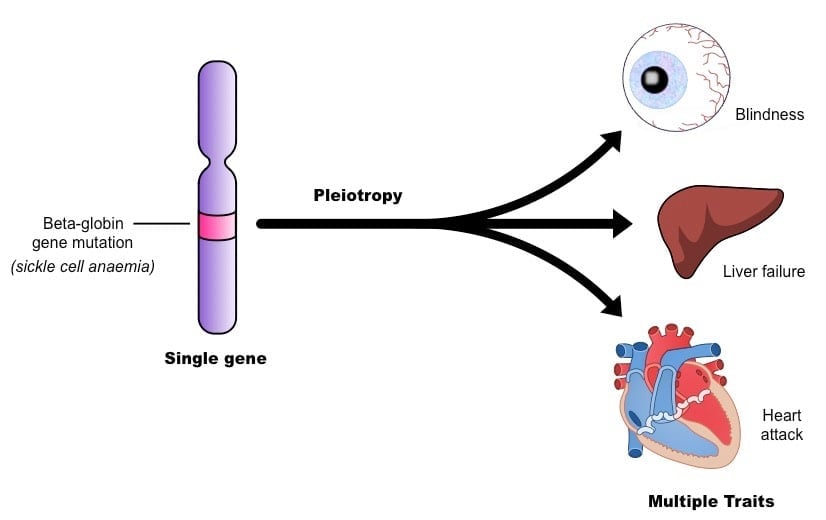
An example of this is Marfan syndrome, which results in several symptoms (unusually tall height, thin fingers and toes, lens dislocation, and heart problems). These symptoms although not seem to be directly related, can be traced back to the mutation of a single gene.
One of the most widely cited examples of pleiotropy in humans is phenylketonuria (PKU). This disorder is caused by a deficiency of the enzyme phenylalanine hydroxylase, which is necessary to convert the essential amino acid phenylalanine to tyrosine. A defect in the single gene that codes for this enzyme therefore results in the multiple phenotypes associated with PKU, including mental retardation, eczema, and pigment defects that make affected individuals lighter skinned (Paul, 2000).
The phenotypic effects that single genes may impose in multiple systems often give us insight into the biological function of specific genes. Pleiotropic genes can also provide us valuable information regarding the evolution of different genes and gene families, as genes are “co-opted” for new purposes beyond what is believed to be their original function (Hodgkin, 1998). Quite simply, pleiotropy reflects the fact that most proteins have multiple roles in distinct cell types; thus, any genetic change that alters gene expression or function can potentially have wide-ranging effects in a variety of tissues.
6. Gene Linkage
- Each chromosome contains more than one gene.
- If the genes are situated in the same chromosome and are fairly close to each other, they tend to be inherited together.
- This type of coexistence of two or more genes in the same chromosome is known as linkage.
Genes that are located on the same chromosome are called linked genes. Alleles for these genes tend to segregate together during meiosis, unless they are separated by crossing-over. Crossing-over occurs when two homologous chromosomes exchange genetic material during meiosis I. The closer together two genes are on a chromosome, the less likely their alleles will be separated by crossing-over. At the following link, you can watch an animation showing how genes on the same chromosome may be separated by crossing-over.
Linkage explains why certain characteristics are frequently inherited together. For example, genes for hair color and eye color are linked, so certain hair and eye colors tend to be inherited together, such as blonde hair with blue eyes and brown hair with brown eyes. W
Genes located on the sex chromosomes are called sex-linked genes. Most sex-linked genes are on the X chromosome, because the Y chromosome has relatively few genes. Strictly speaking, genes on the X chromosome are X-linked genes, but the term sex-linked is often used to refer to them.
7. Extra-nuclear Inheritance
- Though, the genes of nuclear chromosomes have a significant and key role in the inheritance of almost all traits from generations to generations, they altogether cannot be considered as the sole vehicles of inheritance.
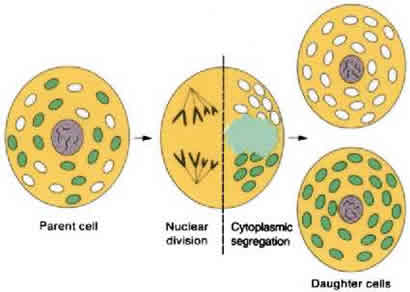
- Certain experimental evidences suggest the occurrence of certain extranuclear genes or DNA molecules in the cytoplasm of many prokaryotic and eukaryotic cells. For eg. Mitochondria and chloroplasts have their own DNA and reproduce on their own inside each cell.
- Mitochondrial DNA is passed down from a mother to her offspring because the mitochondria in sperm cells don’t make it into the egg. Thus, the entire mitochondrial DNA in the offspring —whether male or female—originally comes from the female parent only.
8. Sex Influenced Female Dominant Inheritance

Assigning genotypes for a sex influenced female dominant trait can be challenging. The trait is dominant in females while at the same time it is recessive in males. It is difficult to use “R” to represent the dominant allele and “r” to represent the recessive allele because they behave differently as they pass from females to males. It is customary to use R’ to represent the allele for the unusual condition and R to represent the normal condition. If the shaded individuals in the tree were expressing the trait we call Herberden’s nodes (bony excrescences on fingers) which is sex influenced female dominant, then:
- RR would be expressed as no Herberden’s nodes in both males and females (not shaded)
- RR’ would be expressed as Herberden’s nodes in females (shaded) and no Herberden’s nodes in males (not shaded). This is the difficult one.
- R’R’ would be expressed as Herberden’s nodes in both males and females (shaded)
When completing this pedigree, begin with females with no Herberden’s nodes, these females would have to be RR (if they had an R’ allele they would have Herberden’s nodes because it is dominant in females) and males with Herberden’s nodes would have to be R’R’ (it takes two alleles for it to express in males because it is recessive in males).
Examples: Heberden nodes or a variety of osteoarthritis.
Patterns for Sex Influenced, Female Dominant Inheritance
After filling in the genotypes for individuals in several family trees that exhibit this mode of inheritance, some patterns that can be noticed are:
- If the father possesses the trait, all of his daughters will have it.
- Two parents having the trait may have sons without it.
- Parents without the trait may have a daughter with it.
- Generally, more females than males show the trait.
9. Sex Influenced Male Dominant Inheritance
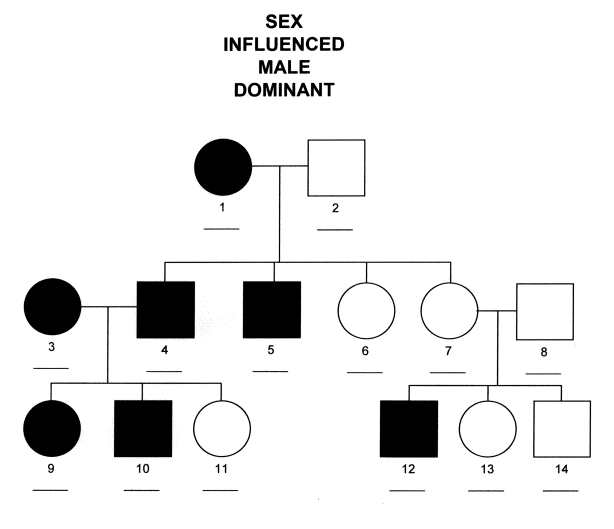
Assigning genotypes for a sex influenced male dominant trait can be challenging. The trait is dominant in men while at the same time it is recessive in women. It is difficult to use “R” to represent the dominant allele and “r” to represent the recessive allele because they behave differently as they pass from males to females. It is customary to use R’ to represent the allele for the unusual condition and R to represent the normal condition. If the shaded individuals in the pedigree were expressing the trait we call Male Patterned Baldness then:
- RR would be expressed as no baldness in both males and females (not shaded)
- RR’ would be expressed as patterned baldness in males (shaded) and no baldness in females (not shaded). This is the difficult one.
- R’R’ would be expressed as patterned baldness in both males and females (shaded)
When completing this pedigree, begin with males with no baldness, these males would have to be RR (if they had an R’ allele they would be bald because it is dominant in males) and females with patterned baldness would have to be R’R’ (it takes two alleles for it to express in females because it is recessive in females).
Real examples: Index finger shorter than ring finger and Male-patterned baldness.
Patterns for Sex Influenced, Male Dominant Inheritance
After filling in the genotypes for individuals in several family trees that exhibit this mode of inheritance, some patterns that can be noticed are:
- If the mother has the trait, all of her sons will have it.
- Two parents who have the trait may have daughters without it.
- Parents without the trait may have sons with it.
- Generally, more males than females have the trait.
10. Sex Limited Inheritance
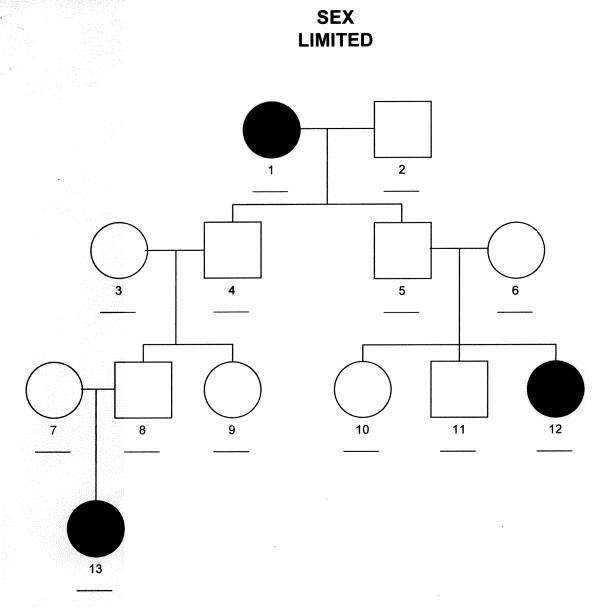
Assigning genotypes for Sex Limited traits can be difficult because the genes can be found in both sexes and probably on the autosomes but they can only be expressed in the sex that is anatomically or physiologically correct. For example, only males can have prostate cancer and only females can have ovarian cancer, although both males and females can carry the genes for these conditions. These traits would usually involve primary or secondary sex traits.
When completing this pedigree with sex limited traits, shaded females would be rr, assuming this sex limited trait acts like a recessive trait on an autosome. Use this knowledge and additional knowledge about how genes are passed from generation to generation to complete the remainder of the pedigree.
Patterns for Sex Limited Inheritance
After filling in the genotypes for individuals in several family trees that exhibit this mode of inheritance, some patterns that can be noticed are:
- These are genes that occur in both sexes (probably on the autosomes) but are normally expressed only in the gender having the appropriate hormonal determiner (activator).
- Throughout the pedigree the trait appears in only one sex, but it need NOT occur in all member of that sex.
- The genes for the trait can be carried and transmitted by the opposite sex although it is NOT displayed in that sex because of anatomical or physiological differences.
example: X-linked Hereditary Prostate Cancer.
11. Y Linked
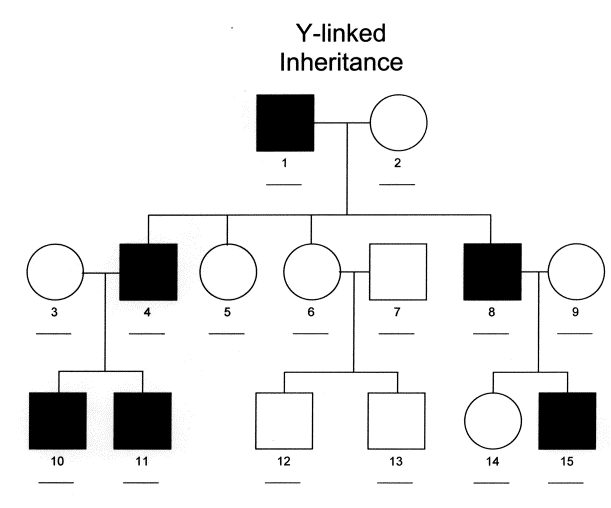
When completing this pedigree with Y linked inheritance, the trait is carried on the Y chromosome and is transmitted from father to son only. When writing genotypes we still use X and Y as symbols for the chromosomes passed on from the previous generation, but only the Y chromosome will have an allele for the gene. For example, all females will have the genotype XX (no alleles). Males with the trait will have the genotype XYR and males without the trait will have the genotype XYr (with the allele on the Y). The alleles are not dominant over one another so the R and r were just randomly assigned as a symbol to represent each allele.
Real example: Hairy Ears and Retinitis Pigmentosa.
Patterns for Y-linked Inheritance
After filling in the genotypes for individuals in several family trees that exhibit this mode of inheritance, some patterns that can be noticed are:
- Trait expression and transmission is only in males, the individuals with the Y chromosome.
- If a male has a trait, so should his father and paternal grandfather as well as his sons and their sons. It follows the inheritance of the Y chromosome.
Bombay blood group
- Perhaps you have heard of the “blood type gene”. The blood type gene can come in three different versions: A, B or O. The versions you inherit determine whether your blood is type A, type B, type AB, or type O.
- Appropriately, the blood type gene is named ABO. When we talk about the genetics of blood type, we typically only refer to the ABO gene. And that’s okay. Usually we don’t need to go into greater detail.
- Bombay blood group is different. Everyone in this group tests as having type O blood, no matter what their ABO genes are. Imagine someone with the A version and the B version of ABO. They should have type AB blood. But if they are in the Bombay blood group, they will still test as type O.
- That’s because there are actually multiple genes that affect blood type. ABO is not the only one. Bombay blood group is caused by one of the other genes. So let’s delve a little deeper into the genetics of blood type!
An Order of Operations
- For many genes, we say one version of the gene is “dominant” to another version. This is fairly common in genetics. In fact, it happens with the ABO gene, where A and B are both dominant to O.
- But some traits aren’t as simple. Often, multiple genes affect the same trait. One way this might occur is when the genes act in a sequence with each other.
- When one gene requires another to act before it, it is called epistasis. We say that the first gene to act in a sequence is epistatic to the second gene. In this relationship, the first gene to act controls the trait.

Gene 1 is epistatic to Gene 2
- One example of epistasis is baldness. Baldness is epistatic to hair color. If you get the gene for baldness, it does not matter what gene you get for hair color. You will be bald.
- This is where Bombay blood group comes in. People in the Bombay blood group have a broken version of a gene that is epistatic to ABO. That gene is FUT1.
- FUT1 comes in two versions, “H” and “h”. Most people have at least one copy of the “H” version of FUT1. This “H” version of FUT1 does not interfere with the ABO gene. If you have the “H” version, you’ll have whatever blood type your ABO gene says.
- One working “H” version of FUT1 is enough to allow ABO to do its job. But if you have two broken “h” versions, the ABO gene no longer sets your blood type.
- People in the Bombay blood group have two copies of the broken “h” version of FUT1. Their broken “h” versions prevent ABO from affecting their blood type. No matter what their ABO gene says, they always have type O blood.
A matter of inheritance
- It’s worth noting that the Bombay blood group is quite rare. It was only first discovered in Bombay (now Mumbai) in 1952. It affects one person out of 10,000 in India. It is a bit more common in Taiwan, where it affects one person in 8,000.
- It’s even rarer in other parts of the world! Among people of European ancestry, Bombay blood group is literally a one in a million event.
- But as rare as it might be, it does happen. And when it happens, it can result in unexpected patterns of inheritance.
- Let’s imagine one such case. Let’s pretend mom is in the Bombay blood group. She has two A versions of the ABO gene. ABO says she “should” have type A blood. But since she is in the Bombay blood group, she has two broken “h” versions of FUT1. This means ABO can’t do its job and she has type O blood.
- Since Bombay blood group is rare, dad almost certainly has two working “H” versions of the FUT1 gene. Let’s also say his ABO gene has an O version and B version. He will have type B blood.
- All their children will get one working “H” version of FUT1 from dad, and one broken “h” version from mom. Since ABO only needs one working “H” version, the children’s blood types will be determined by their ABO gene.
- Based on mom and dad’s blood types (O and B), they would expect their children to have either type B or type O blood. But because mom has two A versions of the ABO gene, she’ll pass the A version to her children. This couple could have children with type A or type AB blood, which would seem to have come from nowhere!
- But, it turns out that these results were possible after all. All it took was epistasis and the Bombay blood group.
A Protein Team
Let’s look at what happens with Bombay blood group at the molecular level.
- In genetics, we like to talk about which versions of a gene produce which traits. But when we do this, we are skipping a few steps. Genes don’t produce traits directly. Instead, each gene helps make a specific protein. Then, those proteins do things in the cells of our body. The overall effect of those proteins is what we call our trait.
- Our blood type trait is the result of several genes working together, including ABO and FUT1. The proteins made by these genes decorate your red blood cells with chains of sugars.
- The protein made by the ABO blood type gene attaches the last sugar to this chain. If you get the A version of the ABO gene, the protein attaches one kind of sugar. If you get the B version of the gene, it attaches a different sugar. The O version of the ABO gene doesn’t attach any sugar at all!

Your red blood cells are decorated with chains of sugars. ABO adds the last sugar to the chain. Different versions of ABO add different sugars, which determines your blood type.
- So now you know what blood type really means! It is based on the identity of the last sugar in a chain that hangs off of your red blood cells.
- This is where Bombay blood group comes in.
- The FUT1 gene makes the second-to-last protein to act on the sugar chain. Remember that FUT1 has a working “H” version and a broken “h” version. The protein made by the “H” version properly puts a sugar on the chain. The protein made by the “h” version does not attach the sugar to the chain.

The “H” version of FUT1 adds a sugar to the chain. The “h” version does not.
- The versions of FUT1 are called “H” and “h” for a reason. When the “H” version of FUT1 attaches a sugar to the chain, the chain is called the “H antigen”. When the broken “h” version of FUT1 fails to attach a sugar to the chain, the H antigen is not formed.
- The “H” version of FUT1 is dominant to the “h” version. If you get one working “H” version of FUT1, it is enough to do all the work. The blood cells all get the H antigen.
- So what does this have to do with blood type? The protein from the ABO gene adds its sugar on to the H antigen. The A version of ABO changes the “H antigen” to the “A antigen”. The B version of ABO changes the “H antigen” to the “B antigen”. The O version doesn’t change anything. People with type O blood have the H antigen hanging from their red blood cells!

The H antigen is changed to the A antigen or B antigen by the A or B version of ABO. The O version of ABO leaves the H antigen unchanged.
- People in the Bombay blood group have two broken “h” versions of FUT1. As a result, they can’t make the H antigen.
- The protein made by ABO will only attach its sugar to the H antigen. So if you are in the Bombay blood group, and you don’t have any H antigen, your versions of ABO do not matter. Without the H antigen around, none of them will be able to do their job.

If you only have broken “h” versions of FUT1, you won’t make any H antigen. Since the ABO protein acts on the H antigen, it can’t find a place to do its job.
- So why do people in the Bombay blood group test as type O? I mentioned that type O blood features the H antigen. But people in the Bombay blood group don’t make the H antigen. What’s the deal?
- The answer has to do with how we test for blood type. People in the Bombay blood group don’t have the H antigen. They also don’t have the A antigen or B antigen.
- Blood tests don’t look for the H antigen. They are only looking for A and B. Someone who doesn’t have A or B is assumed to be normal type O. So, the blood test simply can’t tell the difference between type O blood and the Bombay blood group.