Introduction
Professor L.P. Vidyarthi in his book “The Maler: Nature-Man-Spirit Complex in a hill tribe of Bihar” (1963) developed a methodological framework to conduct analytical study of the complex phenomenon of Nature-Man-Spirit in the life of tribes residing Souria Paharia tribe in Rajmahal Hills of present Sahebganj District. Souria Paharia are also called Maler. Professor Vidyarthi in course of his several visits to the Malers observed that their life was revolving round the phenomenon of Nature-Man-Spirit Complex.
What is Nature-Man-Spirit complex?
According to Vidyarthi “a complex arising out of man’s close interaction with and dependence on nature in his belief in the supernatural and the spirit world” is Nature –Man-Spirit complex.
The three components of the complex are nature, man and spirit. “Nature” refers to environment, “Man” refers to society and “spirit” refers to the religious realm. All the three are intertwined, at times are merged into each other. In Indian tribes there is an intimate relationship and interaction between social organisation on the one hand, and religious complex and ecological conditions on the other. In certain informers, it appears that the nature and spirits condition some of the social ways and practices; while in others it sounds a case of adjustment for smooth living. At times the relationship appears unavoidable; its avoidance would cause hardship to the people. But at other places the shift in some of the lifestyles has been reported leading thereby to the easing of severity traditionally defined in nature-man-spirit complex. However, the changes, mainly because of the alien influences, are of minor form. Both economic necessity and socio-psychological protection have directed man to keep the closest possible liaison with the forces of nature, environmental and supernatural. For these considerations, man is submissive to, and is sometimes dominated by the apparent as well as non-apparent forces of the natural and supernatural worlds.
Professor Vidhyarthi’s study of the Maler signalled an interesting departure from the established tradition of writing a monograph. His approach of nature-man-spirit complex arose from the practical exigency of arranging the data in a meaningful way-to depict the “soul” instead of just the “bones” of Maler culture. This added a new dimension to the cultural ecological studies.
Analysis of data
(i) First, Vidyarthi analysed the interaction between Maler and their natural environment. He showed the ecological basis of Maler culture, showing the importance of hills and forests in the life of Maler. The Maler are dependent on the hills and forests for their livelihood and survival. They practise shifting cultivation (Khallu) in the forest. They collect roots, fruits, fuel and herbal medicines from the forest. They gather all those raw materials necessary for cottage industries from the hills and forests. Forests provided hunting grounds to them. Not only this, different spirits of the Maler also take abode in and around the forest. All timber required for constructing the shelters comes from the forests. Forests provide love-nests and graveyards to the Maler. In this way, the life of Maler is dependent upon forest for manifold purposes.
(ii) Secondly, Vidyarthi dealt with the Maler man. In this context, he examined the network of relationships in all its aspects, including social structure and social organisation, socialisation, personality formation, and the life-cycle of a typical Maler. An average Maler is motivated by two basic needs: hunger for food and sex. The very social structure and organisation, socialisation and personalities formation are arranged in adaptation to the fulfilment of hunger for food and sex. So, in tune with the availability of environmental resources, the Maler shape their marriage practices, family life, lineage system, socialization process, personality formation and life-cycle events. They made their social structure very simple. For this reason, they do not have a clan system and kinship is reckoned through lineage upto three generations in this way, the Maler arranged their network of social relations and social institutions in relation to their needs and environmental conditions.
(iii) Thirdly, Vidyarthi analysed the spirit or supernatural world of the Maler. The Maler express ceaseless anxieties for survival in their environment. They attribute the causes of anxieties to of spirits called Gossayins. They believe that one Gossayian is the presiding one over all the Gossayins. The Gossayins guide their destinies. The spirits may be classified into two categories the benevolent and the malevolent ones. The benevolent are responsible for health, wealth, increased productively in agriculture and so on while the malevolent spirits cause sickness, abortions, death and natural calmities. Every moment of the Maler life is woven with some Gossayin or the other. For this reason the Malers placate the Gossayins in a precise way. To achieve this objective they resort to various types of rites and rituals. Since the presiding spirit of Gossayin serves as the bridge between the Maler and their concept of superhuman and supernatural, it is held in highest esteem. They do not do anything worthwhile without the approval of the Gossayin.
(iv) Finally, Vidyarthi’s analysis of Maler’s life reveals that the “nature” and “spirits” extent profound influences over the social “structure” and organisation” and these three interrelated factors are in constant interaction with each other:

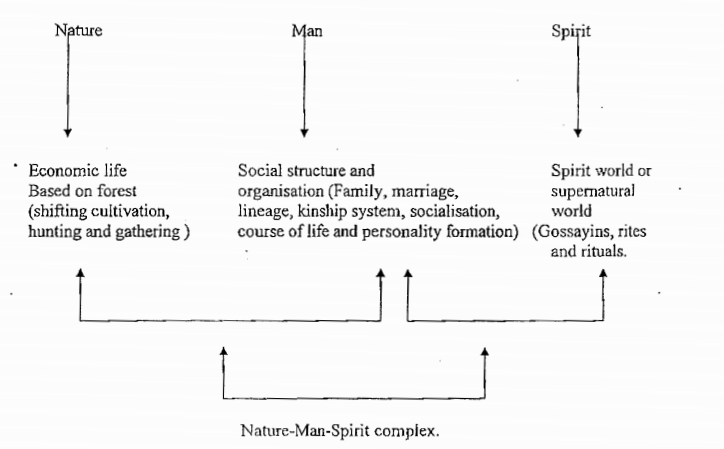
Vidyarthi adopted an ecological approach to study the Maler life. He discovered that “nature” on the one hand and “spirit” world on the other influences every moment of Maler life. “Nature” and “spirit” world, as two ingredients of the complex play, a paramount role in the life-cycle of the Maler. The existences of one simply cannot be through of in the absence of another.
Utility of the concept
(i) Vidyarthi’s concept of nature-man-spirit complex was found to be useful, theoretical and methodological model, which was later on used successfully to study different tribes in different environments by different scholars. The studies of Korwa by A.N. Sandhwar, Parahiya by R.K. Prasad, Pando by R.K. Sinha, Nicobarese by V.S. Sahay, and Soliga by S.G. Morab, all clearly establish that this concept of nature-man-spirit complex is an important and useful tool in studying not only the tribals, but also the peasant and modern societies.
(ii) Vidyarthi’s concept of nature-man-spirit complex has become an important aid or tool for an applied anthropologist especially during the formation or implementation of developmental programmes among the tribal communities. It has been seen several times that the primitive tribal groups resist or reject totally any attempt on the part of the development administration to rehabilitate them anywhere else or introduce radical changes in their life. This resistance or rejection may anger at the disturbance in the equilibrium of nature and spirit. This complex highlights that these tribals can be disturbed radically and abruptly by introducing innovations in their life without preparing them sufficiently for this change.
(iii) This concept tells and applied anthropologist to be very sensitive and receptive to any such change that threatens to disturb this equilibrium otherwise the target group or the potential beneficiary of any programme may not accept it and the scarce resources may go down the drain. This hardly means that the primitive tribal groups or simple peasant groups should be left to their fate with all the visages of status quoism. The purpose and objective of this caution is to ensure that the schemes for their welfare and development help such groups achieve “development” with happiness.
(iv) This concept further tells that the “little traditions” are not only resilient and capable of perpetuating themselves but may also reject the “great traditions” without getting overawed by them. Such a concept may prove very useful especially in the rehabilitation planning for the food-gathering-hunting tribes, shifting cultivators and other simple societies.