Molecular Anthropology is a field of anthropology which is used to determine evolutionary links between ancient and modern human population as well contemporary species by examining the DNA sequence in different population in order to establish the closeness of relationship between populations. The variations are also pivotal in tracing the migration and settlement pattern. Human genome is not static and is subjected to variety of heritable change as without the occurrence of hereditary changes life forms could have not been evolved and diversified. Alternate form of gene can be resulted due to sudden heritable change in the sequence. Mutation can be defined as the abrupt change in the genotype of an organism that is not a result of recombination and includes all types of heritable genetic change of an organism. The process by which mutation is introduced in a gene is termed as mutagenesis whereas a resulted phenotype with mutation is called a mutant. Mutation is the ultimate source of all genetic variation and provides the raw material for evolution. It results from formation of allele where new organisms will be able to evolve and adapt to environmental change. Thus mutation is used to designate processes by which hereditary changes arise General characters of mutation.
- Mutations are generally recessive but dominant mutation also occurs.
- It is harmful to an organism.
- Mutation is random and occurs at any time and in any cell of an organism.
- Mutation being recurrent as the same mutation can occur again and again.
Stages at which mutations occur:
Mutation can occur at any stage of development only if the situation is met:
- Mutation in germinal cell: Before differentiation, mutation in the germinal cell occurs in germinal and also influences several gametes and further influencing all the individuals derived from them.
- Mutation in gamete or zygote: In this stage a single individual will carry the mutation.
- Mutation in a cell: In this stage the mutation occurs after the zygote has undergone one or more division, here only a part of body will show the mutant character. The mutation at this stage is called somatic mutation.
Types of Mutation: Mutation can be classified on the method of its detection, the main types are
- Morphological Mutation: It affects the outward appearance of an individual including colour, shape size etc.
- Lethal Mutation: It involves genotypic changes leading to death of an individual and can be easily studied for mutation frequencies
- Biochemical Mutation : These types of mutations are identified by a deficiency so that a defect can be rectified by supply of that deficient nutrient in the mutant.
- Resistant Mutation: This type of mutation is identified by their ability to grow in the presence of a pathogen or antibiotic.
- Conditional Mutation: This type of mutation allows the mutant phenotype to express under permissive conditions.
- Point Mutation: A point mutation causes replacement of single base nucleotide with another base nucleotide in a genetic material. Point mutation can be of three types: (a)Missense Mutation- A type of mutation that alters the codon and specifies a different amino acid is known as Missense Mutation, (b)Nonsense Mutation- A type of mutation where sequence of DNA results in premature stop codon and (c) Stop Mutation- A type of mutation which results in no change of amino acid or its functionality when the altered or changes messenger RNA is translated.
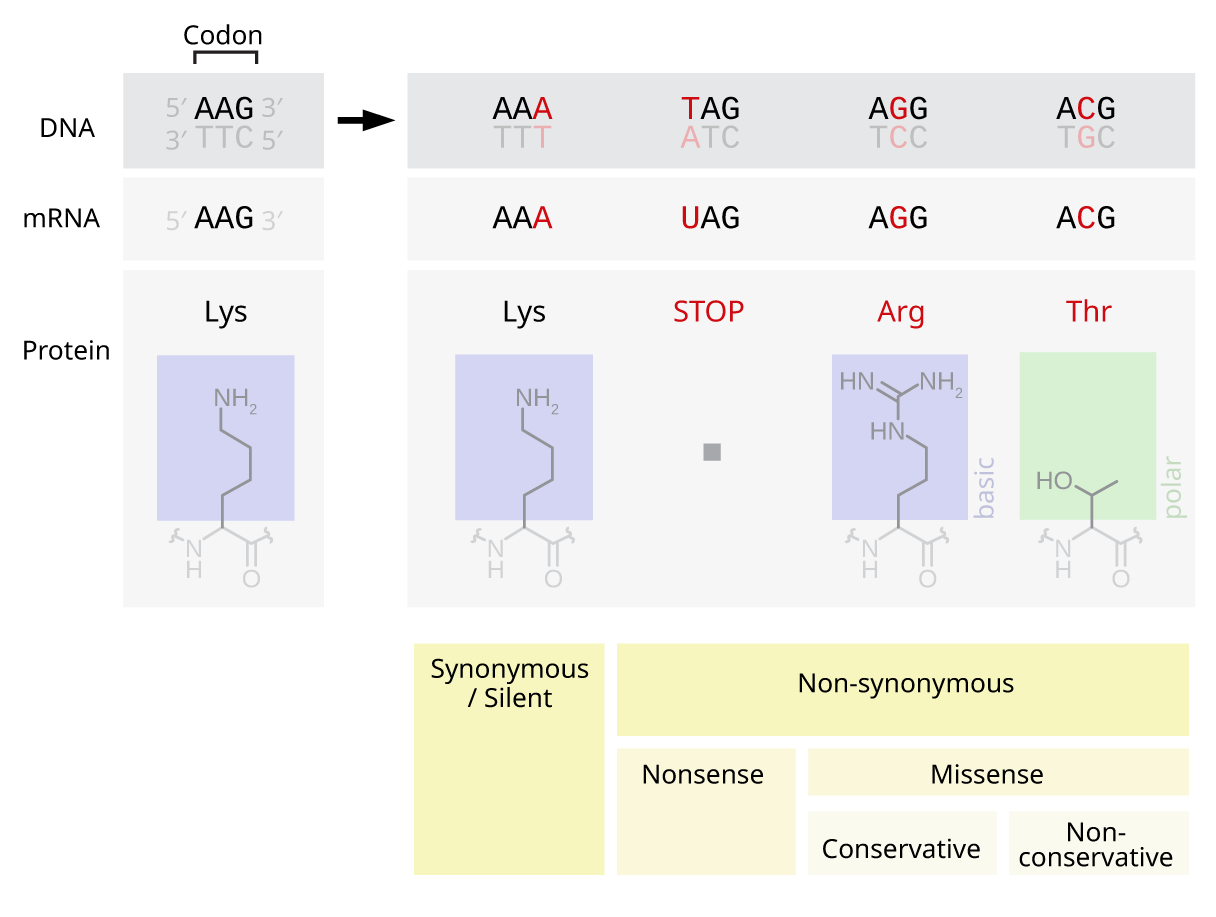
- Spontaneous Mutation: The type of mutation that occurs without treatment of organism with an exogenous mutagen and it is the ultimate source of natural genetic variation in populations. Spontaneous mutation arises from a variety of sources including errors in DNA replication, transposition of transposable genetic elements and spontaneous lesions.
- Induced Mutation: These type of mutation arise due to presence of an exogenous mutagen and its reaction with the parent DNA, resulting in structural change that affects the base pairing capability of the altered nucleotide. Mutations can be artificially induced with the help of two broad categories of mutagens. (a) Physical Mutagens: They are mainly radiations, although change in pH value, temperature can lead to induced mutation. The effect of a mutagen depends on its wavelength and penetrance. Lower is the wavelength, higher the penetrance. (b) Chemical Mutagens: Besides radiations, chemicals also help in inducing mutation. C. Auerbach was the first to detect mutations caused by chemicals as during World War II, chemicals used for inducing mutations were mustard gas, ethyl urethane, formalaldehyde and phenol.
A. Mutation at biochemical level.
Genes control various traits in an organism by controlling synthesis of proteins and expressing themselves through synthesis of enzymes demonstrated by G.W. Beadle and E.L.Tatum due to their discovery of biochemical mutation in Neurospora and proposed one gene one hypothesis. The hypothesis states that if in a biosynthetic pathway several steps are involved, each step will be controlled by a specific enzyme, which is synthesized under a control of specific gene.
Inborn born Errors of Metabolism in Man: Inborn Error of Metabolism are a group of disorders which are genetically transmitted (autosomal recessive or X linked recessive) and cause a single gene defect by blocking significantly the metabolic pathway. There are three important diseases associated with Inborn Errors of Metabolism namely Phenylketonuria, Alkaptonuria and Albinism. Phenylketonuria is due to accumulation of phenylpyruvic acid and causes mental retardation. Children suffering from Phenylketonuria are called Phenylpyruvic idiots and are thus unable to break Phenylpyruvic acid into hydroxyl phenylpyruvic into hydroxyl- phenylpyruvic acid. Alkaptonuria is caused due to accumulation of homogentisticacid, the urine of patients suffering with this disease turns black in contact of air.Albinism is due to the presence of melanin pigment and individuals suffering with this disease are incapable of converting dihydroxy phenylalanine into melanin.
B. Mutation at molecular level
Watson and Crick pointed out the structures of bases in DNA are not static. Hydrogen atoms move from one position in a purine or pyrimidine to another position, from an amino group to ring nitrogen. Such chemical fluctuations are called tautomeric shifts. Mutationsat the molecular level have permanent alterations in sequences of nucleotides in the nucleic acid, which adds to the genetic material. These alterations in the genetic material can be of following types:
- I. Deletion of bases
- II. Insertion of bases
- III. Inversion of a sequence
- IV. Replacement of base pair
Deletion and insertion of base pairs lead to breakage and reunion of DNA segments.Base pairs addition and deletion are collectively known as frame-shift mutation because they alter the reading frame of all base pair triplets. In majority case, these results in a failure to synthesize a functional protein allowing the mutation to be identified by its phenotypic consequences.
Base pair replacement or substitution can be of two types namely Transition and Transversion. Transition comprises the substitution of one pyrimidine by the other or of one purine by the other. If a purine is replaced by a pyrimidine or replacement of pyrimidine by a purine is termed as transversion. Four different transition and eight different transversion are possible Alternation in Base pairs of DNA sequences
Transition G A; A G; C T; T C
Transversion G→T; G→C; A→T; A→C
T →A; T→ G; C → A; C → G
Effect of chemical mutations Nucleotide sequences: Chemical mutations effect nucleotide sequences in three ways
- By acting as a base analog, where the structural similarity to one of the bases in DNA enables it to act as mutagen.
- By reacting directly with the nitrogenous base, causing structural changes in the sequence.
- By reacting indirectly on DNA and causing the cells to synthesize chemicals having mutagenic effect.
Most common types of chemical mutation and their mode of action are described as below– Base Analog-These are certain bases that are not present in DNA but bear a strong structural resemblance to normal nitrogenous bases and can be incorporated from the appropriate triphosphate precursor during DNA sequences.
Inhibition of nucleic acid precursors– there are several agents which interfere with normal syntheisis of nucleic acid precursors as well as with synthesis of purines and pyrimidines. Azaserine and Urethane are alkylating agents is one of the strongest mutagen inhibiting purine and pyrimidine synthesis respectively chemicals such as ethyl methanalesulfonate add groups in DNA molecules called alkylating agents. The effect of alkylation depends on the position at which the nucleotide is modifiedand the type of alkyl group that is added. Nitrous acid (HNO3) is a major mutant that acts on replicating as well as non- replicating DNA and it results in oxidative deamination of the amino groups in adenine, guanine and cytosine.
Inhibition of Acridine dyes: Acridine dyes such as proflavin, Acridine or orange, and a whole series of related compounds induces frame shift mutation. The positively charged acridines intercalate or stack themselves between DNA base pairs
Deleterious Mutation
Many diseases are recognised in form dominant and recessive types, all of these are rare. Most of these diseases seem to be maintained in the population by a balance between selection and mutation.
Dominant Mutations as a cause of Disease: A particular type of dwarfism, called Achondroplasia is found at a very low frequency in nearly all human populations. The disease is not incompatible with life but dwarfs have a low chance of marrying and having children. However the trait is dominant and all affected individuals are heterozygous for the dominant dwarfing gene when one parent is chondrodystrophic and the other normal parent. The incidence at birth of achondroplasia is 1 in 10000. Natural selection keeps the frequency of this disease by eliminating homozygotes and by decreasing the chances of heterozygotes marrying and having children. In the absence of mutations, all affected individuals will have either an affected father or mother, because one of the two parents must have carried the dominant gene responsible for dwarfism. The example of Achondroplasia shows that mutation and natural selection maintains the low frequency of this disease. Natural selection acts not by death of a premature carrier, but through a relative inability to leave progeny, by increasing mortality rather than decreasing fertility. Production of new copies of the deleterious gene by mutation in each generation increases the frequency of disease in the population.
Chromosomal Aberrations causing deleterious mutations
The phenotypes of many organisms are affected by changes in the number of chromosomes in their cells, these numerical changes are described as variation in the ploidy of organism. The existence of genetic variations involving aberration or defect in chromosomes.
Aberrations from Non-disjunction in Human Beings Chromosomal Aberrations such as Down’s, Turner and Klinefelter’s syndrome are considered as deleterious dominants. Their fitness is close to zero and the estimates of mutation rate can be derived from their incidence of birth. Dominant genes are manifested in the form of a heterozygote and thus its effect can be escaped from selection and their frequency is low. High frequencies of recessive genes can be accumulated in the population with the help of mutation before natural selection acts to check their increase in frequency. For instance, the deleterious gene increases in the frequency by 1% as a result q=0.01 i.e. an incidence of this deleterious recessive gene is 1 among 100, thus the expected proportions of homozygous recessives is q2 = 0.0001 i.e. 1 in 10000. Due to adverse selection there is loss in the recessives genes because recessive homozygotes carry only recessive genes.