L.H.Morgan work on evolution of Kinship Systems:
In Anthropological parlance Lewis Henry Morgan took up the initial studies on Kinship. Morgan’s idea of kinship was reflected in his two major works Systems of Consanguinity and Affinity of the Human Family (1870) and Ancient Society (1877) which consisted of ethnographic data collected from the Iroquois, an American tribe during his student days. Later he also acted on behalf of the Iroquois in cases related to land rights. Morgan coined and described the terms Classificatory and Descriptive systems of kinship relationships. Morgan discovered that the Iroquois had two types of terminologies referring to their kinsman.
He stated that in the classificatory system the Iroquois merged lineal kin with the collateral kins who were linked through the same ties (sex), like for example a father’s brother is classified as a father (both having the same ties through men) and a mother’s sister as mother (again both having same ties through female). While on the other hand distinguished lineals from collaterals who were not linked through the same sex ties, for example mother’s brother had a separate term of reference Uncle (being related differently-different sex) and father’s sister as Aunt. Likewise, parallel cousins (father’s brothers’ children and mother’s sisters’ children) were considered as siblings whereas cross cousins (father’s sisters’ children and mother’s brothers’ children) were not considered as siblings.
Morgan’s descriptive system on the other hand classified all collaterals together and kept them separate from the lineal kin. The descriptive system is commonly seen in the European societies where parents (father/mother) are distinguished from all collaterals, who themselves have common terms of reference regardless of the line of descent (uncle, aunt, nephew, niece).
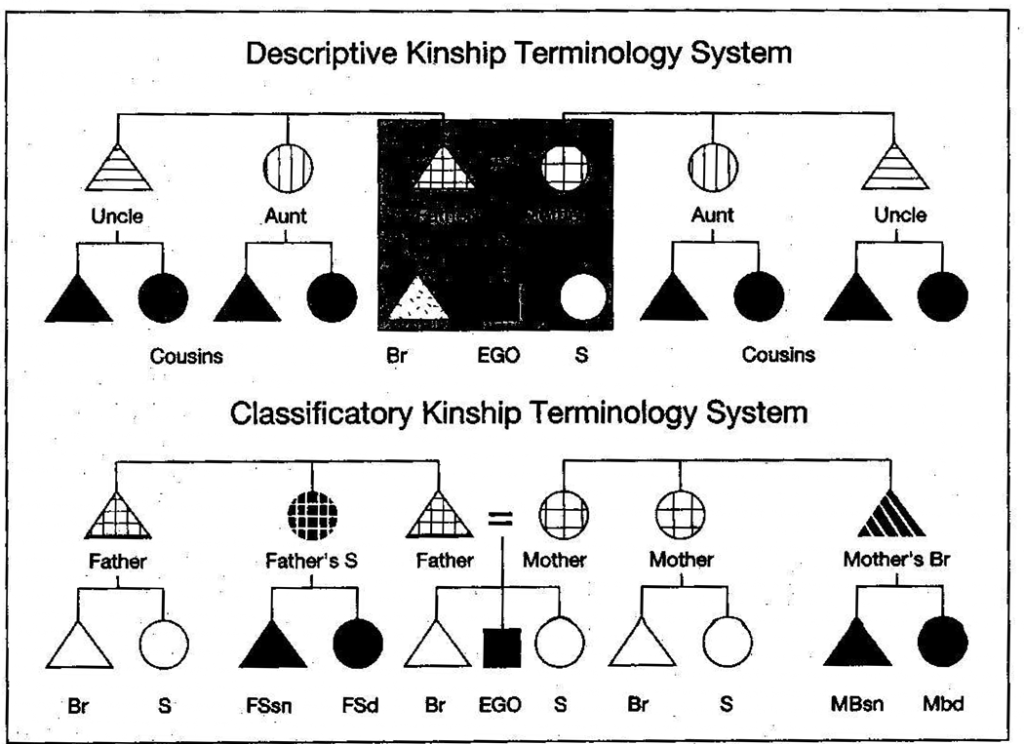
Later on kinship data he obtained from world over , Morgan was able to identify three permutations of the classificatory system and three permutations of the descriptive system.
The classificatory system in- cluded:
- Malayan (Hawaiians, Maoris, and other groups in Oceania);
- Ganowanian (native North Americans);
- Turanian (Chinese, Japanese, Hindu, and other groups in the Indian subcontinent).
The descriptive system included:
- Aryan (all speakers of Indo-European languages, such as Persian and Sanskrit);
- Semitic (Arabs, Hebrews, and Armenians);
- Uralian (Turks, Magyar, Finn, and Estonians).
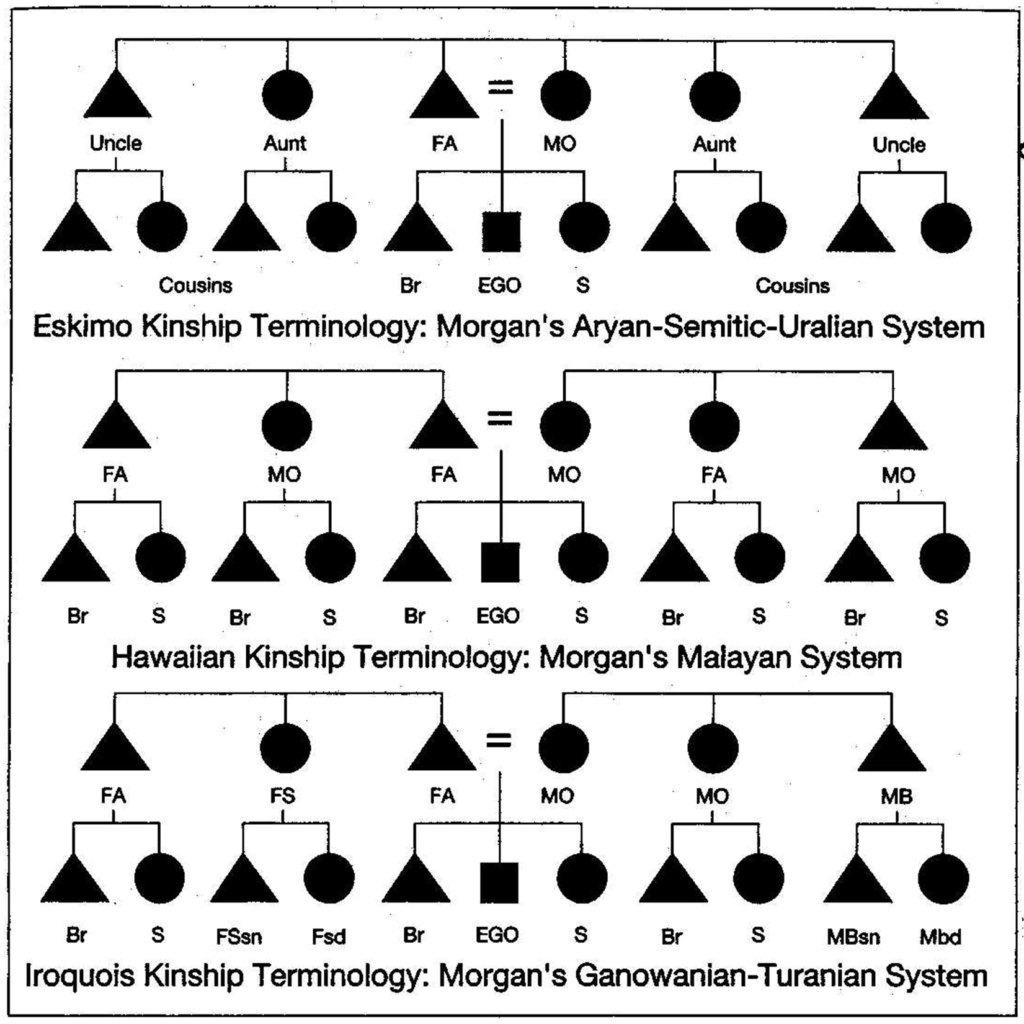
In present-day anthropological terms the Malayan system corresponds to what is called the Hawaiian kinship terminology system, and the Ganowanian-Turanian to Iroquois kinship terminology system. The Aryan-Semitic-Uralian grouping corresponds to the Eskimo kinship terminology system .
The presence of the classificatory kinship sysem in Polynesia and among Australian aborignes (discovered later) convinced Morgan that there was no merit in the attempt to use kinship terminology systems to link American Indians to Asia .
In other words, kinship terminology systems were the basis for evaluating cultural evolution, in which societies that possessed classificatory kinship systems were lower on an evolutionary scale than those with descriptive kinship terminology systems. From the kinship terminology systems, Morgan inferred corresponding marriage and family types, or domestic structures. He then attempted to classify these arrangements along an evolutionary scale, a theme he would develop more fully in his book Ancient Society (1877),
Morgan first traced out the evolutionary development of the family from sexual promiscuity to the nuclear type based on monogamous marriage in a paper entitled “A Conjectural Solution to the Origin of the Classificatory System of Relationships . Morgan argued that the monogamous family was the most advanced evolutionary form and the principle he thought he had discovered was that the number of licit sexual partners decreases chronologically from the stage of savagery to civilization, moving from promiscuity to monogamy.
This success led to the publication of Morgan’s Systems of Consanguinity and Affinity of the Human Family (1871). Despite its shortcomings, this work was important in the development of anthropological thought because it represented the first attempt at the systematic analysis of kinship systems that explored the implications of kin classification and highlighted their sociological correlates As such, the work opened up entirely new direction in anthropological research in kinship systems.
Second Answer
Morgan began a global inquiry about kinship systems. Supported by the Smithsonian Institution and the U.S. State Department, Morgan sent a printed questionnaire requesting information about kinship terms to consular officials, missionaries, and scientists around the world. This cross-cultural survey, combined with Morgan’s own field research, resulted in kinship data from 139 different groups in North America, Asia, Oceania, and ancient and modern Europe. (Africa, South America, and Australia remained essentially unknown.)
Morgan’s goal was to trace the connections between systems of kinship and to explore their “progressive changes” as man developed through “the ages of barbarism” (Morgan 1871:vi). At this point, Morgan had not outlined the evolutionary scheme that forms the explanatory structure of his Ancient Society.
Rather, Morgan approached kinship systems as if they were languages and modeled his analysis on the comparative method (see pp. 11–12). Just as scholars had demonstrated the development and historical relationships between different language families based on linguistic similarities, Morgan argued that “in
the systems of relationship of the great families of mankind some of the oldest memorials of human thought and experience are deposited and preserved” (1871:vi).
Morgan argued that all kinship systems could be divided into two large groups—descriptive systems and classificatory systems. Descriptive systems, such as that used in English, distinguish between lineal relatives and collateral kin; “father” and “father’s brother” are not given the same term. In descriptive
systems, there are fewer special kin terms, and these terms are applied to kin who are relatively close to the speaker, referred to as “Ego” (Morgan 1871:468–469). In contrast, classificatory systems treat lineal and collateral kin as if they were the same, distinguishing generation (Ego’s father versus Ego’s father’s father) and gender (Ego’s male cousins versus Ego’s female cousins), but using the same term for “father” and “father’s brother,” for “mother” and “mother’s sister,” and so on, similar to the pattern Morgan first identified among the Iroquois.
In his survey, Morgan identified six families of kinship systems—three descriptive ones (Semitic, Aryan, and Uralian) and three classificatory ones (Malayan, Turanian, and Ganowanian). Semitic kin systems were found among Arabs, Hebrews, and Armenians; Aryan systems were used by speakers of Persian, Sanskrit, and all the European language groups, modern and ancient; and Uralian kin systems were found among Turk, Magyar, Finn, and Estonian populations. Of the classificatory systems, “Ganowanian” was a term Morgan invented (after the Seneca words for “bow and arrow”) to cover all native North Americans; Turanian included Chinese, Japanese, Hindu, and other groups of the Indian subcontinent; while Malayan subsumed Hawaiians, Maoris, and all the other Oceanic groups in the sample.
These six families of kinship systems may be divided, Morgan wrote, “into two great divisions. Upon one side are the Aryan, Semitic, and Uralian, and upon the other the Ganowanian, the Turanian, and Malayan, which gives nearly the line of demarcation between civilized and uncivilized nations” (1871:469; emphasis added). This is a startling conclusion: the difference between classificatory and descriptive kinship systems marks the distinction between uncivilized and civilized. How could Morgan conclude this? How could he link differences in kinship systems to the levels of cultural advancement?
Morgan’s logic was subtle but flawed. First, Morgan argued that kinship systems were based on “natural suggestions,” primitive ruminations “which arise spontaneously in the mind with the exercise of normal intelligence” (1871:472), a point similar to Tylor’s emphasis on the mental construction of culture (see pp.
9–11). Descriptive systems were natural inferences about descent when marriage was based on monogamy. Kinfolk, Morgan argued, would attempt to explain their relationships by referring to a series of married ancestors (1871:472). Like Tylor, Morgan viewed culture as rationalizations about reality made by “savage philosophers,” rationales that could be reconstructed by the ethnographer.
But then how do classificatory systems develop? Classificatory systems, Morgan argued, are also inferences from social relationships, but those where marriage is either polygamous, communal, or promiscuous. For example, Morgan discussed the Hawaiian kin classification in which Ego uses the same kin term for “father,” “father’s brother,” and “mother’s brother” and another term for “mother,” “mother’s sister,” and “father’s sister.”
Morgan interpreted Hawaiian kinship as reflecting promiscuous intercourse within prescribed limits. The existence of this custom necessarily implies an antecedent condition of promiscuous intercourse, involving the cohabitation of brothers and sisters, and perhaps of parents and child; thus finding mankind in a condition akin to that of the inferior animals, and more intensely barbarous than we have been accustomed to regard as a possible state of man. (1871:481)
The classification systems are reasonable inferences based on promiscuous sex and indeterminate parentage (Morgan 1871:482–483). (I refer to my brothers’ children as my children because I have intercourse with my brothers’ wives, and how can I tell whose kid is whose? We’re just one big happy family.)
Morgan inferred different social relations from distinct kinship systems and then arranged them on a continuum from “most primitive” to “most civilized,” from promiscuous intercourse to monogamy. But given the “natural stability of domestic institutions” (Morgan 1871:15), why would one system give rise to another? Why would classificatory systems evolve into descriptive ones? Why would kinship ever change?
Morgan offers a mix of explanations, each envisioning the “reform” of a previous state of society. When communal husbands defend their communal wives from other men, promiscuous society is partially “reformed.” This begins a process that ultimately leads to “the family as it now exists” (Morgan 1871:481), that is, the independent nuclear family based on monogamous marriage.
But the real change follows the invention of private property; at this point, Morgan dramatically expands the implications of his study: There is one powerful motive which might under certain circumstances tend to the overthrow of the classificatory form and the substitution of the descriptive, but it would arise after
the attainment of civilization. This is the inheritance of estates. Hence the growth of property and the settlement of its distribution might be expected to lead to a more precise discrimination of consanguinity. (1871:14) With the “rise of property, . . . the settlement of its rights, and above all, with the established certainty of its transmission to lineal descendants,” descriptive kin systems evolve, and the nuclear family eventually develops. The family “became organized and individualized by property rights and privileges” (Morgan 1871:492). Social structure and economy are thus linked. The British social anthropologist Meyer Fortes has written of Morgan’s “combination of insight and confusion,” arguing that Morgan’s appeal to the role of private property was “pure guesswork—a projection of his private values as an American of
his day in a society undergoing rapid economic expansion” (1969:32). Rife with assumption and reliant on conjectural history, Morgan had no evidence that Hawaiian kin terms were remnants of a promiscuous horde or that “barbarous nations” were ignorant of inherited property (Morgan 1871:492). Yet, Morgan was among the first to explore the importance of kin systems and their relationship to other aspects of human life, such as economy and politics. What began as a method for understanding the historical connections between societies was transformed into a scheme for understanding the development
of all human society, the framework he elaborated in Ancient Society.