Gregor Johann Mendel was born on July 22, 1822 to peasant parents in a small agrarian town in Czechoslovakia. He is considered as the father of genetics. Through his hybridization experiments on garden pea plant (Pisum sativum), in the year 1865 he presented some basic ideas on inheritance in a research paper. This remarkable piece of work unfortunately remained unrecognized for 34 long years. In the year 1900, Mendel’s work was rediscovered by three botanists namely Hugo de Vries, Carl Correns and Erich Von Tschermak. Interestingly, it was not Mendel but Correns, one of the discoverers of Mendel’s work, who proposed this work as Mendelian laws of Inheritance. These laws of heredity are listed below.
- a) Law of Segregation (the First Law)– The law of Segregation states that every individual contains a pair of alleles for each particular trait which segregate or separate during cell division (assuming diploid) for any particular trait and that each parent passes randomly selected copy (allele) to its offspring. The offspring then receives its own pair of alleles of the gene for that trait by inheriting sets of homologous chromosomes from the parent organisms. Interaction between alleles at single locus termed dominant and these influence how the offspring expresses that trait. During game, the allele for each segregation from each other so that gametes carries only one allele for each gene.
- b) Law of Independent Assortment (the Second Law)-It is state that in the inheritance of more than one pair of traits in a cross simultaneously, the factors responsible for each pair heritance Law of traits are distributed to the gametes. The law of Independent Assortment, also known as Inheritance Law which states that separate genes for separate traits are passed dependent and independently of one another from parents to children. The biological selection of a particular gene in the gene pair for one trait to be passed to the offspring has nothing to do with the selection of the gene for any other trait. More precisely, the law state that if the different allele genes assort independently of one another during gamete formation. Genes for different traits can segregate independently during the formation of gametes.
- c) Law of Dominance (the Third Law)-The third law state that recessive alleles will always be masked by dominant allele. A cross between homozygous dominant and homozygous recessive will always express the dominant phenotype, while still having a heterozygous genotype. It can explained easily with the help of a mono hybrid cross experiment. It is important to note that the law of dominance is significant and true but is not universally applicable. According to the latest revisions, only two of the rules are considered to be laws. The third one is considered as a basic principle but not a genetic law of Mendel. Some alleles are dominant while other recessive, an organism with at least one dominant allele will display the effect of the dominant allele.
Some of Mendelian traits examples
| Finger Hair | Having fingers hair (between knuckles) is dominant over lacking finger hair. |
| Tongue Rolling | Ability to roll tongue into a “u” shape is dominant over not being able to roll tongue. |
| Earlobes | Free earlobes are dominant over attached earlobes |
| Dimples | Dimples are dominant over no dimple. |
| Roman nose | A nose with a bump is dominant over a straight nose. |
| Shapes of hairline | Widow’s peak is dominant over no widow’s peak. |
| PTC | Ability to taste PTC is dominant over inability to taste PTC |
Mendelian Inheritance in Man
Mendelian traits or traits of simple inheritance are mainly discrete in nature and are controlled by alleles at single genetic locus. Therefore, in humans, traits or disorders that a single gene specifies are said to be Mendelian traits. Currently more than 4500 human traits are said to be inherited as per Mendelian principles; and another large conditions are suspected to be Mendelian traits. Many of the known Mendelian traits may be classified as disorders as per physical or mental disability. However, the most prevalent Mendelian disorders are very rare, usually affecting 1 in 10000 births or even less than that.
It is necessary to know the patterns of inheritance in man, before understanding the features of any genetic disease for the following reasons.
- For the precise diagnosis of genetic disorders.
- To estimate the risk of genetic disease (recurring risk) appearing in the offspring.
- To identify the means to prevent the genetic disease.
The inheritance of common traits will broadly fall in the following categories.
- Monogenic (single gene) or Mendelian Inheritance.
- Polygenic or multi-factorial inheritance.
Monogenic (single gene) or Mendelian Inheritance.
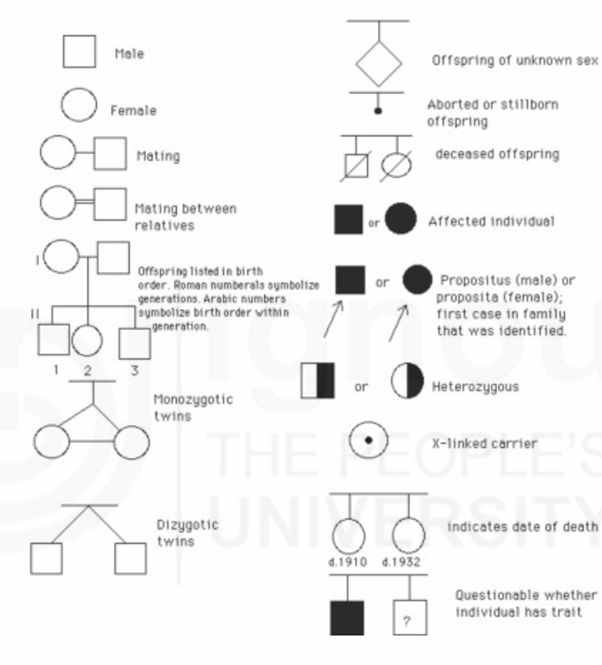
Human geneticist unlike others, who carried out experiment on plant or animal, can’t have an access over experimental or controlled breeding. Hence they have to confine their study by observing the mode of inheritance in a pedigree. A Pedigree is a systematic drawing of the ancestral line of a given individual (both father and mother side) or family tree of a large number of individuals that depict blood relationship and transmission of inherited traits. A Pedigree can help to determine the genetic basis of a particular trait, especially in human, where experimental mating is not possible.
The term ‘pedigree’ (line of ancestors) is derived from French word ‘pie de grue’ means crane’s foot. The diagram of pedigree of large families with parents linked by curved lines to their offspring often resembled a bird’s foot. You can tell a mode of inheritance just by looking at a pedigree. Pedigree is built of shapes connected by lines, vertical lines represent generations, horizontal lines that connect two or more shapes at their centers represent parents and vertical lines joined horizontally above them represent siblings. Matings are shown as horizontal lines between two or more individuals. In case of shapes, square indicate male, circles indicate female and diamonds for unknown sex. Different shades or colours can be added to the symbols to identify different phenotype — full coloured shapes for individuals who express the trait under study and half-filled for carriers. Each generation is listed on a separate row labeled with Roman numerals, whereas, individuals within a generation labeled by Arabic numerals.
TYPES OF INHERITANCE
The patterns, in which Mendelian traits appear or transmitted in families, are called modes of inheritance. On the basis of chromosome where genes are located, you can find two types of inheritance – autosomal i.e. located on autosomes; and sex-chromosomal i.e. located on sex chromosomes, X or Y. Both autosomal and sex chromosomal inheritance may be subdivided as dominant or recessive inheritance on the basis of expression of alleles. However in respect of Y chromosome, there is no such subdivision like that described earlier. Hence, we have five modes of inheritance — autosomal recessive inheritance, autosomal dominant inheritance, X-linked recessive inheritance, X-linked dominant inheritance and Y-linked inheritance.
Mendel’ s observation of two different expressions of an inherited trait in a single locus (e.g. short or tall in respect of pea plant) narrates the facts that a gene can exist in alternate forms, usually called allele. An individual having two identical alleles is called homozygous, whereas the one with two different alleles is called heterozygous. Hence an individual may be homozygous either by two dominant alleles or two recessive alleles.
The allele that masks the effect of the other allele is called dominant (specifically completely dominant) and the masked one is called recessive. Whether the trait is dominant or recessive mostly depends upon the particular nature of the phenotype. Sometimes the heterozygous behave like an intermediate or a mix between homozygous dominant and homozygous recessive. Recessive disorders, in many cases, tend to be more severe or lethal and produce symptoms at an earlier age than dominant disorders.
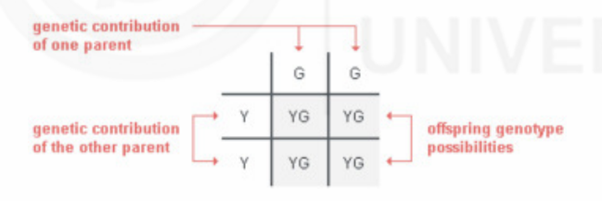
If the genetic basis of a trait is known one can predict the outcomes of crosses. These are Punnett square method, forked line method and probability method. The ratios predicted from Mendel’s law, apply to a new allele combination to each newly conceived offspring i.e. 50% chance of inheriting the allele, no matter what was the previous combination. You can compare the situation with tossing of coins; for first one the possibility of its being the head (or tail) is 50%. The same is true for second or any subsequent tossing. Therefore, if there is a 25% chance for a recessive disorder and first child is affected, there is no guaranty that next three will not be affected. The best way to calculate the probability of inherited traits was invented by Reginald Punnett and is called Punnett square. This is a simple graphical way to calculate all potential combinations of genotype for each time. You can start the same by drawing a grid of perpendicular lines. Now put the genotype of one parent across the top and other one down the left side. At last you can fill all the boxes by copying row and column letters (alleles).
a) Autosomal Recessive Inheritance
Autosomal recessive trait can affect both sexes in equal proportions and can (but not necessarily) skip generation. The gene is carried on autosomes. For expression of recessive trait to be displayed, two copies of trait or allele needs to be present, which indicate that both the parents must be at least carrier for the specific traits. Therefore, a recessive trait can remain hidden for several generations without displaying the phenotype or diseases. The trait characteristically appears only in sibs, not in their parents, offspring or other relatives.
| Trait | Characteristic features |
| Achondroplasia | Dwarfism with short limbs, normal size head and trunk. |
| Hypercholesterolemia | Very high serum cholesterol levels, heart disease. |
| Polydactyly | Extra fingers and/or toes. |
| Huntington disease | Progressive uncontrollable movements and personality changes, beginning in middle age |
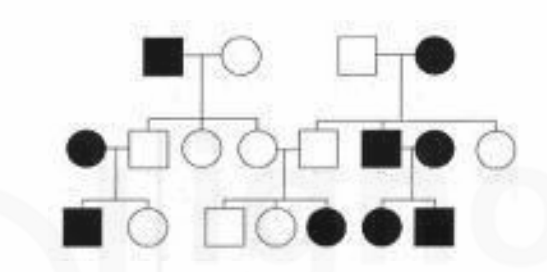
Sometimes a rare autosomal recessive trait may occur in families where the parents are close (blood) relatives, who are supposed to inherit the allele from a common ancestor. The situation is called consanguinity. Marriages between relatives “consanguineous marriages”, as they are often called, are important genetically.
Because closely related individuals have a higher chance of carrying the same alleles than less closely related individuals. The children from consanguineous marriages are more frequently homozygous for various alleles than are children from other marriages. In some ancient societies like the Pharaohs of ancient Egypt and the Incas of Peru favoured marriages of brothers and sisters of the ruling dynasties, to keep the ‘royal blood’ pure. These are extreme cases of consanguineous marriages. In some societies, more common types of close consanguinity are observed in cousin marriages. Examples of other consanguineous relations are those between uncle or aunt and nephew or niece (third degree), between cousins (fourth degree) and between second cousins (sixth degree). Consanguinity relations are identified by the number of steps from a common ancestor to only one of the related individuals, namely, the one more remote from him.
Some important characteristic features are:
- Occurrence and transmission is not influenced by sex;.
- Traits can express only in homozygous condition;
- In a pedigree you can find the trait only in siblings, not in their parents;
- On average ¼ th of the sibs of the proband are affected;
- In the instance of a rare disease, affected individuals have normal parents;
- Ratio of affected, carrier and non-affected is 1:2:1 (in sibs); and
- Parents of an affected child, in many cases, are close blood relatives.
| Parents | OFFSPRING |
| One parent homozygous Normal Other parent homozygous Normal | All the offspring will be homozygous normal |
| One parent homozygous Normal Other parent heterozygous Normal (Carrier) | 50% probability that offspring will be homozygous normal 50% probability that offspring will be heterozygous normal (Carrier) |
| One parent heterozygous Normal (Carrier) Other parent heterozygous Normal (Carrier) | 25% probability that offspring will be homozygous normal 50% probability that offspring will be heterozygous normal (Carrier) 25% probability that offspring will be affected |
| One parent homozygous Normal Other parent affected | All the offspring will be heterozygous normal (Carrier) |
| One parent heterozygous Normal (Carrier) Other parent affected | 50% probability that offspring will be heterozygous normal (Carrier) 50% probability that offspring will be affected |
| One parent affected Other parent affected | All the offspring will be affected |
b) Autosomal Dominant Inheritance
Autosomal dominant trait, like autosomal recessive traits, can affect both sexes in equal proportions; the gene is carried on autosomes but unlike previous one does not skip generations. If no offspring inherits the trait in any generation its transmission stops. The trait is called “dominant” because a single copy of the trait, inherited from either parent, is enough to cause this trait to appear; the dominant allele masks the recessive one. Hence both homozygous dominant and heterozygous individual can express the trait. This often means that at least one parent must have the trait to transmit; otherwise it may appear because of mutation. Unaffected family members do not transmit the trait to their children. Dominance and recessiveness are obviously developmental phenomena resulting from genic action. They refer to the effect of a combination of differing alleles as compared to the effect of a homozygous combination.
| Trait | Characteristic features |
| Phenylketonuria | Mental retardation, fair skin |
| Cystic fibrosis | Lung infection and congestion, poor fat digestion, male infertility, poor weight gain, salty sweat |
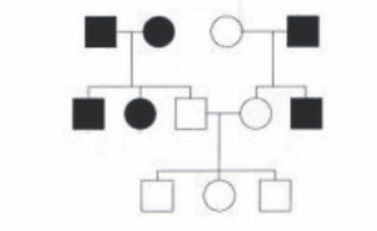
Some important characteristic features are:
- Occurrence and transmission is not influenced by sex;
- Traits can express in both homozygous and heterozygous condition;
- You can find the trait in every generation of a pedigree;
- Affected individuals are usually born of normal parents;
- Affected individuals are always the product of a parent carrier of the same character;
- Trait always transmitted by an affected person (if heterozygous he/she is supposed to transmit the trait to half of the children and if homozygous to all the children); and
- All children of a normal individual will be normal i.e. unaffected family members do not transmit the trait to their children.
| Parents | Offspring |
| One parent homozygous affected Other parent homozygous affected | All the offspring will be homozygous affected 50% probability that offspring will be homozygous affected 50% probability that offspring will be heterozygous affected |
| One parent homozygous affected Other parent heterozygous affected | 25% probability that offspring will be homozygous affected 50% probability that offspring will be heterozygous affected 25% probability that offspring will be normal |
| One parent heterozygous affected Other parent heterozygous affected | All the offspring will be heterozygous affected |
| One parent homozygous affected Other parent normal One parent heterozygous affected Other parent normal | 50% probability that offspring will be heterozygous affected 50% probability that offspring will be normal |
| One parent normal Other parent normal | All the offspring will be normal |
Sex-Linkage: In the human species, the sex-chromosomes contain many more genes than those concerned with sex-determination. These affect the widest range of characters and bear no relation to sex. Genes carried in the same chromosome are said to be ‘linked’ because they are assorted together. Haemophilia is due to the operation of a recessive sex-linked gene. A woman, heterozygous for it is therefore unaffected, since she carries the haemophilia gene (h) in one Xchromosome, and its normal allelomorph (H) in the other. Normal women can transmit haemophilia while a normal man cannot do so.
Sex-linked Inheritance: Colour blindness is an example of sex-linked inheritance in man. Women are much less often colour blind than men. But if a woman does happen to be colour blind, and if she marries a normal man, all of her sons are colour blind but none of her daughters are.
c) X-linked Dominant Inheritance
X-linked dominant inheritance shows the same phenotype as a heterozygote and homozygote. Incase of an X-linked dominant inheritance, male to male transmission is not there. This also makes it distinct from autosomal traits. X linked dominant cannot be distinguished from Autosomal Dominant by progeny of affected females, but only from the progeny of affected males. Affected females are more common than affected males (but heterozygous females have milder expression); on the other hand the traits (especially disorder) are more severe in males than their female counterparts.
| Trait | Characteristic features |
| Hypophosphatemia | Vitamin-D resistant rickets. |
| Incontinentia pigmenti | Swirls of skin color, hair loss, seizures, abnormal teeth. |
| Xg blood groups | Normal character |
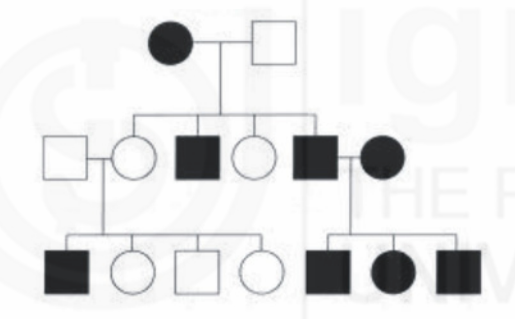
Some important characteristic features are§ Occurrence and transmission is influenced by sex; females are more affected than males but may be with variable expressions;
- Homozygous female transmitted the trait to all the children; § Male transmitted the trait to all the daughters but never to a son;
- Affected males have no normal daughter; § Affected heterozygous females transmit the trait to half of their children of either sex. Affected homozygous females transmit the trait to all their children; and
- X linked dominant cannot distinguish from Autosomal Dominant by progeny of affected females, but only from the progeny of affected males.
| Parents | Offspring |
| Mother homozygous affected Father affected | All the offspring will be homozygous affected |
| Mother homozygous affected Father normal | All the daughters will be heterozygous affected All the sons will be affected |
| Mother heterozygous affected Father affected | 50% probability that daughter will be homozygous affected 50% probability that daughter will be heterozygous affected 50% probability that son will be affected 50% probability that son will be normal |
| Mother heterozygous affected Father normal | 50% probability that daughter will be heterozygous affected 50% probability that daughter will be normal 50% probability that son will be affected 50% probability that son will be normal |
| Mother normal Father affected | All the daughters will be heterozygous affected All the sons will be normal |
| Mother normal Father normal | All the offspring will be normal |
d) X-linked Recessive Inheritance
Sex-linkage was first discovered by Thomas H. Morgan (father of modern genetics) in 1910. Sex-linked traits affect male and female differently. As human male is hemizygous for X-linked traits, any gene on a male’s X chromosome is expressed in his phenotype because there is no such second allele to mask its expression. Therefore, the condition of dominant and recessive trait is limited to female only. Females express X-linked traits or disorders when they are homozygous for the disorder and become carriers when they are heterozygous. Therefore female can transmit the trait as affected if her father is affected and mother at least carrier. However male can transmit the trait if any of the parents is affected or carrier (for mother). Therefore, the incidence is much higher in males than females. These patterns of inheritance are also called crisscross inheritance or skip generation inheritance, in which a character is inherited to the second generation through the carrier of first generation. X-linked (both recessive and dominant) traits are always passed on by the X chromosome from mother to son or from either parent to daughter. The trait never passed from father to son. The human male is hemizygous in respect of X-linked inheritance as they have single copy of X chromosome.
| Trait | Characteristic features |
| Haemophilia | Absence of clotting due to factor VIII. |
| Red green colour blindness | Abnormal red cone pigments in retina. |
| Muscular dystrophy | Progressive muscle weakness. |
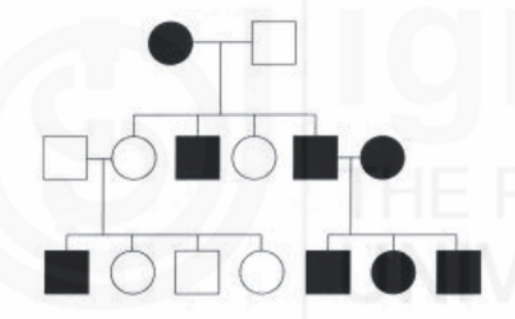
Some important characteristic features are:
- Occurrence and transmission is influenced by sex; males are more affected than females;
- Affected male does not transmit the trait to his sons but always transmits to all his daughters;
- Carrier female can transmit the trait to half of her children of either sex;
- The trait is transmitted from affected male through all his daughters to half of his grandsons; and
- The trait may be transmitted through a series of carrier females; carrier shows variable expression of the trait.
| Parents | Offspring |
| Mother homozygous Normal Father Normal | All the offspring will be homozygous normal |
| Mother homozygous Normal Father affected | All the daughters will be heterozygous normal (carrier) All the sons will be normal |
| Mother heterozygous Normal (carrier) Father Normal | 50% probability that daughter will be homozygous normal 50% probability that daughter will be heterozygous normal (carrier) 50% probability that son will be normal 50% probability that son will be affected 50% probability that daughter will be heterozygous normal (carrier) 50% probability that daughter will be affected |
| Mother heterozygous Normal (carrier) Father affected | 50% probability that son will be normal 50% probability that son will be affected |
| Mother affected Father normal | All the daughters will be heterozygous normal (carrier) All the sons will be affected |
| Mother affected Father affected | All the offspring will be affected |
e) Y-linked Inheritance
The genes located on the Y chromosome, whose alleles are absent on the X chromosome are Y-linked genes or holandric genes (also hemizygous). Y-linked inheritance occurs when a gene is transmitted through the Y chromosome. Since Y chromosomes can only be found in males, hence Y linked genes are only passed on from father to son and never appear in females. Therefore, there is no skipping of generation and affected males have all affected sons, no females are said to be affected for the trait.
| Y-linked traits |
| Hypertrichosis of ear: growth of hair on the rim of pinna |
| Testis determining factor (TDF) |
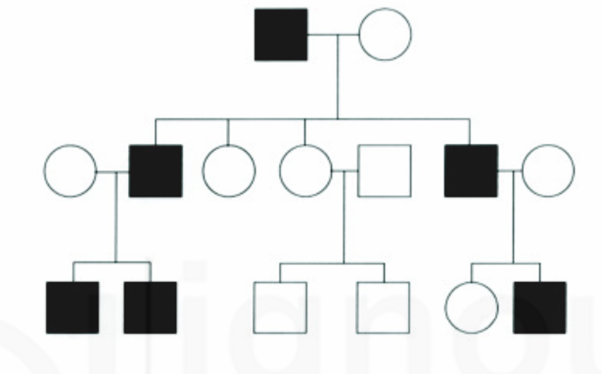
Some important characteristic features are
- In pedigree, only males are affected;
- Affected male transmitted the trait to all his sons but never to his daughter; and
- No skipping of generations.
| Father | Offspring |
| Father affected | All the sons will be affected |
| Father normal | All the sons will be normal |
Mitochondrial inheritance: The transmission of the mitochondrial genome from mother to child. Mitochondrial contain their own set of genes which are chiefly involved in metabolic processes. This is in addition to the genes in the cell’s nucleus. They have their own DNA and extra nuclear DNA cell presents. The disease is transmitted solely by women to all her descents. The genetic defect is not present in all but in some of a fraction of mitochondria which transmitted to generation to next then according to the number of gene mutation in mitochondria.
Example mitochondrial inheritance diseases are
| Trait | Characteristic features |
| Mitochondrial myopathies | Weak and placid muscles and intolerance to exercise. |
| Leber’s hereditary optic neuropathy (LHON) | Impairs vision. |
SEX LIMITED CHARACTERS
Here the expression of character is limited to one sex. In humans, beard growth in males and breast development in females are sex limited traits. A woman does not grow a beard because she does not produce the hormones required for facial hair growth. She, can, however pass to her sons the genes specifying heavy beard growth. Such a gene may be sex-linked or autosomal. Due to anatomical differences between males and females, intrauterine or testicular defects constitute other examples of sex limited characters. Another inherited condition known as preeclampsia that arises during pregnancy is also a good example of sex limited trait. Since males do not get pregnancy, preeclampsia in females leads to a sudden increase in blood pressure that occurs in pregnant woman as the birth approaches.
SEX INFLUENCED CHARACTERS
A trait is said to be sex influenced when it expresses differently in males and females because an allele is dominant in one sex but recessive in the other. Again
such a gene may be X-linked or autosomal. The difference in expression can be caused by hormonal differences between the sexes. For example, the expression
of common baldness is different in males and females. It is an autosomal dominant trait in males and hence very common. While it is autosomal recessive in females hence they are rarely seen bald. Female heterozygote can transmit the trait to their offspring but do not manifest it. Females display the trait only when they inherit two copies of the gene, i.e. when they are homozygous recessive. Even then, they are more likely to display marked thinning of the hair, rather than
complete baldness whereas an affected male may be completely hairless on the top of the head.
Other Facts of inheritance
Some of the exceptions like pleiotrophy, variable expressivity of gene, incomplete penetrance, co-dominance and intermediate inheritance are discussed here in
detail in the following.
Pleiotrophy
Usually an autosomal dominant gene has one effect and thus involves only one organ or part of the body. However, when single gene disorder produces multiple phenotypic effects then it is called pleiotrophy. For example, in case of osteogenesis imperfecta the mutant gene is responsible for defect in the synthesis of collagen. However, the formation of defective collagen leads to many other defects like osteosclerosis, blue sclera and brittle bone etc.
Variable expressivity of gene
The phenotypic expression of an autosomal dominant gene can vary from person to person. In clinical terms the expression of gene may be in mild, moderate or severe form of the trait. One common example is polydactyly (extra finger). In some individuals this extra finger may be fully formed while in other individuals it may be very small.
Incomplete penetrance
It is the extreme end of variable expressivity. In this condition a person who is heterozygous for a dominant disorder fails to manifest a disorder clinically. Thus
it may appear as if the disorder has skipped the generation. The penetrance of a gene in any generation is expressed in terms of percentage (%) which is calculated from the number of offspring showing the trait as compared to the expected. The cause of reduced penetrance or the variation in the expression of gene may be due to influence of genes at other loci. It may be also due to the difference in environmental factors.
Codominance
When both the traits are expressed fully in heterozygous state they are called codominant. For example, a person with blood group AB shows both A and B
antigens on his red blood cells. The allelic genes ABO*A and ABO*B, which are present near the tip of long arm of chromosome 9, are therefore codominant.
Intermediate Inheritance In the heterozygous condition of a recessive trait, abnormal (mutant) allele is unable to express itself. However, when in heterozygous condition if it shows intermediate expression between abnormal heterozygous and normal heterozygous then this is known as intermediate inheritance