Introduction
L.P. Vidyarthi (1931-1985) proposed the theory of scared complex for studying the places of pilgrimage as a dimension of Hindu civilization (1961). Within the framework of great and little traditions used by Redfield (1955) and Singer (1956), L.P. Vidyarthi (1961) developed a set of analytical concepts and terms to describe the sacred city as a part of Hindu civilization while studying Sacred complex of Hindu Gaya, Thus, Vidyarthi limited his frame of reference from Indian civilisation to Hindu civilisation.
What is a sacred complex?
According to L.P. Vidyarthi (1961), the pattern of life of a sacred city which emerged with the fusion of several elements namely scared geography, sacred performances and sacred specialists is sacred complex.
- The components of sacred complex are: sacred city, sacred geography, sacred specialists and sacred performances.
- Within the area where Hindus live, certain communities are considered as holy and are accorded sacred quality. Such communities are either little communities or urban communities. The urban communities comprise the sacred cities.
- The spatial organisation of the sacred city refers to sacred geography. In other words, sacred geography refers to a differentiated space created owing to the sacred qualities bestowed on it.
- The sacred specialists are those experts who perform rituals in the sacred places. They are in the form of priests, monks, barbers, florists, pilgrim-hunters, sacred singers, reciters, musicians, composers and so on.
- The sacred performances are those rituals and activities conducted within the differentiated space of sacred geography. They are in the form of rituals, offerings, prayers, recitations, baths, and philanthropic activities.
- The total arrangement of sacred geography, sacred performances and sacred specialists of a sacred city is a sacred complex, which reveals the very structure, organisation and dynamics of a Hindu civilisation.
After forming the theory of sacred complex, L.P. Vidyarthi put forth three hypotheses, which are stated as follows:
- (a) The sacred complex of a Hindu place of pilgrimage reflects a level of continuity, compromise and combination between great and little traditions.
- (b) The sacred specialists of a place of pilgrimage maintain a district style of life and transmit certain elements of the great tradition to the rural population of India by popularizing certain texts, by organising pilgrimages and by officiating as the ritual and temple priests, and
- (c) The sacred complex in general and the sacred specialists in particular have been in the process of modification and transformation as a result of general development in the larger universe of Hindu civilisation of which they are a part.
L.P. Vidyarthi tested these three hypotheses in the light of the data pertaining to Gaya which he collected between 1948 and 1956 and found them to be true (1961).
Sacred complex of Gaya
(i) L.P. Vidyarthi analysed the sacred geography of Gaya in the ancient cultural of Magadha in Bihar. Vidyarthi calls the entire space occupied by Gaya as Kshetra (ground or region). The Kshetra is divided into simpler parts as shown in the following diagram.
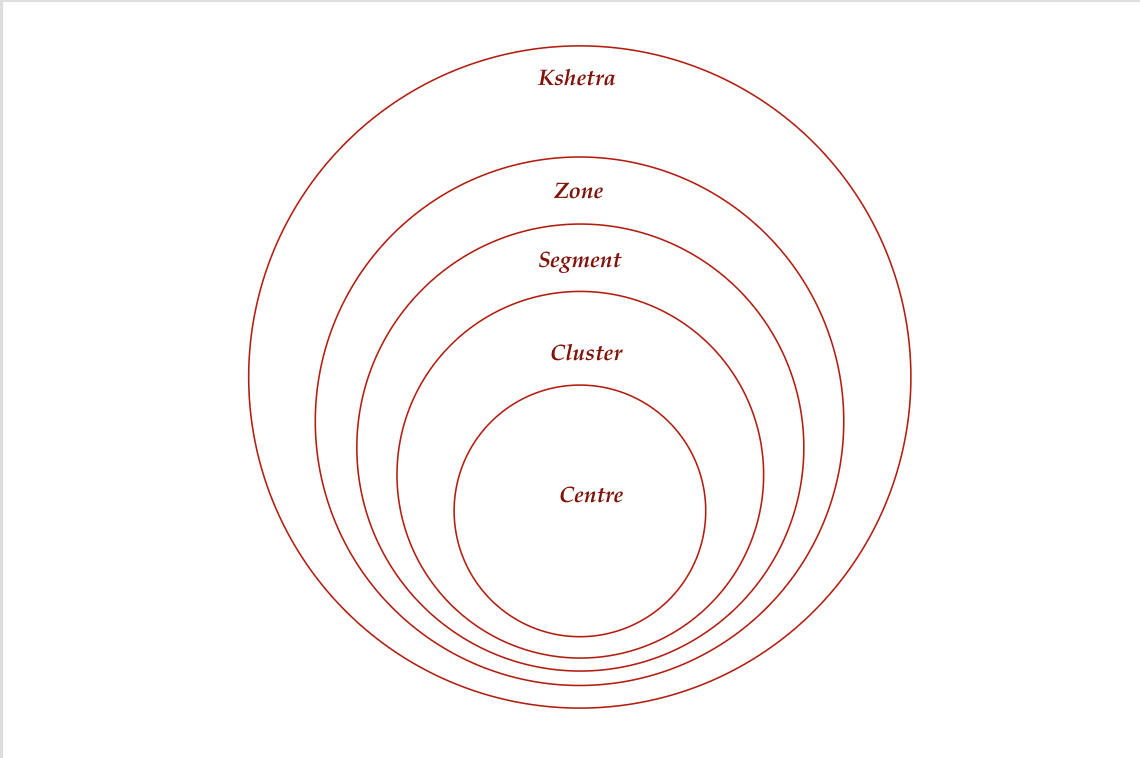
A sacred centre is a simple single spot represented by an image, river, temple or tree. It is the minimum unit of worship. It may have universal, regional, or local importance. When there is a combination of several sacred centres around a dominant sacred centre, the term sacred cluster is used. Two or more clusters form a sacred segment. Several sacred segments together comprise a sacred zone. Two or more zones constitute a Kshetra.
Vidyarthi studied the history a every centre, cluster, segment and zone and the whole Kshetra and concluded as follows:
- Gaya Kshetra contains a complex of hundreds of sacred objects and places.
- Both in space and time the sacred geography demonstrates the continuity of great and little traditions of Hindus.
- The sacred geography also exhibits several kinds of combinations between Hindu and Buddhist traditions at different levels.
- Due to drastic changes in modern times the secular zone of Gaya has been expanding at the cost of the shrinking sacred zone. This is discernible at the sight of many old and dilapidated sacred objects where rest houses, parks, restaurants etc have come up. All these conclusions support the first and the third hypotheses framed by Vidyarthi.
(ii) Secondly, Vidyarthi analysed sacred performances at Hindu Gaya. The performances made at Gaya are shown in the following diagram:
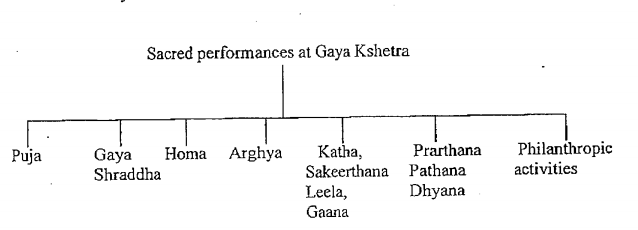
Puja is floral worship. Shraddha is an elaborate from of sacrifices to ancestral spirits. Homa refers to fire offerings. Arghya is offering of water. Prarthana is prayer. Pathana is reading of sacred texts, and Dhyana is meditation. Philanthropic activities include giving alms to beggars and sadhus, gifts to priests, giving of presents to the specialists and inviting the Brahmins to a ritual meal. After studying the sacred performances, Vidyarthi draws are the following conclusions:
(a) The performances include great and little traditional types.
(b) Of all the performances the main one for which Gaya is revered in the Hindu world is Gaya Shraddha.
(c) The history of the performances is commensurate with the history of the sacred geography.
(iii) Thirdly, Vidyarthi analysed the data pertaining to sacred specialists. The sacred specialists are as follows:
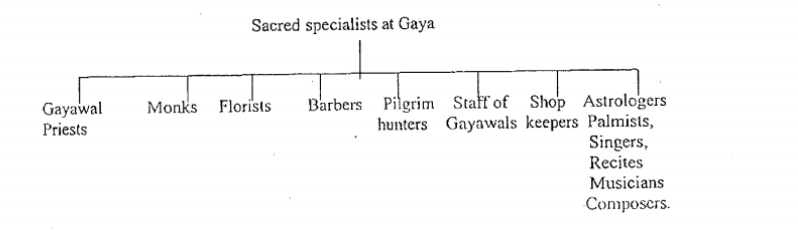
Of all the specialists, the Gayawal priests who are Brahmins are the most important ones. The Gayawals may be classified into three categories namely the Sanskritic, the Feudalistic and the proletarian. The Sanskritic Gayawals lead a life of orthodoxy, ceremonialism and strict adherence to the Brahminic rules as prescribed by the ancient Sanskritic texts. The Feudalist Gayawals lead a wealthy and aristocratic way of life. They also employ a number of servants to perform their priestly and domestic work. The Proletarian Gayawals show various changes in their behaviours and way of life. They are ridden with rivalry and group disorganization and at the same time pretend to maintain priestly life.
The Gayawal priests have Jajmani relationships with well-to-do patrons located in various parts of India. The rich patrons from all over India financed construction of sacred buildings. They provide a livelihood to the sacred specialists by holding elaborate sacred performances and giving them valuable gifts. On the basis of his analysis of the life of the Gayawals, Vidyarthi has drawn the following conclusions:
- All the three classes of Gayawals show three different in the development of priests through time.
- In the process of cultural development of the priests, each variety did not replace the other all the three are existing simultaneously today.
- The relationship of the priests with the outside world is not one sided. The priests fulfilled the religious needs of the people and the people patronised the sacred complex of Gaya. This proves the second hypothesis. Further, the very changes occurring in the lives of the priests reveal the changes in the Hindu civilisation in general and the sacred complex in particular this proves the third hypothesis
Similar studies
| Sociologist | Study |
| Bidayanath Saraswathi | The holy circuit of Nimsar Sacred complex of Khasi Temple organisation in Goa Myth and reality of a classical cultural tradition |
| Mohapatra | Lingaraj Temple, its structural change |
| Morab and Goswami | Chamundeswari temple |
| Chakravarthi | Tarakeswari temple |
| Makhan Jha | The Sacred complex of Ratanpur Sacred Complex of Janakpur (in Nepal) Sacred Complex of Kashi |
Conclusion
- According to L.P. Vidyarthi, the study of Hindu place of pilgrimage like Gaya shows that even though Gaya appears to be a great traditional in its context, in reality it has incorporated within its framework elements of performances and specialists of little traditional origins. There is a peculiar process of combination and compromise of tradition in the past leading to the development to Hinduism.
- A sacred complex by serving the local, regional and entire Hindu universe through its sacred activities has provided a meeting place for different kinds of people and traditions of castes and sects, and of classes and status and thus nourished a sense of Indian unity, even at a time when the spirit of nationalism was lacking.
- Finally, the sacred complex has undergone secondary urbanization. Especially under the impact of western civilization the sacred complex is in the process of transformation. The secular zone is in the process of expansion and is gaining more importance. This has resulted in the education of the activities in the sacred zone. In short, the sacred complex is in a process of reorganisation in response to the general change occurring in and around India.
Criticism
- Bidayanath Saraswathi (1982) proved that the heterogeneous pilgrims interacting in a sacred complex do not hold a common foundation of the sacred complex. Even then, the sacred centers integrates diverse cultural traditions into a common bond of civilisation.
- (ii) Bidayanath Saraswathi (1965,1962 and 1975) studied the sacred complexes of Nimsar of Goa and Kashi and concluded that a sacred complex, as in the case of Kashi, need not be a Brahmin complex rather it may be a non-Brahmin complex because it includes the coexistence of the Brahminic temples of Viveshwara and the nonBrahminic shrine of Agiyabeer and the sacred performances made by Brahmins and non-Brahmins including the untouchable Doms. That means a sacred complex may appear as predominantly a Brahmin complex, it is indeed a complex of a much bigger organisation of traditions known as Indian civilization.
- In the place of Vidyarthi “sacred complex” as a theoretical model, Marriot and Cohn (1958) developed alternative theoretical model in the form of “networks and centers for studying the places of pilgrimage as dimensions of Indian civilisation.