The discovery in 1982 of a fossilized skull in the central Narmada valley in Madhya Pradesh, India, provides the first scientifically recorded evidence of human skeletal remains from the Indian subcontinent dating to the late Middle Pleistocene of 300,000 to 150,000 years ago. Dr. Arun Sonakia of the Geological Survey of India found the fossil exposed on the ground surface of a thick Quaternary sediment of fluvial origin and embedded in a fossiliferous gravel conglomerate on the north bank of the Narmada river. This is near the village of Hathnora and some 40 km northeast of Hoshangabad town. Preserved parts of the specimen are the left side of the cranial vault, most of the base of the skull, and the left half of the brow ridges and orbit. Hence, it is a calvaria, not a complete skull with a full face including upper and lower jaws. Teeth are absent. In 1997, an announcement was made of the finding of a hominid right clavicle from Middle Pleistocene deposits in the Hathnora region during field explorations between 1983 and 1992, a bone that Dr. A. A. Sankhyan of the Anthropological Survey of India, Calcutta, associates with the Narmada Man calvaria and describes as having belonged to a female the size of a modern adult pygmy of “stocky” build.
In Sonakia’s description, published in 1984 in the Records of the Geological Survey of India, he assigned “Narmada Man” to the hominid taxon Homo erectus narmadensis. Its antiquity is based upon the direct association of the calvaria with stone tools, mainly handaxes and cleavers, typical of the prehistoric Acheulian technological tradition that was dominant in Middle Pleistocene times in India. The fossilized animal remains in the deposit—cattle, buffalo, elephant—include some species that are now extinct, but they are reliable “index fossils” of the late Middle Pleistocene. Radiometric dating methods are not feasible, so the age of the specimen is a relative dating estimate based upon its lithic and faunal associations.
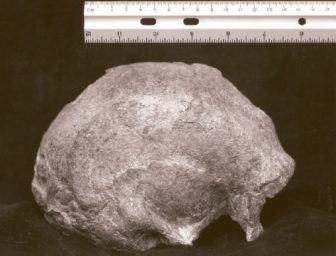
By 1988, reexaminations of the calvaria had been undertaken independently by biological anthropologists from the Laboratory of Human Paleontology and Prehistory at Marseille in France and from the Human Biology Laboratory at Cornell University at Ithaca in the United States. The French investigator, Dr. Marie-Antoinette de Lumley, recognized that some physical features of the calvaria were not typically those found in Homo erectus fossils from southeast Asia, China, and Africa. For example, the cranial capacity of these Early and Middle Pleistocene specimens averages 1,000 cm3, but estimates for the Narmada cranial vault fell between 1,155 and 1,421 cm3, values within the range of anatomically archaic Homo sapiens. Dr. de Lumley christened Narmada Man as an “evolved Homo erectus.” This label is acceptable to those biological anthropologists who profess that anatomically modern humans have a lineage that includes Homo erectus as an ancestral species, the anatomically archaic hominids of the Middle and Late Pleistocene (called Homo heidelbergensis) having an intermediate status in this evolutionary progression.
Aside from learned debates over this matter, the American investigator, Dr. Kenneth A. R. Kennedy, broadened de Lumley’s observations by an extensive examination of the calvaria using measurements, morphological analyses, and statistical procedures that support the thesis that Narmada Man (actually a young adult female) merited reassignment as an early Homo sapiens. The specimen was compared with crania of other hominid fossils of the Middle Pleistocene (Bodo, Kabwe, Petralona, Dali, Ngandong, Saldanha, Sambungmachen, and those from other sites in Africa, Asia, and Europe), with which it exhibited a significant number of anatomical similarities. The archaeological data do not rule out the possibility that Homo erectus had inhabited the Indian subcontinent, but fossil remains of this species have not been recovered. The importance of the Narmada calvaria is that it demonstrates that the Acheulian tool tradition was practiced by early sapiens in a part of the world that lies between the richer hominid fossil sites in Africa and in southeast Asia and the Far East. It is the most ancient hominid fossil recovered in India at the time of this writing.
The calvaria show a mosaic of H. erectus and “archaic” H. sapiens characters.
The main Homo erectus characters include:
1) Small mastoid process
2) Narrow post-orbital constriction
3) Maximum breadth across the mastoid
4) Prominent torus angularis
The important Homo sapiens characters traits include
1) A relatively high elevation of the cranial vault
2) The landmarks bregma and vertex are not coincident
3) The most posterior point in the instrumental calibration of maximum cranial length falls superior to the landmark inion (where it lies in erectus skulls)
4) The estimated cranial capacity is between 1155 and 1421 cubic centimetres. This on the contrary averages at about 1000 cubic centimeters in erectus.
Important “unique features” in Narmada Cavaria infrequent/absent in erectus and modern sapiens are:
1) The furrowing of the sagittal ridge along the top of the Cranial Vault.
2) A large external auditory meatus (ear hole)
3) An unusually long temporal bone.
But, scholars remained divided on the status of Narmada calvaria as either “evolved” H. erectus or “archaic” H. sapiens, but, recently many favour it as H. heidlebergensis
Phylogenetic significance in Indian context
- Indian soil being acidic yielded very less number of specimens.
- The debate whether India was one of the region where Homo erectus was present was debated.
- The presence of skeletal remains belonging to the lower Palaeolithic phase shows that evolution has occurred
- The importance of the Narmada calvaria is that it demonstrates that the Acheulian tool tradition was practiced by early sapiens in a part of the world that lies between the richer hominid fossil sites in Africa and in southeast Asia and the Far East.
Phylogenetic significance
In Sonakia’s description, published in 1984 in the Records of the Geological Survey of India, he assigned “Narmada Man” to the hominid taxon Homo erectus narmadensis.
Its antiquity is based upon the direct association of the calvaria with stone tools, mainly hand axes and cleavers, typical of the prehistoric Acheulian technological tradition that was dominant in Middle Pleistocene times in India. The fossilized animal remains in the deposit—cattle, buffalo, elephant—include some species that are now extinct, but they are reliable “index fossils” of the late Middle Pleistocene.
Radiometric dating methods are not feasible, so the age of the specimen is a relative dating estimate based upon its lithic and faunal associations.
Debate on the position of Narmada Man
The French investigator, Dr. Marie-Antoinette de Lumley, recognized that some physical features of the calvaria were not typically those found in Homo erectus fossils from southeast Asia, China, and Africa. For example, the cranial capacity of these Early and Middle Pleistocene specimens’ averages 1,000 cm3 but estimates for the Narmada cranial vault fell between 1,155 and 1,421 cm3, values within the range of anatomically archaic Homo sapiens.
Dr. de Lumley christened Narmada Man as an “evolved Homo erectus.” This label is acceptable to those biological anthropologists who profess that anatomically modern humans have a lineage that includes Homo erectus as an ancestral species, the anatomically archaic hominids of the Middle and Late Pleistocene (called Homo heidelbergensis) having an intermediate status in this evolutionary progression.
Aside from learned debates over this matter, the American investigator, Dr. Kenneth A. R. Kennedy, broadened de Lumley’s observations by an extensive examination of the calvaria using measurements, morphological analyses, and statistical procedures that support the thesis that Narmada Man (actually a young adult female) merited reassignment as an early Homo sapiens. The specimen was compared with crania of other hominid fossils of the Middle Pleistocene (Bodo, Kabwe, Petralona, Dali, Ngandong, Saldanha, Sambungmachen, and those from other sites in Africa, Asia, and Europe), with which it exhibited a significant number of anatomical similarities. The archaeological data do not rule out the possibility that Homo erectus had inhabited the Indian subcontinent, but fossil remains of this species have not been recovered.
Extra knowledge on Postcranial Remains
Another discovery of Narmada Man was made by A. R. Sankhyan of the Anthropological Survey of India, reported in January 1997 in Journal of Human Evolution from the vicinity of the Calvaria site of Hathnora but slightly younger bed to it. It was of three postcranial fossils, namely right and left clavicles and a partial 9th left rib. These fossils revealed very short, robust and stocky archaic hominin, with a stature (134 cm) and shoulder width (30 cm) found in the shortest female Andaman Pygmy.
Thus, the cranial and postcranial bones from Narmada valley come from two types of Middle to Late Pleistocene archaic hominins. They were found associated with Late Acheulian handaxes, cleavers and choppers, and Middle Pleistocene mammalian fauna indicating about 250-200 Kya