Introduction
Evolution in a larger aspect can be defined as encompassing changes over time. The various micro evolutionary forces contribute to the process of evolution. Natural selection being leads to the divergence of the individuals from their common ancestors. In 1995, philosopher Daniel Dennet in his book “Darwin’s Dangerous Idea” called Natural selection a blind process as the real one of the micro evolutionary force among mutation, genetic drift & gene flow and has a unique role in adaptation and evolution. As written by Charles Darwin in one of his masterpiece Origin of Species (1959), “the importance of selection lies in the power of selection accounting for unique & appreciable differences accumulated till the end resulting in fit and compatible offspring. These unique and appreciable features wonderfully quip them for survival and reproduction and it also design of the existing world and is not affected by supernatural & natural designer. Natural selection led to the evolution of
adaptation a characteristic feature which enhances the functional role in the life history of an organism maintained with greater adaptive potential, an organism becomes best suited to some of their environment through change in their survival and reproduction. The thing which mattered in natural selection was the overall advantage of a trait or physical feature over number of traits varying and dependent on different environmental conditions. Like for example, small bodied organisms were best suited in some environmental conditions whereas large bodied organisms were suited in some other. Very often we are mistaken in considering natural selection with evolution, but that’s not the case. Evolution is an outcome of processes i.e. evolutionary process can occur only by genetic drift, without any evolutionary change. Humans placed in the higher order among the organisation of life, face basically the same adaptive challenges as faced by all organisms but among the humans most of the adaptations is culturally transmitted, because of this complex form of cultural adaptations human’s have adapted themselves to the varied Earth’s ecological habitats.
History of Natural Selection
The theory of natural selection was proposed by Charles Darwin and Alfred Wallace on their voyage expedition. Both of them carried out an extensive study on natural world and added new observations which were further helpful in formulating the developing theory. Darwin more over emphasised on the competition taking place within the population whereas Wallace emphasized on the demands acquired by various species when subjected to different environment. Natural selection works with a bunch of different phenomenon and it was among the five vital theories given by Charles Darwin. The other theories were Evolution, Common Descent, Reproduction and Gradualism. All these theories supported one Idea or notion which was accounting the fact Origin of Species. Ernest Mayr (1991) in his book One Long Argument provided a convenient & simple way of understanding the process of natural selection. He gave five facts namely Super fecundity, steady populations, limited resources, unique individuals and heritability.
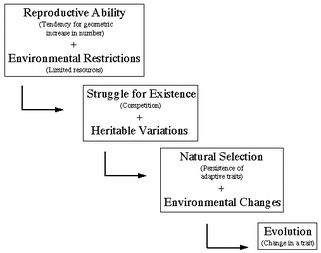
The first inference or conclusion is competition among the individuals for example goose which may hatch more than a half dozen goslings in a season with an excellent ability to reproduce can hatch more than a dozen of goslings in a season but due to limited resources such as food water or places and harsh environment conditions only few goslings survive after the stiff competition. Other two conclusions were based on the uniqueness and heritability differences among the individuals in a population. This uniqueness among the individuals will be due to the variation gives a boost to survival. The fitness among the individuals helped them to survive and reproduce offspring was termed as Darwinian fitness or relative fitness. The extent to which one trait relative to another becomes represented in the next generation through reproductive success and differential survival conferred as a consequence of that trait. Darwinian fitness is applied where a given trait is not recognized through its design to fulfil a particular function but as residual demographic effect of its performance of that particular trait. This variation among the individuals is inherited by their parents and is further passed to their offspring. The thing which mattered in Natural selection was the overall advantage of a given trait varying by environment like for example small body size or large body size can serve as a not advantage in various environment. It is also the machine that drives evolution and let those organisms that are abnormal to survive an environmental change and making them the new normal. Endler in 1986 defined as the consistent difference in fitness among phenotypically different classes of biological entities.
Various components of selection in sexually reproducing organism & can be extended to two levels. First level is the zygotic selection whereas the second level is gametic selection. In zygotic selection, the viability or probability of survival of the genotype to adulthood is different. It also accounts for the survival of the individual organism and further its mating success
which is whether the number of males affects the individual’s number of progeny. Mating success will contribute to the sexual selection which will depend on the genotypes of both the mates. The second level operates between the parents and its gamete is gametic selection where the pressure is on the allele. An allele may affect the parent gamete’s ability to fertilize an ovum.
Fitness
Fitness in simple term it refers to the probability of survival & reproductive success and it is equal to the average contribution to the gene pool of the next generation. The various components of reproductive success & fitness are
- Probability of survival in various reproductive ages
- Average number of offspring laid down by females and males.
The process of natural selection depends on the relationship between phenotypes, genotypes and fitness which further adds to evolutionary change. The fitness of a genotype is the average lifetime contribution made by an individual’s genotype of that population over one generation to another. Survival and female fecundity can be assigned as the components of fertility. The complexity of fitness depends on repeatedly sexually reproducing species during its lifetime. The term Darwinian fitness is often used to make distinction from physical fitness. A change in the allelic frequency over the generations affect the arwinian fitness, the alleles with higher fitness become more common & favourable.
General mode of natural selection
Natural selection can alter the frequency of heritable traits in three ways:
Stabilizing Selection
Directional selection , (2) Stabilizing Selection and (3) Disruptive selection
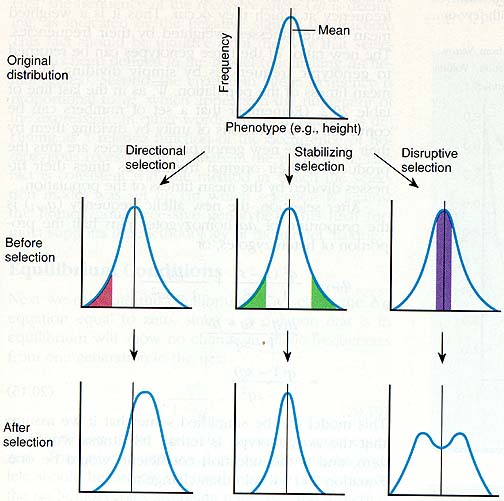
Figure 1 demonstrating the three modes of natural selection. The shaded areas shows the groups being selected against. The top graph shows the original distribution of the individual whereas the final distributions of the individual appear in the graph after selection.
Directional selection: individuals at one end of the frequency distribution do well.
Features:
- It occurs due to change in the environment in a particular direction
- It favours the phenotype which has an extreme or non- average character.
- It alters the mean value of the trait in the population in one direction.
- It eliminates the normal or average individual.
Example:
Industrial Melanism: The phenomenon of Industrial melanism is used to describe the evolutionary process in which light coloured organism’s population becomes dark as a result of natural selection. It was studied in the peppered moth, Biston betularia. Before industrial melanism these species had light colour pattern, dark coloured or melanic moths were rare. But after industrial revolution light coloured became highly vulnerable to predators due to darkened tree trunks and killed off lichens. Thus due to sudden change in the environmental conditions dark coloured moth became abundant, the cause of this change was selective predation by birds, as they favoured camouflage coloration in the moth.
Stabilizing selection: the extreme varities for a particular heritable character is eliminated from both the ends of frequency distribution. Features
- It operates in a constant and changing environment.
- It keeps a population genetically constant.
- It favours the normal or average phenotypes.
- It introduces homozygosity in the population.
Example:
The human baby with 73 lbs weight has less mortality rate whereas the human baby beyond 53 lbs and above 101 lbs has high mortality rate.
Diversifying/ Disruptive Selection: it is a process that enhances the adaptedness of population that live in heterogenous environments. Features:
- Previously homologous population breaks into several different adaptive groups.
- Extreme values have highest fitness and intermediate or mean values are relatively disadvantageous.
- It occurs when a population previously adapted to a non- homologous environment is subjected to divergent selection pressure in different parts of its distributional area.
Examples:
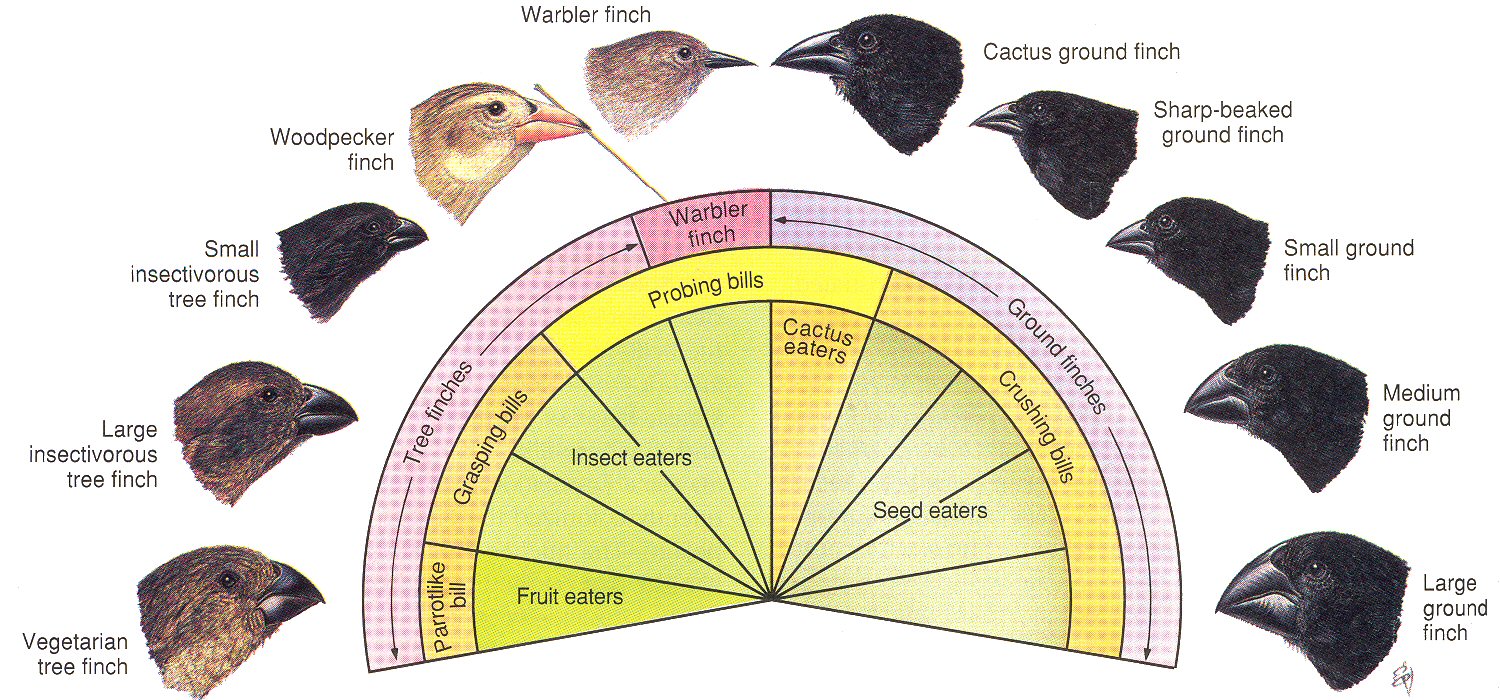
Darwin finches
Darwin finches were a group of 14 species of small bird, out of which 13 species of birds occurred on the Galapagos Islands. The Galapagos Islands, a cluster of 29 islands served as the cradle of evolution. These islands were relatively young and were never connected with the adjacent mainland of South America. Galapagos being a group of small islands were home to large flock of birds and would adjust themselves to the local conditions through the process of natural selection. With advent of time, they were different progressively from the original populations. The descendents now occupy many different kinds of habitats. These habitats encompasses a variety of niches comparable to those occupied by several distinct birds inhabiting the mainland.
Case studies of Natural selection in human population.
Cultural evolution meant that we no longer evolve genetically in any significant way. The rapid change are not as a result of natural selection but are instead changes in environmental conditions i.e. a primarily shift in infectious disease and nutrition, an unfortunate truth is that many humans continue to live in impoverished environments without proper health care or diet, and do not share with the existence of different conditions enjoyed by those living in other parts of society or the world. Natural selection shapes the human population over time. Here are some case studies which gives an idea about how does it work and shows the evidence of evolutionary change in recent human evolution since the initial beginnings of agriculture.
A. Haemoglobin S and Malaria( Balancing Selection): The story of natural selection and haemoglobin molecule is a classic example in anthropology. Haemoglobin is a protein of the blood that transports oxygen to tissues throughout the body (different tissues). Normal haemoglobin consists of 4 protein chains i.e. 2 identical chains of alpha (α) and Beta (β). The normal form of β haemoglobin gene is known as the A allele and people with AA genotype have haemoglobin functions normally in transferring oxygen.SS genotype results in manifestation of disease Sickle cell anaemia where a single mutation replaces the sixth amino acid of the beta chain Glutamic Acid with amino acid Valine. The disease can cause the red blood cells to become distorted and change the levels of oxygen. The deformed blood cells do not carry oxygen effectively, causing serious problems throughout the body. With respect to natural selection, relative fitness is assigned to different genotypes (AA, AS and SS). The genotype AA is reported to have highest relative fitness, genotype AS slightly lower relative fitness whereas the genotype SS is expected to have the lowest fitness. A main focus is laid on A and S alleles, because S allele is harmful in the homozygous case and a selection against allele is done. Allele S is mutant and has the lowest frequency.
Balancing selection and Haemoglobin S: Balancing selection refers to a selective process by which multiple alleles get added and are maintained in the gene pool of a population. A moderate to higher frequency of S allele are found in the populations inhabiting the areas of West Africa, Middle East, South Africa and India. Populations having malarial histories tend to have a high frequency of S allele and can be best explained by balancing selection. Malaria an infectious disease is one of the harmful
disease recorded in human history of which the parasite Plasmodium falciparum is the most fatal. Presence of an S allele renders the red cell inhospitable to the malaria parasite, thus protecting the individual from its effects. The fitness difference among the SS and AA genotype can be seen by an example provided by Bodmer and Cavalli-Sforza(1976) from the Yoruba of Nigeria inhabiting the malarial environment. The observed genotype numbers in adults were AA=9365,AS=2993 and SS=29)
for a total of 12387 adults, where 21723 A alleles and 3,051 S alleles, for a total of 24774 alleles. Hardy Weinberg proportions can be easily computed and will give the genotypic and allelic frequencies.
Allele frequency Allele a Allele S
21723/24774 3051/24774
=0.877 =0.123
Genotypic frequencies
AA= p2
(12,387)= (0.877)2
(12387)
=9527.2
AS=2pq(0.877)(0.123)(12387)
=2672.4
SS=q2
(12387)= (0.123) 2
(12387)
=187.4
The absolute fitness for the various genotypes can be observed
AA=9365/9527= 0.983
AS= 2993/2672.4= 1.120
SS=29/187.4= 0.155
The absolute fitness can be further used to calculate relative fitness
AA= 0.983/1.120=0.878
AS=1.120/1.120=1
SS=0.155/1.120=0.138
The selection coefficients (obtained by subtracting the relative fitness from 1) for the homozygotes are
s=1-wAA= 1-0.878=0.122
t=1-wSS=1-0.138= 0.862
These values shows that for every 100 people with genotype AS surviving to adulthood, whereas 88 and 14 with genotype AA and SS respectively.
b. Duffy Blood Group and Malaria
Duffy blood group is defined by the presence of antigens on the surface of red blood cells. The gene of duffy blood group is present on the chromosome 1 and consist of three codominant alleles: Fy0, (coding for the absence of any Duffy antigen); Fya
( coding for a antigen) and Fyb (coding for b antigen). A selection and fixation for the Duffy negative alleles will be there in populations experiencing vivax malaria. The highest frequencies of Duffy negative alleles is found highest frequencies in central and South Africa reaching a value of 1.0 (100%) in number of populations.
c. Lactase Persistence and Evolution of Human Diet
Many humans today have developed lactose intolerance, physical effect of lactose intolerance can vary and include flatulence, diarrhoea, bloating and cramps. The gene controlling lactase activity is present on the chromosome 2. The critical factor that explains global variation variation in lactose persistence is diet. Populations indulged in dairy farming tend to have higher frequency of lactose intolerance. The fact can very well be explained by natural selection where lactase persistence was selected for the populations engaged in dairy farming because of the nutritional advantage among individuals who are
able to digest the milk. An European cattle study revealed that the geographic distribution of various protein genes was correlated with levels of lactase persistence in humans. The estimated age of lactose persistence fits the age of domestication of cattle. Cattle farming began in Africa and the Middle east between 7500 and 9000 years ago.
d. Genetic Adaptation to High Altitude Population
A change in the adaptability was observed among the humans, as our ancestors expanded out of Africa and spread across the world. One particular challenge occurred in adapting themselves to high altitude and overcome the physiological stress. When a low native enters a high altitude environment, the hypoxic conditions can be encountered by various individuals and an adaptive response is further generated like increase in the red blood cells and increased respiration, increased chest dimensions, greater lung volume relative to high altitude. There are some genetic influences on high altitude environment then some physiologic and biochemical traits as a result of natural selection as the genetic make-up of the respiratory components of the Tibetan and the Ethiopian populations are significantly different. These two populations differ in the level of oxygen in the blood, the level of oxygen saturation in the blood and levels of haemoglobin concentration.
e. The Evolution of Skin Colour
Human skin colour (pigmentation) is a quantitative trait that shows an immense amount of variation between human groups around the world, ranging from very dark to extremely light. The wide range of skin colour is affected by natural selection. Skin colour is affected by geographical distribution and tends to increase and decrease with distance from equator, both north and south as the amount of ultraviolet (UV) varies with distance. UV radiation is strongest at the equator and diminishes with increasing distance.
Extra Resources:
- Stabilising selection : If both small and large type individuals contribute lesser number of offsprings than the average size to the population it is stabilizing selection. This reduces variation but does not change the mean value. The rate of evolution is slow
- Directional selection : If individuals of one extreme size contribute more offspring than the other type then mean-sized population increase. If this selection operates for many generations an evolutionary trend with in the population emerges.
- Disruptive selection : When natural selection simultaneously favour the two extreme (opposite) traits it produces two peaks in the distribution of traits. It is of rare kind.
- Balancing selection : When a deleterious gene is retained to continue in a population through heterozygotes, this balances the loss occurring due to death of homozygotes. e.g. sickle cell gene in heterozygotic form. This is rare phenomenon and no explanation for the type of genetic variation in natural population.