The first fossil of Homo Habilis was discovered in Oldwai Gorge (Tanzania) by ‘ Louis Leakey in 1960-61. The find consisted of only a few cranial material and others. It was regarded as an intermediate between australopithecine and Homo Sapiens because fragments of skull bones measured a cranial capacity of 700 CC well above the value of australopithecines. The cheek, teeth, though longer, were narrow than australopithecines. However, many similar fossils have been discovered since then from Oldwai, Omo, Koobifora and East Turkana. Age of such fossils have been estimated to be around 2 to 1.5 million years ago. Perhaps most famous of all these fossils is KNM-ER 1470 from Koobifora, found in 1972.
Characteristics of Homo habilis:
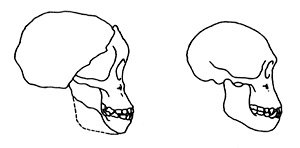
- Cranial capacity i.e. 630 cc was greater than in australopithecines and approached Homo erectus.
- The endocast studies show development of frontal lobe, the seat of higher mental abilities, not found in australopithecines but present in us.
- The brain case is rounded.
- The top of the skull was more rounded with lesser crests than that of australopithecines.
- The teeth, in general, show human affinity, particularly pre-molars, which have two ridges like humans.
- Size of teeth vary.
- Dental arcade was more parabolic.
- Mandible is less massive than that of australopithecine.
- Hind limb morphology clearly like human’s foot.
Elaboration of Physical Feature
a. Skull and teeth
The skull of early Homo became more rounded with extension of brain size. Forehead became slightly visible. The face is less projecting and reduced in size with smaller and arched brow ridge compared to Australopithecines (earlier ancestors). The foramen magnum, the hole for attachment of the vertebral column was located in the centre of the skull base indicating bipedalism. The average cranial capacity is estimated to be about 630 cc which is significantly larger than that of Australopithecines. The jaw of early Homo became smaller with more rounded dental arcade than those of Australopithecines. The teeth became smaller but the incisors were still relatively large. The feature of teeth suggest that they were depending more on stone tools and technologies for getting food or else they may have very limited food resource.
b. Post Cranial
The size of the body is relatively small and similar to that of Australopithecines with about four feet height. The leg and foot bones indicate that they were definitely bipedal. But bones of upper limbs show some primitive characteristic. The arms were relatively long suggesting that they retained some climbing ability (Wood, 1996). Fingers have slightly curved bones, intermediate between curved finger bones of quadrupedal apes and straight fingers of modern human. The proportion of finger bones suggests that they have the ability for precision grip. This might help them in manufacturing and using stone tools.
‘Homo habilis’ Culture
a. Early stone tools
The earliest stone tools were discovered from Olduvai Gorge in 1959 when the Australopithecus bosei was excavated and it is estimated to be 2.5 million year old. The same site also yielded another hominine – Homo habilis. At first it was thought that A. bosei manufactured and used those tools. But, later it was realized that A. bosei will be too primitive to have made something so sophisticated. Therefore, these tools were used and manufactured by H habilis. Whoever have manufactured and used it, the earliest stone tools were available from 2.5 million year ago. These tools from Olduvai Gorge are so named as Oldowan tool industry, taking the name of the site from where it was first found. Most of the tools were core, water-smoothed cobbles 3-4 inches across, modified by knocking off a few chips from one or two face to make a sharp edge and flakes, small fragments removed from the core. Other tools found from Oldowan industry was hammer stone. It was used to break open the bones of large animals to get marrow and also to manufacture flakes from the core. Authorities initially thought that the Oldowan tools were all core tools and that flakes were the waste products of their manufacture. However, experiments have suggested that majority of core were the raw materials for the manufacture of flake tools which were used as cutting and scraping tools. Cores were used to produce flakes multiple times until it become too small to produce flakes and were discarded.
Sometime, flakes can be very sharp and are effectively used to cut through tough animal hides to remove meat from bones or dig out roots and tubers. Early Homo seems to have travelled some distance in search of superior raw material to produce sharp and durable flakes. They may also probably carryied those cores with them in order to remove flakes whenever required (Schick and Toth, 1993). So, if early Homo carried their tools around it must be because those tools were an important part of their daily life like cell phone and wallet in the present day life.
Analyzing the pattern of tool used at various sites in East Africa, archaeologists categorized the sites into different types. In some sites stone tools are found in association with varieties of mammal bones some of which bears cut and percussion marks made by stone tools. So, such sites may be the butchering sites. Stone tools are also found in large number in some particular sites where the raw material are found to be abundant but not in association with bones. These sites may be quarrying sites from where they get raw material for manufacturing stone tools. Glynn Isaac (1978) proposes a third type of site called home base, some more comfortable central place, perhaps near a shade of tree or a water hole, where early Homo repeatedly brought butchered carcasses. They manufactured or refined and stored tools in this site. They slept and ate in greater safety in this site than the place where animal was killed. But this hypothesis faces skepticism due to lack of proper evidences.
b. Food Habit
With the availability of sharp stone tools, animal foods became an important adaptive strategy for early Homo. The first indisputable evidence of tool use for getting animal meat is from the cut marks on fossilized bones of antelope about 2.5 million year ago. However, despite the enormous amount of evidence of meat eating in the form of butchered bones, we don’t know how often early Homo might have eaten meat or how important meat was in their diet. How they get those meats? Do they hunt or scavenged? There are three probable models on how they acquired carcasses:
- Active hunting: group of early Homo might have courageously attacked and slaughtered large and dangerous game.
- Confrontational scavenging: Large and dangerous game may be hunted down by large predators such as saber-toothed cats. Early Homo might have bravely fought off these predators to gain access to significant amount of meat.
- Passive scavenging: early Homo might have patiently waited till the large predator who hunted down the big game left the carcasses after they finish eating to get a few scraps of meat and fat.
It is important to know whether early homo evolved as hunter or scavenger as these activities indicate a different set of behavioral adaptation. Analyzing some of the cut marks on fossilized carcasses it is evident that carnivores first chewed and butchered later. Bone from Olduvai site show cut marks by the gnawing of contemporaneous lion, hyena, etc. and on top of that early Homo’s cut marks were found.
This inferred that early Homo eats flesh from the bone after it had already been chewed by predators. So, at least occasionally early Homo scavenge but not hunt. There are more evidences of scavenging by early Homo. Analyzing the animal bones found from early Homo’s sites, Lewis Binford (1985) found that most of the bones belongs to the lower legs of antelopes where little flesh/meat was attached. This may be the left over part of the carcass after carnivores have finished eating. So, they might have cut through the bone to get nutritious marrow inside.
The climatic condition may give the most unfavorable condition for survival to early Homo but they were successful to survive through it with adaptive strategies. These adaptive strategies include enlarged brain, manufacture and use of stone tool and technology. This led them to explore new and nutritious animal based diet. The success of early Homo set the stage for the rest of the hominine evolution. So, the first early Homo appears in around 2 million year ago. Before they disappeared, a new hominine species – Homo erectus appeared, equipped with more enhanced adaptive strategy which soon spread all over the old world, out of Africa.