- Genetic marker is a gene or DNA sequence with known location on chromosome that can be used to identify an individual or species.
- Human blood is an important source of genetic markers and it has advantages as it is easily obtained and can be easily transported.
• Genetic markers in human blood
- (1) Genetic markers on blood cells
- (a) Red cell antigens
- (i) ABO System
- (ii) MNS System
- (iii) Rh System
- (b) Hemoglobin
(c) G-6-PD enzyme
- (a) Red cell antigens
- (2) Genetic Markers in plasma : Haptoglobin, Transferrin, Albumin, Globulin, GM factor etc.ft
ABO Blood Grouping and its uses
- Landsteiner in 1900-02 discovered the ABO blood group system.
- There are 4 types of Blood Groups in this system: A, B, AB and O formed on the basis of three alleles a , b , o , located on chromosome 9 .
- Antigens : substances on surface of RBC which react with serum of other individuals causing clumping are antigens.
- Antibodies : Types=Anti-A, Anti-B.
- Principle of ABO Blood Grouping : 4 groups are determined by the fact that the blood corpuscles of certain individuals react upon the serum or plasma of certain other individuals and thereby cause agglutination or clumping together of RBCs.
- Blood Groups (phenotype), Genotype, antigen and antibodies-chart:
| Blood group | Phenotype | Genotypes | Antigens | Antibodies |
| A | A | AAor AO | A | Anti-B |
| B | B | BB or BO | B | Anti-A |
| AB | AB | AB | AandB | No antibody |
| O | O | OO | No antigens | Anti-A, Anti-B |
• Distribution of ABO blood groups
- (1) A-(21.5%) – Europe & Eurasia, Australian Tribes
- (2) B-(16.2%) – North India & Central Asia (Absent in Australian Tribes)
- (3) 0-(62.3%) – America.
- (4) Blood Group A2 : High frequency in European, Caucasoid & Negroids
It implies that ABO blood groups are affected by environmental selection
• Use of ABO Blood Group System
(1) Racial Classification: Distribution of ABO blood groups as given above.
Advantages of using ABO for Racial classification
- (i) Follows medelian principle
- (ii) Not altered by differences in environment
- (iii) Frequency in population is very stable.
- (iv) Arose very early in man’s evolution
- (v) Correlation between geography and distribution
- (vi) Blood groups are sharply distinguishable-all or non-phenomena.
(2) ABO blood groups & diseases
- Blood group O-Ulcer (gastric & deuodenal)
- Blood group A
- (1) Stomach Cancer
- (2) Pancreatic Cancer
- (3) Pernicious Anemia
- (4) Ovarian Tumor
- (5) Diabetes
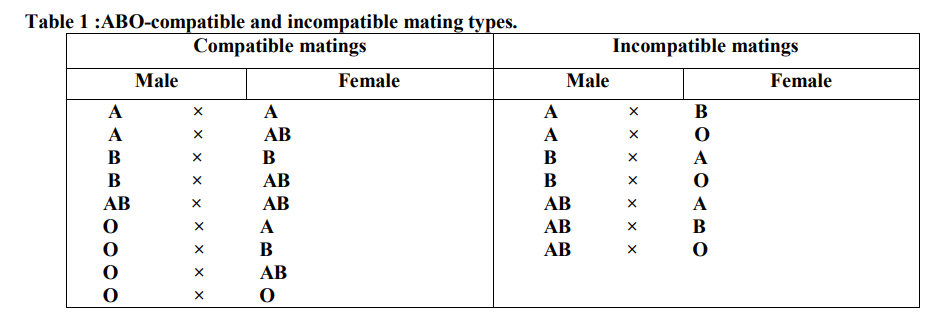
(3) ABO incompatibility and hemolytic diseases
2 types of marriage according to Blood Group : (1) Compatible (Homo-specific) (2) Incompatible (Hetero-specific)
(4) Paternity Diagnosis
Although blood group studies cannot be used to prove paternity, they can provide unequivocal evidence that a male is not the father of a particular child. Since the red cell antigens are inherited as dominant traits, a child cannot have a blood group antigen that is not present in one or both parents. For example, if the child in question belongs to group A and both the mother and the putative father are group O, the man is excluded from paternity. The table shows the phenotypes (observed characters) of the offspring that can and cannot be produced in the matings on the ABO system, considering only the three alleles (alternative genes) A, B, and O.
| Matings | possible children | impossible children |
|---|---|---|
| O × O | O | A, B, AB |
| O × A | O, A | B, AB |
| O × B | O, B | A, AB |
| O × AB | A, B | O, AB |
| A × A | O, A | B, AB |
| A × B | O, A, B, AB | |
| A × AB | A, B, AB | O |
| B × B | O, B | A, AB |
| B × AB | A, B, AB | O |
| AB × AB | A, B, AB | O |