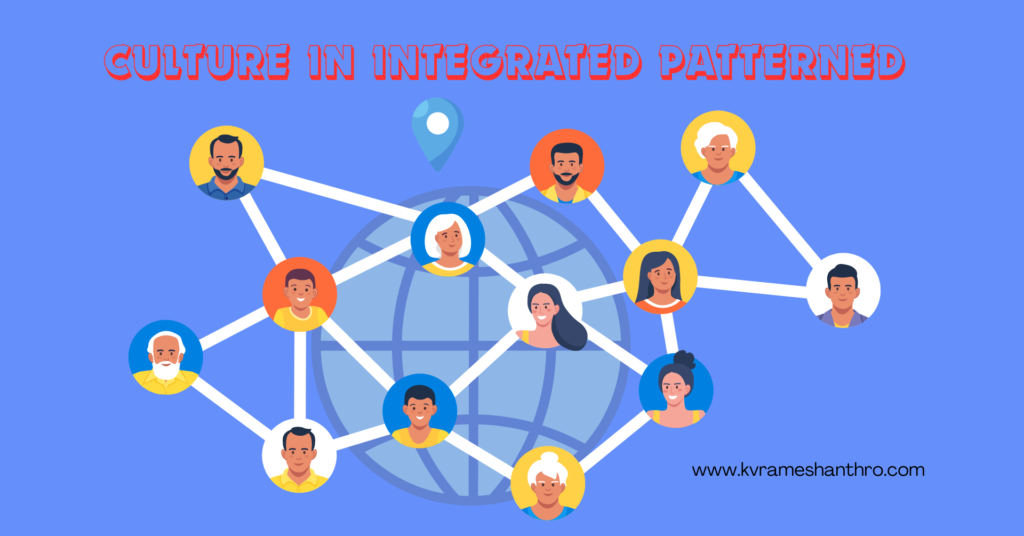
Culture is Integrated or Patterned
Culture is integrated or patterned: Anthropologists have always known that culture is not a hodgepodge of unrelated behaviors and ideas— culture is integrated that a culture is mostly integrated. In saying that a culture is mostly integrated, we mean that the elements or traits that make up that culture are not just a random assortment of customs but are mostly adjusted to or consistent with one another.
A culture may also tend to be integrated for psychological reasons. The ideas of a culture are stored in the brains of individuals. Research in social psychology has suggested that people tend to modify beliefs or behaviors that are not cognitively or conceptually consistent with other information. We do not expect cultures to be completely integrated, just as we do not expect individuals to be completely consistent. But if a tendency toward cognitive consistency is found in humans, we might expect that at least some aspects of a culture would tend to be integrated for that reason alone. How this pressure for consistency works is not hard to imagine. Children, for example, seem to be very good at remembering all the things their parents say. If they ask for something and the parents say no, they may say, “But you said I could yesterday.” Such pressure to be consistent may even make parents change their minds! Of course, not everything one wants to do is consistent with the rest of one’s desires, but there surely is pressure from within and without to make it so.
Humans are also capable of rational decision making; they can usually figure out that certain things are not easy to do because of other things they do. Culture is integrated For example, if a society has a long postpartum sex taboo (a custom in which couples abstain from sex for a year or more after the birth of a baby), we might expect that most people in the society could figure out that it would be easier to observe the taboo if husband and wife did not sleep in the same bed. Or, if people drive on the left side of the road, as in England, it is easier and less dangerous to drive a car with a steering wheel on the right because that placement allows you to judge more accurately how close you are to cars coming at you from the opposite direction.
Consistency or integration of culture traits may also be produced by less conscious psychological processes. People may generalize (transfer) their experiences from one area of life to another. Culture is integrated For example, where children are taught that it is wrong to express anger toward family and friends, it turns out that folktales parallel the childrearing; anger and aggression in the folktales tend to be directed only toward strangers, not toward family and friends. It seems as if the expression of anger is too frightening to be expressed close to home, even in folktales. Adaptation to the environment is another major reason for traits to be patterned.
Customs that diminish the survival chances of a society are not likely to persist. Either the people clinging to those customs will become extinct, taking the customs with them, or the customs will be replaced, thereby possibly helping the people to survive. By either process, maladaptive customs—those that diminish the chances of survival and reproduction—are likely to disappear. Culture is integrated The customs of a society that enhance survival and reproductive success are adaptive customs and are likely to persist. Hence, we assume that if a society has survived long enough to be described in the annals of anthropology (the “ethnographic record”), much, if not most, of its cultural repertoire is adaptive, or was at one time.
When we say that a custom is adaptive, however, we mean it is adaptive only with respect to a specific physical and social environment. What may be adaptive in one environment may not be adaptive in another. Therefore, when we ask why a society may have a particular custom, we really are asking if that custom makes sense as an adaptation to that society’s particular environmental conditions. If certain customs are more adaptive in particular settings, then those “bundles” of traits will generally be found together under similar conditions.Culture is integrated For example, the !Kung, as we have mentioned, subsisted by hunting wild animals and gathering wild plants. Because wild game is mobile and different plants mature at different times, a nomadic way of life may be an adaptive strategy. Because this food-getting strategy cannot support that many people in one area, small social groups make more sense than large communities. Since people move frequently, it is also probably more adaptive to have few material possessions. These cultural traits usually occur together when people depend on hunting and gathering for their food.
Culture Is Imperfectly Patterned
Not all aspects of culture are consistent, nor is a society forced to adapt its culture to changing environmental circumstances. Even in the face of changed circumstances, people may choose not to change their customs. The Tapirapé of central Brazil, for example, did not alter their custom of limiting the number of births even though they had suffered severe population losses after contact with Europeans and their diseases. The Tapirapé population fell to fewer than 100 people from over 1,000. They were on the way to extinction, yet they continued to value small families. Not only did they believe that a woman should have no more than three children, but they took specific steps to achieve this limitation. They practiced infanticide if twins were born, if the third child was of the same sex as the first two children, and if the possible fathers broke certain taboos during pregnancy or in the child’s infancy.
Of course, it is also possible that a people will behave maladaptively, even if they try to alter their behavior. After all, although people may alter their behavior according to what they perceive will be helpful to them, what they perceive to be helpful may not prove to be adaptive. The tendency for a culture to be integrated or patterned, then, may be cognitively and emotionally, as well as adaptively, induced.