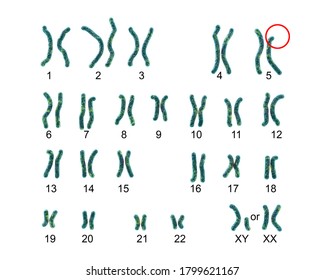
A deletion refers to the loss of a segment of a chromosome. This leads to the loss of the genes present in the missing region. A single break in the chromosome leads to the loss of the terminal segment and is called terminal deletion . Intercalary deletion, however, involves two breaks in the chromosome, loss of the segment, and rejoining of the two chromosomal parts. Very large deletions are usually lethal because the monosomic condition of the large number of genes of the missing fragment reaches the level of genetic imbalance that cannot sustain life. Usually any deletion resulting in loss of more than 2% of the genome has a lethal outcome. Microdeletions, however, are reported and documented for specific disorders.
Cri-du-chat Syndrome
This syndrome results from a deletion on the short arm of chromosome 5. It is also known by other names such as 5p deletion syndrome and Lejeune’s syndrome. The disorder gets its name from the characteristic cat-like cry of affected infants. Described first by Jérôme Lejeune in 1963, this disorder has an incidence of 1 in 25,000 live births. This disorder, being autosomal, should affect males and females in equal frequencies; but incidence is seen to be more in females by a ratio of 4:3 of females: males affected. The deletion occurring on the short (p arm) arm of chromosome 5 varies in different affected individuals. The phenotypic effects are also shown to vary between individuals. Most cases show deletion of 30 to 60% of the terminal region of the short arm. Studies show that larger deletions tend to result in more severe intellectual disability and developmental delay than smaller deletions.
Affected individuals characteristically show a distinctive, high-pitched, catlike cry in infancy with growth failure, microcephaly, facial abnormalities, and mental retardation throughout life. Some common clinical manifestations are:
• Cry that is high-pitched and sounds like a cat
• Downward slant to the eyes
• Low birth weight and slow growth
• Low-set or abnormally shaped ears
• Mental retardation (intellectual disability)
• Partial webbing or fusing of fingers or toes
• Slow or incomplete development of motor skills
• Small head (microcephaly)
• Small jaw (micrognathia)
• Wide-set eyes