Cell division in somatic cells is called mitosis, and it’s the way somatic cells reproduce. Mitosis occurs during growth and development; it also plays a role in the repair of injured tissues; and it replaces older cells with newer ones. But while mitosis produces new somatic cells, another type of cell division, called meiosis, may lead to the development of new individuals, since it produces reproductive cells, or gametes.
Mitosis
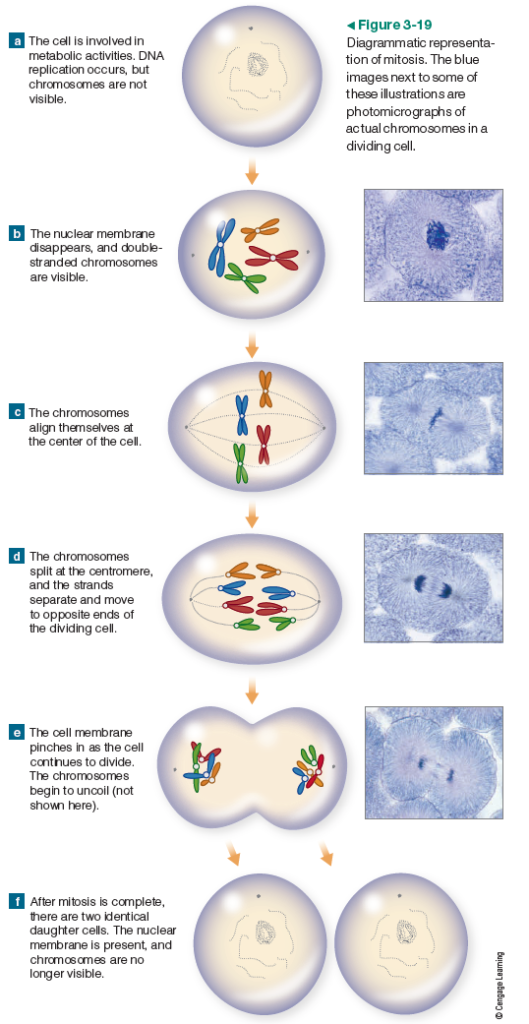
In the early stages of mitosis, a human somatic cell has 46 double-stranded chromosomes, and as the cell begins to divide, these chromosomes line up along its center and split apart so that the two strands separate . Once the two strands are apart, they pull away from each other and move to opposite ends of the dividing cell. At this point, each strand is a distinct chromosome, composed of one DNA molecule. Following the separation of chromosome strands, the cell membrane pinches in and seals, so that there are two new cells, each with a full complement of DNA, or 46 chromosomes
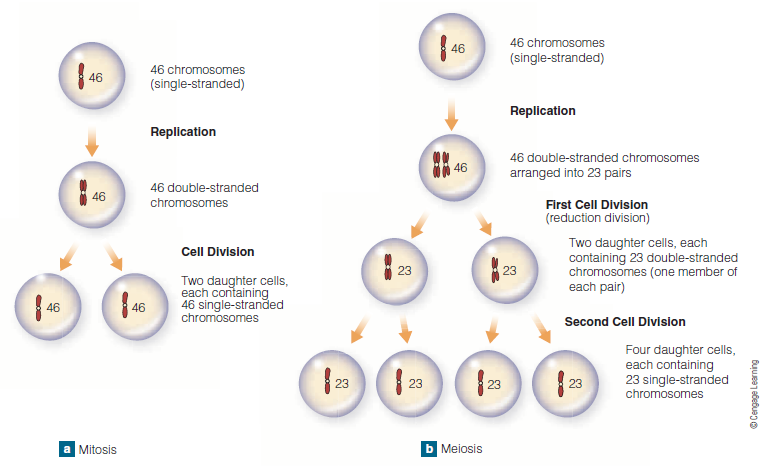
Mitosis is referred to as “simple cell division” because a somatic cell divides one time to produce two daughter cells that are genetically identical to each other and to the original cell. In mitosis, the original cell possesses 46 chromosomes, and each new daughter cell inherits an exact copy of all 46. This precision is made possible by the DNA molecule’s ability to replicate. Therefore DNA replication ensures that the amount of genetic material remains constant from one generation of cells to the next. We should mention here that certain types of somatic cells don’t divide. Red blood cells are produced continuously by specialized cells in bone marrow, but they can’t divide because they have no nucleus and no nuclear DNA. Once the brain and nervous system are fully developed, brain and nerve cells (neurons) stop dividing, although there is some debate about this issue. Liver cells also do not divide after growth has stopped unless this vital organ is damaged through injury or disease. With these three exceptions (red blood cells, mature neurons, and liver cells), somatic cells are regularly duplicated through the process of mitosis.
Meiosis
While mitosis produces new cells, meiosis can lead to the development of a new organism because it produces reproductive cells (gametes). Although meiosis is similar to mitosis, it’s more complicated. In meiosis, there are two divisions instead of one. Also, meiosis produces four daughter cells, not two, and each of these four cells contains only half the original number of chromosomes.
During meiosis, specialized cells in male testes and female ovaries divide and eventually develop into sperm and egg cells. Initially, these cells contain the full complement of chromosomes (46 in humans); but after the first division (called reduction division), the number of chromosomes in the two daughter cells is 23, or half the original number . This reduction of chromosome number is crucial because the resulting gamete, with its 23 chromosomes, may eventually unite with another gamete that also has 23 chromosomes. The product of this union is a zygote, or fertilized egg, in which the original number of chromosomes (46) has been restored. In other words, a zygote inherits the exact amount of DNA it needs (half from each parent) to develop and function normally. If it weren’t for reduction division in meiosis, it wouldn’t be possible to maintain the correct number of chromosomes from one generation to the next.
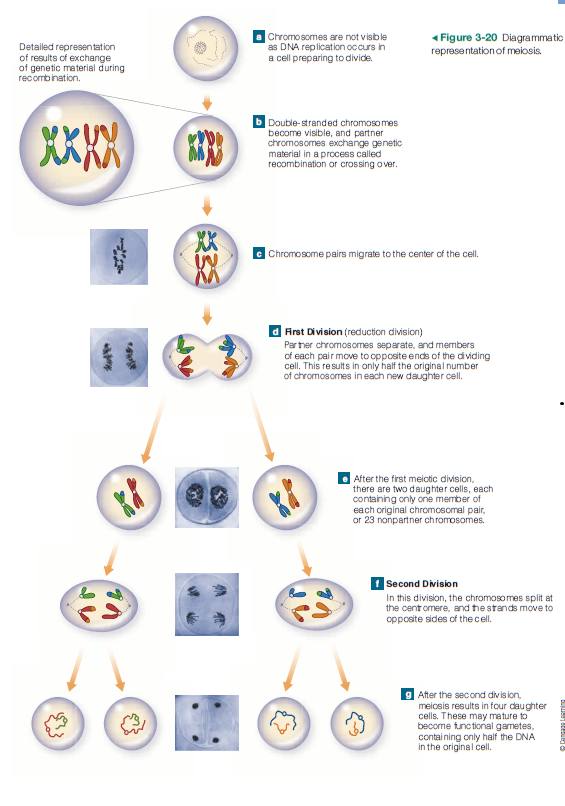
During the first division, partner chromosomes come together to form pairs of double-stranded chromosomes that line up along the cell’s center. Pairing of partner chromosomes is essential because while they’re together, members of pairs exchange genetic information in a process called recombination. Pairing is also important because it ensures that each new daughter cell receives only one member of each pair.
As the cell begins to divide, the chromosomes themselves remain intact (that is, double-stranded), but members of pairs pull apart and move to opposite ends of the cell. After the first division, there are two new daughter cells, but they aren’t identical to each other or to the parental cell. They’re different because each cell contains only one member of each chromosome pair (that is, only 23 chromosomes), each of which still has two strands. Also, because of recombination, each chromosome now contains some combinations of alleles it didn’t have before.
The second meiotic division is similar to division in mitosis. In the two newly formed cells, the 23 double-stranded chromosomes line up at the cell’s center and, as in mitosis, the strands of each chromosome separate and move apart. Once this second division is completed, there are four daughter cells, each with 23 single-stranded chromosomes, or 23 DNA molecules.
The Evolutionary Significance of Meiosis
Meiosis occurs in all sexually reproducing organisms and is an extremely important evolutionary innovation because it increases genetic variation in populations. Members of sexually reproducing species aren’t genetically identical clones of other individuals because they receive genetic contributions from two parents. Just from the random assortment of chromosome pairs during the first division of meiosis, each parent can produce around 8 million genetically different gametes. In human matings, literally trillions of genetic combinations can result in the offspring of two parents. Consequently every individual represents a unique combination of genes that, in all likelihood, has never occurred before and will never occur again.
As you can see, genetic diversity is considerably enhanced by meiosis, and this diversity is essential if species are to adapt to changing selective pressures. As we mentioned that, natural selection acts on genetic variation in populations; thus if all individuals were genetically identical, natural selection would have nothing to act upon and evolution couldn’t occur. In all species, mutation is the only source of new genetic variation because it produces new alleles. But sexually reproducing species have an additional advantage because recombination produces new arrangements of genetic information, potentially providing additional material for selection to act on. In fact, the influence of meiosis on genetic variation is the main advantage of sexual reproduction. Thus, sexual reproduction and meiosis are of major evolutionary importance because they contribute to the role of natural selection in populations.
Chromosomal Abnormalities
Problems with Meiosis For fetal development to occur normally, the process of meiosis must be exact. If chromosomes or chromosome strands don’t separate during either of the two divisions, serious problems can develop. This failure to separate is called nondisjunction; when it happens, one of the daughter cells receives two copies of the affected chromosome while the other daughter cell receives none. If such an affected gamete unites with a normal gamete containing 23 chromosomes, the resulting zygote will have either 45 or 47 chromosomes. If there are 47, then there will be three copies of one chromosome instead of two, a situation called trisomy.
You can appreciate the potential effects of an abnormal number of chromosomes if you remember that the zygote, by means of mitosis, ultimately gives rise to all the cells in the developing body. Consequently every one of those cells will inherit an incorrect number of chromosomes. And since most abnormal numbers of autosomes are lethal, the embryo is usually spontaneously aborted, frequently before the pregnancy is even recognized.
Trisomy 21 (formerly called Down syndrome) is the only example of an incorrect number of autosomes that’s compatible with life beyond the first few years after birth. Trisomy 21 is caused by the presence of three copies of chromosome 21. It occurs in approximately 1 out of every 1,000 live births and is associated with various developmental and health problems. These problems include congenital heart defects (seen in about 40 percent of affected newborns) as well as increased susceptibility to respiratory infections and leukemia. However, the most widely recognized effect is mental impairment, which is variably expressed and ranges from mild to severe.
Trisomy 21 is partly associated with advanced maternal age. For example, the risk of a 20-year-old woman giving birth to an affected infant is just 0.05 percent (5 in 10,000). However, 3 percent of babies born to mothers aged 45 and older are affected (a 60-fold increase). Actually, most affected infants are born to women under the age of 35, but that’s because the majority of women who have babies are less than 35 years old. The increased prevalence of trisomy 21 with maternal age is thought to be related to the fact that meiosis actually begins in females during their own fetal development and then stops, only to be resumed and completed at ovulation. This means that a woman’s gametes are as old as she is, and age-related changes in the chromosomes themselves appear to increase the risk of nondisjunction, at least for some chromosomes.
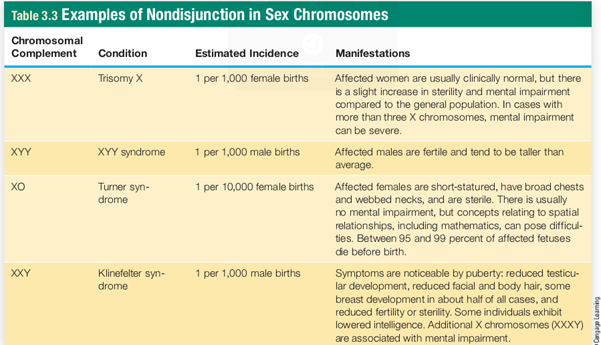
Nondisjunction also occurs in sex chromosomes . For example, a man may have two X chromosomes and one Y chromosome (XXY) or one X chromosome and two Y chromosomes (XYY). Likewise, a woman may have only one X chromosome (X0), or she may have more than two (XXX). Although abnormal numbers of sex chromosomes don’t always result in spontaneous abortion or death, they can cause sterility, some mental impairment, and other problems. And while it’s possible to live without a Y chromosome ( roughly half of all people do), it’s impossible for an embryo to survive without an X chromosome. (Remember, X chromosomes carry genes that influence many traits.) Clearly normal development depends on having the correct number of chromosomes.