The definition of Homo has been enlarged to accommodate all erectus species from Asia, Africa and Europe with only distinctions at the subspecies level such as Homo erectus javanensis (Java), Homo erectus pekiensis (China) and Homo erectus narmadalensis (India).
Phylogentically speaking there is only one genus and one species with different subspecies belonging to different geographical areas, which may differ slightly from each other, but which can interbreed with other subspecies of the same species. The Asian remains assigned to Homo erectus exhibit common morphological characters. The oldest sample of Homo erectus appears in East Africa (dated 1.9 or 1.8 million years ago) while the Asian dates are more of the order of 400,000 to 300,000 years ago.
This genus and species is probably the intermediate evolutionary step between the lower Pleistocene Homo habilis and Homo sapiens. Although the line is still quite hazy but some fragments of the transition can be seen in Africa, Asia and Europe. A minority opinion states that Homo erectus was not on the direct evolutionary line of Homo sapiens and some suggests that human evolution bypassed Homo erectus in Asia. Although this means Homo sapiens arose directly from African Homo habilis but further information and evidences are still awaited to settle this point.
There are 3 view points on this. They are:
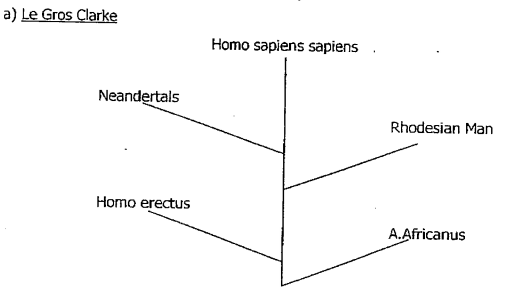
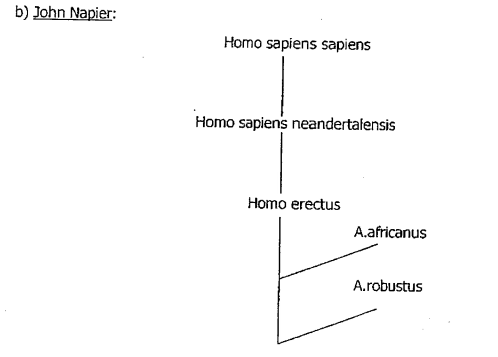
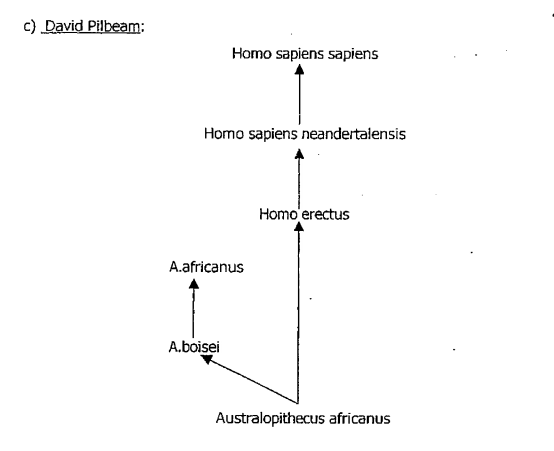
Le Gros Clarke, John Napier and David Pilbeam reanalyzed the fossil material of homo erectus and tried to ascertain their phylogenetic position. All these sittings judged the duration of their existence (homo erectus) as 1.8 million years to 0.20 million years and concluded that erectus was a successfully adapted group.
Prolonged anatomical and archaeological (cultural) stability also point to this fact. According to Pilbeam and others (1992) the abundance of tools, smaller teeth and also the controlled use of fire by the erectus people revealed that they cooked food and prepared it more than the habilis people did and that tool making and its use besides hunting and group living acted as selective forces and favoured the development of memory sites in occipital lobe, thinking sites in frontal lobe and different motor areas in cerebral cortex in the brain thereby enabling the erectus population with symbolic behaviour.