Hardy Weinberg Equilibrium
The Hardy-Weinberg principle was discovered independently by both G.H. Hardy and W. Weinberg in 1908. It is one of the simplest and most important principles in population genetics. The law is a mathematical model that evaluates the effects of reproduction and Mendelian population principles on allelic and genotypic frequencies. This relationship is of basic importance to population genetics because it enables us to describe the genetic content in diploid populations in terms of allele not and not in terms of genotype frequencies. With recent documentation of loci with many alleles or genes or genetic regions with haplotype, this principle has become very important.
The rule has three aspects.
- The allelic frequencies at autosomal loci in equilibrium in a population will not change from one generation to the next.
- The genotypic frequencies of the population are predicted by the allelic frequency.
- The equilibrium is neutral and will be re-established within one generation of random mating at the new allelic frequencies.
The Hardy Weinberg Equilibrium makes several simplifying assumptions about the population and provides key predictions if these assumptions are met.
Assumptions: If the population is large, random mating, and not affected by mutation, natural selection, then:
Predictions: The genotypic frequencies stabilize after one generation in the proportions p2 (the frequency of AA) , 2pq ( the frequency of Aa), q2 ( the frequency of aa), where p equals the frequency of allele ‘A’ and q equals the frequency of allele ‘a’. A large population of sexually reproducing organisms is considered where the organisms are assumed to be diploids (two copies of each chromosome, one received from each parent). The gametes produced by them are haploid (only one of each chromosome pair). Two haploid gametes fuse to form a diploid zygote during sexual fusion and then it grows and develops into an adult organism. For an autosomal locus with two alleles there are two possible alleles, A1 and A2.Organisms with the A1A1 and A2A2 genotypes are called homozygote; those with the A1A2 genotype are heterozygote. The relative frequencies, of the three genotypes in the overall population may be denoted as f(A1A1), f(A1A2) and f(A2A2) respectively, where f(A1A1) + f(A1A2) + f(A2A2) = 1 and are same for both males and females. The relative frequencies of the A and B alleles in the population may be denoted p and q, where p + q = 1. For a locus with five alleles, there is threshold between five allele frequencies and 15 genotypic frequencies. This simplification is particularly useful for a locus with two alleles because it allows us to follow changes in the frequency of one allele instead of the frequency of two genotypes.
An important graphical tool to depict genotype and allele frequencies simultaneously for a single locus with two alleles is the De Finetti. These diagrams are helpful when we examine how population genetic processes dictate allele and genotype frequencies. In both the graph it is apparent that heterozygotes are most frequent when frequency of the two alleles is equal to 0.5.It can be easily deduced from the diagram that when an allele is rare, the corresponding homozygote genotype is even rarer since the genotype frequency is the square of the allele frequency.

Random mating means the absence of a genotypic correlation between mating partners, i.e. the probability that a given organism mates with an A1A1 partner, for example, does not depend on the organism’s own genotype, and similarly for the probability of mating with a partner of one of the other two types.
The Hardy Weinberg law indicates that, when the assumptions are met, reproduction alone does not alter allelic or genotypic frequencies and the allele frequencies determine the frequencies of genotypes.
Genotypic frequencies at hardy Weinberg equilibrium
That random mating will lead the genotypes to be in the above proportions (so-called Hardy- Weinberg proportions) is a consequence of Mendel’s law of segregation. To see this, note that random mating is in effect equivalent to offspring being formed by randomly picking pairs of gametes from a large ‗gamete pool‘ and fusing them into a zygote. The gamete pool contains all the successful gametes of the parent organisms. Since we are assuming the absence of selection, all parents contribute equal numbers of gametes to the pool. By the law of segregation, an A1A2heterozygote produces gametes bearing the A1 and A2 alleles in equal proportion. Therefore, the relative frequencies of the A and B alleles in the gamete pool will be the same as in the parental population, namely p and q respectively.
The gamete pool is very large, when we pick pairs of gametes from the pool at random, we will get the ordered genotypic pairs {A1A1}, {A1A2}, {A2A1}, {A2A2} in the proportions p2:pq:qp:q2. But order does not matter, so we can regard the {A1A2} and {A2A1} pairs as equivalent, giving the Hardy-Weinberg proportions for the unordered offspring genotypes. Importantly, whatever the initial genotypic proportions, random mating will automatically produce offspring in Hardy-Weinberg proportions (for one-locus genotypes). So if generations are non-overlapping, i.e. parents die as soon as they have reproduced, just one round of random mating is needed to bring about Hardy-Weinberg proportions in the whole population; if generations overlap, more than one round of random mating is needed. Once Hardy-Weinberg proportions have been achieved, they will be maintained in subsequent generations so long as the population continues to mate at random and is unaffected by evolutionary forces such as selection, mutation etc. The population is then said to be in Hardy-Weinberg equilibrium—meaning that the genotypic proportions are constant from generation to generation
The relationship well know for Hardy Weinberg equation is p2+2pq+q2=1, where p and q are allele frequencies for a genetic locus with two alleles. In most organisms, random union of gametes is quite unlikely because it is the parental genotypes that pair and then produce gametes that unite. Therefore, let us consider the situation in which reproductive individuals randomly pair. If we consider a diploid organism , there are three possible genotypes in the population- A1A1, A1A2, A2A2-that are present present in frequencies in the P,H and Q respectively(P+H+Q=1). Because all of the alleles in the two homozygotes A1A1 and A2A2 are A1 and A2 respectively, and half the alleles in the heterozygote are A1 and half are A2, the allele frequencies in terms of the genotype frequencies are then:
- p= P+1/2H
- q= Q+1/2H.
Let us assume that there is random mating in the population, which yields nine possible combinations of mating between the male and female genotype as given in table below.
TABLE1-The frequency of different mating types for two alleles at an autosomal locus when there is random mating.
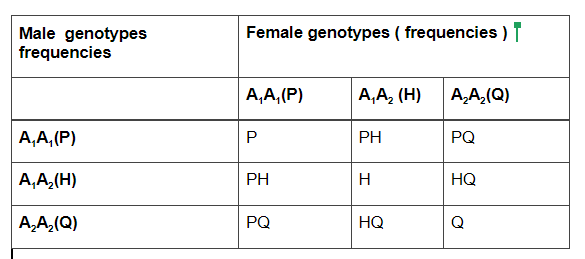
These six mating types, their frequencies and the expected frequencies of their offspring genotypes assuming that gametes segregate in Mendelian proportions. For example, the mating A1A1× A1A1 produces 1/2 A1A1 and 1/2 A1A2 and so on.
Replace A 1= A , A2 = a and A1 frequency with p & A2 frequency with q;
TABLE 2-Demonstration of the Hardy Weinberg Principle Assuming Random Mating In the Parents and Mendelian Segregation To Produce The Progeny
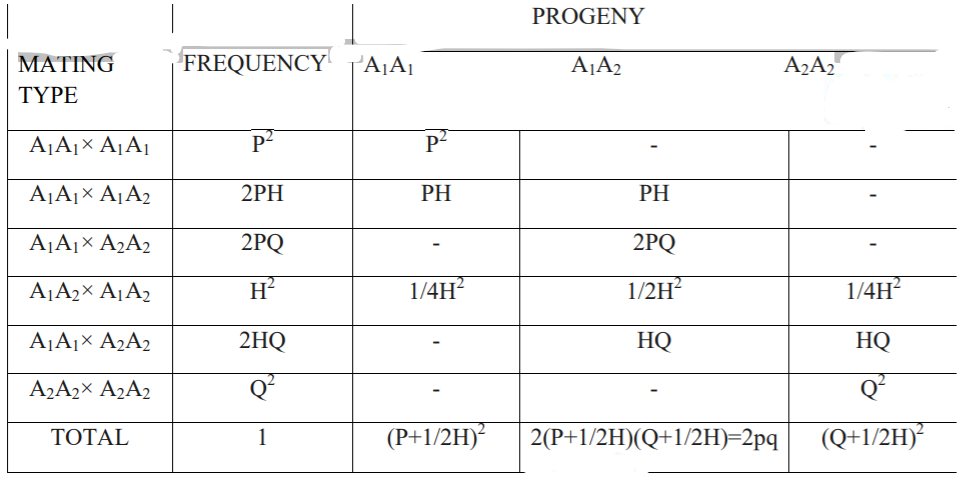
Hardy Weinberg law holds true for any frequencies of A and a, as long as the frequencies add to 1 and all the assumptions are evoked. A population in which the allele frequencies remain constant from generation to generation and in which genotype frequencies can be predicted from the allele frequencies can be predicted from the allele frequencies is said to be in a state of Hardy Weinberg equilibrium for that locus. Genotype proportions may deviate from Hardy Weinberg expectations for several different reasons. The most significant evolutionary factors are selection, inbreeding and gene flow and thus it is often said that hardy Weinberg proportions are expected only in situations in which there is no selection, random mating, and gene flow
Implications of Hardy Weinberg law
When considering the genetic structure of a population, the populations maintaining the Hardy Weinberg Equilibrium has several implications. A significant implication of the Hardy Weinberg relationship is that the frequency of the dominant and recessive alleles will remain unchanged from one generation to the next under given certain conditions.
IMPLICATION 1: a population cannot evolve if it meets the hardy Weinberg assumptions, as evolution consists of changes in the allelic frequencies of a population. Therefore it can be concluded that reproduction alone cannot alone bring evolution. Other evolutionary processes like natural selection, migration, mutation are required for populations to evolve.
IMPLICATION 2: the genotypic frequencies are determined by the allelic frequencies for the populations in hardy Weinberg equilibrium. Considering a locus with two alleles, the frequency greatest for the heterozygote is when the allelic frequencies are between 0.33 and 0.66 and is maximum when the allelic frequencies are 0.5. when the frequency of one allele is low, homozygotes for that allele will be rare and will be present in heterozygote
IMPLICATION 3: In a single generation of random mating produces equilibrium frequencies of p2,2pq and q2 and this fact doesn‘t proves that the population is free from natural selection‘
Extension of Hardy Weinberg law
The Hardy Weinberg principle is also applied to X- linked genes and to genes with multiple alleles. For an X-linked gene such as the one that controls colour vision, the allele frequencies are estimated from the frequencies of the genotype is males, and the frequencies of the genotypes in females are obtained by hardy Weinberg principle to these estimated allele frequencies. In one generation, the genotypic frequencies are at equilibrium when random mating is occurring. If the alleles are X linked and sexes differ in allele frequency, the equilibrium frequencies are approached over several generations as males receive their X chromosome from their mother only, whereas female receive an X chromosome from both mother and father. For genes with multiple alleles, the Hardy Weinberg genotype proportions are obtained by expanding a multinominal expression. To calculate the allelic frequencies from the number of genotypes, we count up the number of copies of an allele by adding twice the number of homozygotes to the number of heterozygotes that possess the allele and divide this sum by twice the number of individuals in the sample.
Validity for Hardy Weinberg Equilibrium:
It is possible to establish whether a population is in Hardy Weinberg equilibrium for a particular trait. Consider a system with two alleles A and a, with three resulting genotypes AA, Aa/aA, aa. Amongst 1000 selected at random, the following genotype distributions are observed.
| AA | 800 |
| Aa/aA | 185 |
| Aa | 15 |
From this data,
The frequency of the allele A (p) = [(2×800)+185]/2000=0.8925 The frequency of the allele a (q) = [185+(2×15]/2000=0.1075
Now consider what the expected genotype frequencies would be if the population is in Hardy- Weinberg equilibrium and compare these with observed values.
| Genotype | observed | Expected |
| AA | 800 | 796.5(p2×N) |
| Aa/aA | 185 | 192(2pq×N) |
| aa | 15 | 11.5(q2×N) |
With observed and expected genotypic frequencies we can compute statistical analysis with a ᵡ2 test to confirm and determine probability that the difference between observed and expected value is matter of chance. The chi-square is computed by the formula
Chi-square (ᵡ2 )= ∑(observed-expected)2 / Expected
= (800-796.5)2 / 796.5 + (185-192)2 / 192 + (15-11.5)2 / 15
= (3.5)2 / 796.5 + (7)2 / 192 + (3.5)2 / 15
= 0.0153+ 0.2525+ 1.0652
= 1.3357
Thus p˃0.05,(p=3.84) the deviation of expected from the observed is not statistically significant.
We can always find allele frequency from Hardy Weinberg law, if we assume that the genotypes in the population are found in Hardy Weinberg equilibrium.
Factors effecting equilibrium
Five factors can change genotype frequencies – nonrandom mating, gene flow, genetic drift, mutation, and natural selection.
Applications of Hardy-Weinberg Law Population Genetics
More precisely, Hardy-Weinberg equilibrium postulates a set of conditions where no evolution occurs. If all the conditions are satisfied, allele frequencies will not change (that is, no evolution will take place) and a permanent equilibrium will be maintained as long as these conditions prevail. However, it is obvious that the Hardy-Weinberg ideal population can never be found in the real sense in human populations. First, the formula provides a standard against which genetic change in a population may be measured and predicted. The formula serves as a basic theorem which can be expanded and elaborated by other mathematical models that deal with changes in populations (Jurmain et al 1998). Secondly, the Hardy-Weinberg formula may be applied to large populations to provide an estimate of gene frequencies at a single point in time. Microevolution reflects changes in allele frequencies in populations. It is not occurring if allele frequencies stay constant over generations (Hardy-Weinberg equilibrium).