Introduction of Cross-Cousin Marriages:
Studied Generations of anthropologists preferential marriages such as a those with cross-cousin to understand their actual implications. However, it was Levi-Strauss (1949), who tried to lay bare the structural factors favoring the symmetrical and asymmetrical preferential marriages. Malinowski (1929), on the other hand, brought to light the social-cultural psychological basis of patrilateral cross-cousin marriages. G.Homans and David M. Schneider (1955) visualized the psychological foundations of patri and matri-cross-cousin marriages.
A) Levi Strauss : Structural implications
Levi-Strauss chooses incest taboo as the starting point of his discussion. According to him, among animals , mating is random and promiscuous, while incest taboo by its very nature dictates an ordered exchange of women, thus instituting marriage rules. The marriage rules lead to exogamy. A cycle of reciprocal exchange is set in motion. A system appears whereby kin groups are linked by rule of prescriptive or recurrent marriage and the groups remain in an affinal relationship to one another across generations. Thus form the alliances.
Levi-Strauss argues that one basic function of all trade and exchange in human society is to promote social solidarity through interdependence; women constitute the most important and most highly valued commodities that people exchange Therefore, when people generate and perpetuate alliances the exchange of women assumes special importance and how the exchange is accomplished determines the kind of social integration that is achieved.
Symmetrical cross-cousin marriages are examples of restricted exchange and mechanical solidarity. In these marriages the exchange is restricted to two groups. The exchange is direct structured and symmetrical. Two groups of brothers exchange their sisters. The result of this consistent exchange is that one’s wife is simultaneously one’s cross cousin, and , furthermore, that cross-cousin marriage is necessarily symmetrical since one’s wife can be either a matrilateral (MoBrDa) or patrilateral (FaSiDa) cross-cousin. The participating groups become affinally related, but the linkage is presumably not as firm as it might be were a different system of exchange to be adopted because the exchange of women is completed, and balance is achieved in the space of a single generation, The exchange of women may tie the groups more tightly to one another but it is not a strong integrating principle, The diagram given below shows that group A gives its women to group B and receives the women from group B. Each group is a giver as well as a receiver of women with respect to another group, In terms of division of labour and function they are similar. Therefore, it creates mechanical solidarity.
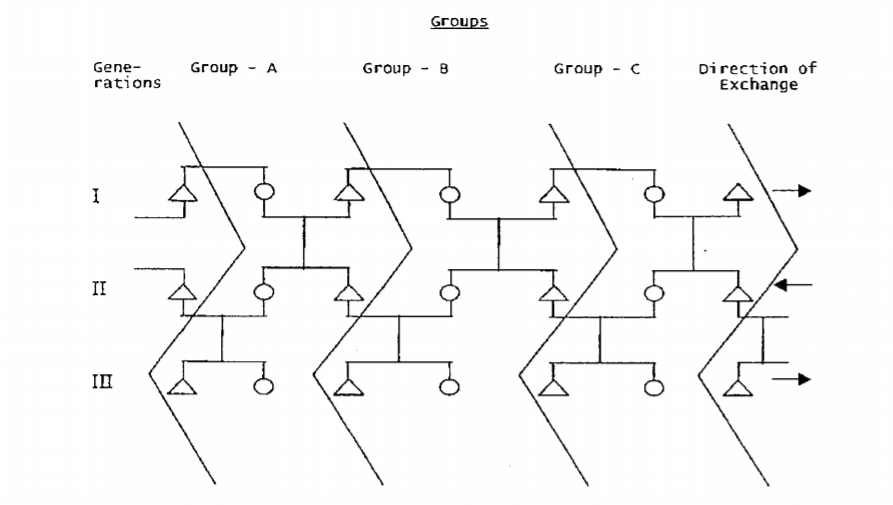
According to Levi-Strauss, a patrilateral cross-cousin marriage system in a matrilineal society is like the symmetrical cross-cousin marriage system. Below diagram demonstrates that in a matrilineal society, the groups A, B and C exchange women in opposite directions. In the first generation A gives brides to B, B to C. in the next generation the direction of exchange is reversed and in the third generation the direction is again reversed, a balance of exchange is achieved among groups in the course of two generations .The groups involved in the exchange are functionally equivalent and unspecialized for they are all both givers and receivers of women with respect to each other. Therefore mechanical solidarity results as in the case of symmetrical cross-cousin marriages.
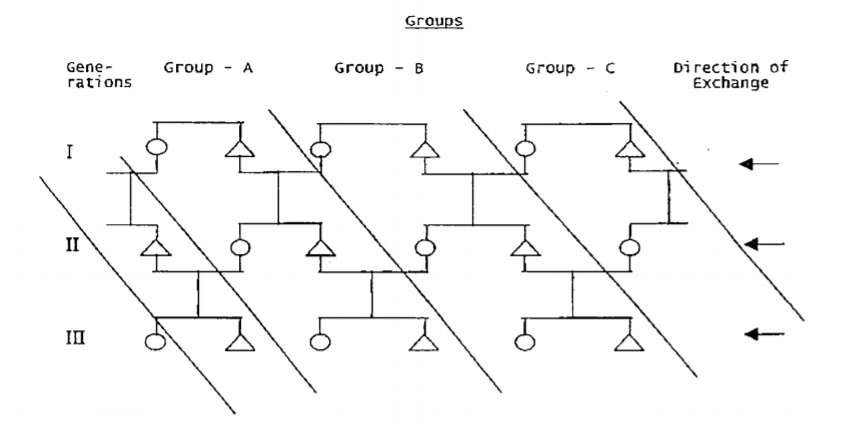
Levi-Strauss points out that the matrilateral cross-cousin marriages in patrilateral societies generate organic solidarity. In a patrilineal society men consistently marry their matrilateral cross-cousins. This entails specialization of function between groups. In these societies generally wife receivers in inferior to wife givers and the girl in reverse does not allowed because she came from inferior family. B s always give women to As but take their wives from C s, and the marriage system as a whole is organically integrated. The cycle of exchange is never completed. One group is always interlocked firmly with another because the interdependence is greater. The system as a whole creates firmer integration of society. The development of human society has evolved a process of increasing societal complexity in terms of increased specialization and interdependence. Consequently, matrilateral cross-cousin marriages are more in number than patrilateral and symmetrical cross-cousin marriages because they stimulate better social interaction. In other words the matrilateral option is exercised more commonly because of the selective advantages it confers in the struggle of societies for survival.
B) Malinowski (1929): psychological basis of patrilateral cross-cousin marriages
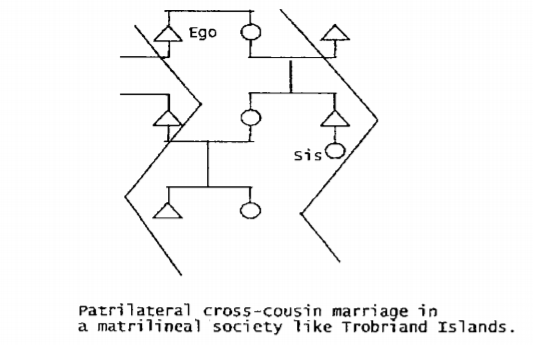
Bronislaw Malinowski proposes a different explanation for the fact that patrilateral cross-cousins are as frequently preferred as spouses in societies in which descent is traced exclusively through females. According to him, in matrilineal societies like Trobriand islanders as estate has to be passed on by a man to his sister’s son. But no man really wants to pass on his property to his nephew, he would rather pass it to his own son. thus in matrilineal societies there exists a fundamental conflict between the principle of descent and paternal desire and patrilateral cross-cousin marriage alleviates this contradiction somewhat by allowing a man to pass his estate to his son’s son through his sister’s son. Thus Malinowski proposes a cultural-social-psychological basis of patrilateral cross-cousin marriages in a matrilateral society.
C) G.Homans and David M. Schneider (1955) : psychological foundations of patri and matri-cross-cousin marriages.
More recently G.Homans and D.M.Schneider like Malinowski before them noted the special relationship between the cross-cousin marriage and patrilineal descent on the one hand and patrilateral cross-cousin marriage and matrilineal descent on the other, and proposed a psychological basis for The linkage.
According to them, in a patrilineage society authority is provided by a father while a mother is considered indulgent. AS children grow, sentiments developed with respect to each parent are extended to include the siblings of their parents. Thus, attitudes developed with respect to one’s mother are extended to her brother and he too is indulgent figure. Marriage with a matrilateral cross-cousin is one expression of the particularly warm relationship between a man and his maternal uncle in patrilineal societies. On the other hand of Cross-Cousin Marriages, in matrilineal societies authority is provided not by a father but by the mother ’s brother. A maternal uncle is interested is his sister’s children because they, and not his own children, are members of his descent group, He must concern himself with the upbringing of his nephews and nieces but he can afford to be quite indulgent towards his own children, The attitudes a child develops with respect to an indulgent father are extended to his paternal aunt and to her children and marriage with one’s patrilateral cross-cousin supposedly reflects this extension of sentiments.
There are many problems with this interpretation, Needham (1962) said that it assumes a questionable and certainly unproven psychological process: the extension of sentiments from primary to secondary relatives. Murdock (1957) pointed out that most patrilineal societies do not in fact have matrilateral cross-cousin marriages and most matrilineal societies lack patrilateral cross-cousin marriages.