Like non- ceremonial distribution, ceremonial gift exchange consists of an initial transfer of goods which in the short run appears as a one-sided give-away, but in the long run leads to a deferred counter-transfer. Unlike non ceremonial distribution, however, ceremonial gift exchange often involves ritual items not intended or suitable for consumption (e.g., shells in Melanesia, copper dish among the Kwakiutl), and gives rise to symbolic or incorporeal returns (e.g., political support, esteem, courtesy, fealty , friendship). Indeed, the term “prestation” is preferable to “gift” in this context, because an initial ceremonial transfer-circumscribed as it is by various religious, political, and ritual sanctions often is not voluntary and always creates the obligation to return. As Mauss (1954) emphasized in his seminal essay on the relationship between gifts and return gifts (see also Panoff 1970), the most compelling force toward reciprocation by the recipient of a given donation is the fact that he is minister to the magister donor until such time as he reciprocates. Failure to reciprocate results in social disapproval and loss, of prestige.
Ceremonial prestations regularly occur in all societies, but quantitatively (e.g., volume of goods traded) and functionally (i.e., role in the economy and elsewhere) they are considerably more important in primitive and peasant societies, where they are often associated with life cycle celebrations or feasting related to other social or political events. Mauss’s study, for example, includes illustrative cases of ceremonial prestations in Samoa, New Zealand (Maori), the Andaman Islands, Melanesia, northwest North America (Kwakiutl, Tlingit, Haida), ancient Rome, the Hindu classical period, and feudal Germanic societies.
In any society a prestation cycle is based on three kinds of obligations: to give, to receive, and to repay or return. In primitive and peasant societies, various cultural and situational pressures encourage the individual to give gifts to others. For example, among the Zapotec-sp-caking peoples of the valley of Oaxaca, where an ancient reciprocity system known as guelaguetza still operates (Beals 1970), individuals occupying certain social statuses vis-a-vis ego (consanguineal or affinal kinsmen, fictive kinsmen, neighbors, friends) will suffer disapproval or loss of prestige if they fail to cooperate when he asks them for a donation. The obligation to give, on the other hand, carries with it an obligation to accept a donation when it is offered. A refusal of the donation is tantamount to a rejection of social relations, and might be interpreted as a declaration of hostility. Finally, the obligation to return the donation closes the prestation cycle. In the Zapotec case, the recipient is required to reciprocate in kind when the donor requests him to do so. This requirement is reinforced by an accounting procedure according to which the exact specifications of the donation are measured and recorded in an account book, which is consulted when the counter donation is subsequently offered. Failure to reciprocate with an equivalent donation when requested to do so may result in the intervention of local political or judicial authorities and the levying of a fine on the reneging party. However, the usual pattern in Zapotec society is for any donation to be reciprocated with “interest” or on an incremental basis (e.g., a turkey weighing ten pounds is reciprocated with one turkey weighing twenty pounds or two turkeys weighing more than ten pounds; ten dozen eggs are reciprocated with twenty dozen eggs and four kilograms of chocolate). This practice can be viewed not only as a response to the prestige associated with generosity but as a means of saving, as well as a means of extending the inter household donor/recipient -recipient/ donor relationship indefinitely. Of course, when a donation is reciprocated equally (without increment) the former economic equilibrium between the two households is restored and the future prestation potential is maintained.
Case study : Kula ceremonical Exchange (Trade)
Kula ceremonical trade was presented by Malinowski in his text Argonauts of the Western Pacific(1922). In Melanesia , some islands have food surplus but shortages of tools. Some other islands have surplus tools but shortage of food . No island has the skills to produce all the goods to be consumed, Under these circumstances one island depends upon other island to get the required items, This created the kula exchange..

The participants in Kula system are men. They are inhabitants of single village or neighbouring village.The participants shall have adequate knowledge of magic and hold recognized posts in villages. Sister’s son’s become members of maternal uncle’s group. Once in Kula is always in Kula. The chief bears the expenses of Kula generation and provides guidance to Kula travelers.
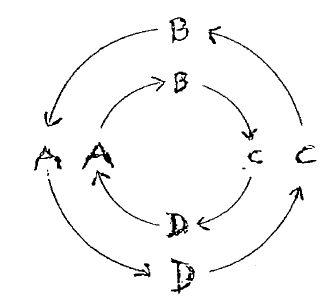
The leaders exchange the ceremonial objects namely Soulava(necklaces) and Mwali(bracelets). Those with Soulava move in clock wise direction and those with Mwali in anti clock wise direction. There will be no direct lines of connection between A and C, A and D. A gives Soulava to B and A receives Mwali from B. A gives Mwali to D but receives Mwali from D. As such there is no direct exchange of goods between A and C.
When the leaders are exchanging the ceremonial goods, their fellowmen will be engaged in barter activities They exchange their goods for the goods of others. in this context, considerable bargain goes on.
Magic is performed in five stages in Kula exchange
1.Canoe building and preparation (6 months): remove wood spirits, launching.
2.‘Softening’ the partners, making them generous (rites before the major expedition)
3.Prevent shipwreck.
4.In the event of a shipwreck.
5.Rites to impress the trading partners.
Thus, Kula system serves the following functions:
- a) Indicates status of individuals who are parties to the transaction.
- b )Creates peaceful atmosphere for affecting the barter system.
- c) Provides congenial atmosphere for renewal of friendship and for creation of new partners.
- d) Provides an opportunity for canoe making , recreational activities – and learning of magical skulls.
- e) Keeps the partners in ever lasting obligations of reciprocity and exchange of material goods.
Case study : Potlatch
Just as the Trobriand kula is a particularly well studied example of an institution that is found over a very wide area of Melanesia, so the potlatch of the southern Kwakiutl of British Columbia is the most fully documented instance of an exchange system that is characteristic of four groups of the American north-west, the Haida. Tlingit, Tsimshian, and Kwakiutl.
‘Potlatch’ means ‘give’, and in principle of a counter-gift was important in this institution as in the kula. But it had significance beyond that of linking pairs of individuals in a relation of friendship. A potlatch was a public distribution of goods made both to establish certain claims of the giver and to recognize the claims of the recipients. The Kwakiutl had an elaborate ranking system which placed every man in order according to his degree of closeness in descent to the remotest remembered ancestor. The line of eldest sons was senior and provided the chiefs of the different descent groups. Chiefs had special ritual privileges- titles and the rights to use songs, dances, carved mask, and so forth. But in order to demonstrate his claim to these that is the claim to be a chief a man had to give a potlatch at which he recalled the famous potlatches and other deeds of his ancestors, and made the distribution to his guests in strict order of rank. Thus, he proved both that he has the command over enough wealth (contributed by his descent group as a whole) to be given away and that he was properly informed about the accepted order of rank. As the Kwakiutl came to earn money and so acquire wealth from outside the system, lesser men began to potlatch and now it became the rule that a man who had previously made a present to the giver should get a larger gift in return, even if this was out of proportion to his rank order. Rivals for a title or for precedence would assert their claim by trying to outdo each other in the amounts they distributed.
Another way-in which the Kwakiutl used their property is a manner that might be considered ‘uneconomic’ was in what has been called the ‘rivalry gesture‘. Among their prized objects were large shield-shaped plaques of copper which- like the kula valuables were used only in potlatch exchanges. The rivalry gesture consisted in publicly destroying such an object; this act is committed by an enemy as an act of revenge or to humiliate. It put him in a worse position than the receiver of a gift who had later to make a return since he received nothing. Such gestures might be made at a potlatch where they got the maximum publicity, but they were not an integral part of the potlatch ceremony. Nevertheless they had in common the principle that material goods may be used deliberately and with calculation to attain non-material ends. The potlatcher ‘buys’ recognition of his status; the destroyer of a ‘copper’ ‘buys’ the humiliation of a rival. Both must certainly give much thought to the allocation of their resources.
As Mauss pointed out, one can find analogues of kula and potlatch in many such societies. The Mandari of the upper Nile, who were lesser known to ethnographers, illustrate the characteristic features of both. Mandari chiefs exchange valuables with their fellow chiefs, not in a fixed order as with the kula, nor with the same elaborate preparation; this is not necessary, as their journeys are made over dry land. These exchanges do not apparently create permanent partnerships or rivalries (the latter word was used by Jean Buxton, who studied these people) between pairs of chiefs. A chief who has seen a fine weapon in another’s house makes a formal visit to ask for -it, bringing with him a band of retainers with presents of a more everyday kind, food and tobacco to distribute in his rival’s house. Later on, a return visit is made to demand a return gift. It is noticed here that the calculation of equivalence is not left to the giver. But the potlatch principle is operative in that he who refuses to give what is asked is shamed; he is said to be ‘afraid’ and is an object of ridicule. Another Mandari custom is for a band of youths to go to the home of a neighbouring chief and offer to honour him with a dance, for which they will expect to be rewarded with gifts like bulls and spears, earlier but now bulls and money. This is not a challenge in the sense that the youths are in competition with the chief, but there is the obligation to return a service which has not been solicited but cannot be refused without loss of prestige.
In Africa, as in many other parts of the world, the most conspicuous way in which social relationships are created by transfers of property is the payment which legitimizes marriage. This can be described as an exchange of goods for women; to Levi-Strauss it is a substitute for an earlier direct exchange of women. But as the chapter on marriage has argued, it is certainly not the type of once-for-all transaction that we think of when we speak of a sale; on the contrary, it initiates a permanent relationship between the givers and receivers of the bride wealth, other types of relationship rest on the exchange of cattle alone, and in that respect are analogous to the kula. The Turkana of northern Kenya establish, friendships with individuals by gifts of cattle in remote parts of the country through which they wander with their herds. On his home ground the partner in such an exchange is an ally and protector to his fellow. Here-again there is no formal arrangement for making the return gift; it may be made at the initiative of the giver, or asked for by a partner who is in some urgent need, notably for bride
wealth cattle. As the Turkana move about in small bands through their inhospitable country these transfers are made with the minimum of publicity, and there seems to be no sanction of shame or ridicule against the man who fails to make a gift when it is his turn; indeed sometimes it is necessary to refuse a partner because a close kinsman, whose claim is stronger, is also asking for help, simply, if a gift remains too long unreciprocated, the friendship lapses.
These exchanges maintain partnerships between equals. In other cases a gift which cannot be repaid in kind creates a relationship of inequality, and in societies where political authority is not vested in recognized offices the deployment of superior wealth is one of the roads to leadership. A leader must have the qualities considered appropriate to the role, but he must also be in a position to put others under obligation to him, In this case he will not seek out persons on whom to confer gifts but will render help to those in need, and they, if they can make no material return, will become his ‘henchmen’; either in the full sense of being available to work for him when he needs them or in the narrower: sense of simply giving him their support in public discussion.
The procedure and values of gift exchange may operate also in peasant societies where value for exchange purposes is regularly measured in terms of money. The making of feasts that is, in effect, the distribution of food on a lavish scale to celebrate significant occasions in people’s lives, notably marriages, seems to be characteristic of all societies, and ‘entertaining’ without any such specific justification is characteristic of many. In non-monetary economies the distribution of the food itself constitutes the economic aspect of the feast; in industrialized societies this kind of distribution is an infinitesimal part of the giver’s total economic activity. But there is an intermediate stage where the continuing exchanges created by reciprocal feasting include money as well as goods. When a Malay peasant in Kelantan gives a feast the guests, most of the people who have previously entertained him, bring presents of money. The host expects that these will amount to more than the outlay on the feast; indeed, a man often gives a feast when he wants to raise cash for some heavy item of expenditure such as a new fishing net. Firth has described these feasts as a means of calling in credit. Everyone who has earlier received a similar money contribution from the host is under a social obligation to attend the feast and bring his gift. But this procedure is quite different from pressing for the repayment of a loan. There is no legal obligation to return the equivalent of what was originally received, or indeed to return anything at all. The procedure is what would anywhere be associated with the making and returning of gifts. Sometimes the host makes a glossary of his outlay for the gifts. The ways of using property which have been described might indeed suggest to a superficial observer a failure to appreciate the value of material possessions. People whose major preoccupation is accumulating vast stocks of blankets just to give away, people who keep ‘open house’, people like the Swat chief who was said to come down to his men’s house with his shirt full of coins to hand out to whoever was there, in western society would get the name of spend thrifts. A leading economist has called the potlatch a ‘deviation from the acquisitive behaviour of competition’. But whatever may be said of the potlatch, there is nothing reckless about the long-term; elaborate preparations that are made for it; and other types of ‘free’ distribution are not reckless or irrational either. In this kind of transaction people ‘buy’ if one likes to use the word, honour and power; and though honour and power are not material goods, most men account them good. In societies of simple technology people allocate their resources among various possible ends on a different scale of priorities from that to which the western business world is accustomed, but they allocate them consciously and rationally. Firth has written in a discussion of gift exchange from the economist’s point of view: ‘It is possible to conceive of an economic system in which the items of productivity, of concern in maximization, are status tokens and symbolic ties.’ Of course, as he also makes clear there is no actual economic system in which property is valued solely as a source of status, whether this is gained by possessing and displaying it or by giving it away. But this way of describing institutions of competitive gift exchange brings home the fact that they are not illustrations of inability to make economic calculations, but the very opposite.
In many societies more wealth circulates in transactions which are as much social and political as economic-payments of bride wealth and blood wealth, gifts to create and maintain friendships and alliances, tribute to superior authorities than in trade or barter where commodities are exchanged by a process of bargaining with overt calculations, however rough, of their relative value. But there are others in which barter is recognized and differentiated from gift exchange. The Trobriand Islanders have a word for it is called gimwali. It may be conducted on various occasions. Makers of wooden objects, men from inland villages where there are more trees for their raw material, visit the coast and hawk them around for coconuts and fish. Sometimes coastal people visit these villages to look for some object they need. On kula voyages people barter such goods for the special ties of the islands they visit, but a man must barter with his own kula partner only.