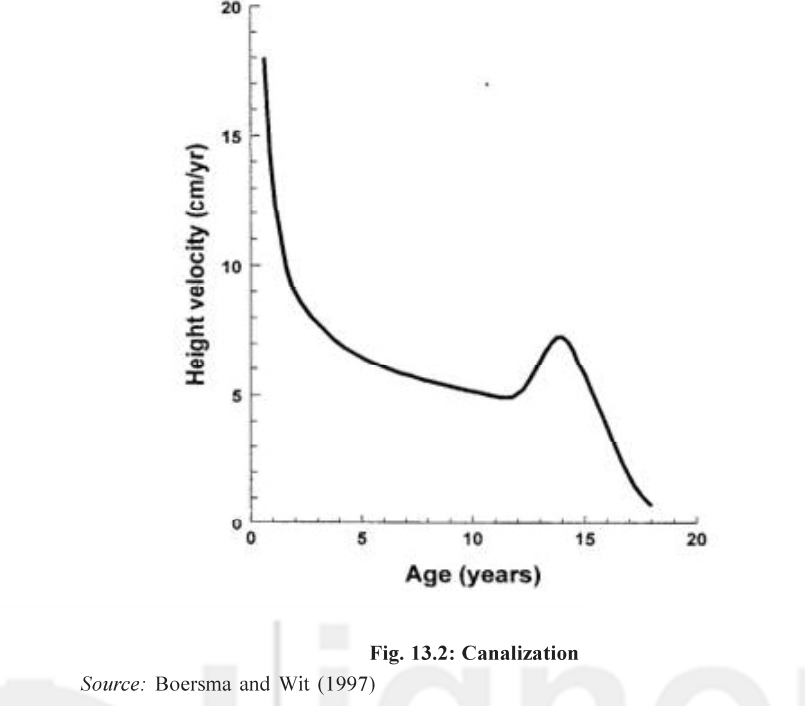
It is true to say that all children, when in an environment that does not constrain their growth, exhibit a pattern of growth that is more or less parallel to a particular centile or within some imaginary ‘canal’. This phenomenon was described by a British geneticist, C. H. Waddington, in 1957 and has been termed
canalization or homeorrhesis. It is most likely that this pattern is genetically determined and that growth is target seeking, in that we have a genetic potential for adult stature and the process of growth, in an unconstrained environment, takes us inexorably toward that target (Cameron, 2002).
As shown in figure 13.2, a high velocity from birth with a rapid deceleration up to about 3 year of age is observed, followed by a period with a lower and slowly decelerating velocity up to puberty. Puberty starts with an increased velocity and after the age of peak velocity a deceleration is observed until growth ceases. Taking into account its irregularity in the long term, linear growth must be under the control of a dynamic and complex system that makes the growing child return to its path of growth after deviation. This tendency to keep a narrow and predictable track of growth has been called “canalization” and is a prerequisite for catch-up growth (Boersma and Wit, 1997).