Anthropology of Preferential Marriages:- Marriages between kinsfolk are common in primitive societies. In Australia, it is a common practice that a man must marry a kinswoman since he is related by bond of kinship . According to their tradition many of the primitive societies prefer certain relatives who as mates by choice in selecting them. These preferential mating may be classified as follows:-
- (1) Cross-cousin marriage.
- (2) Parallel-cousin marriage.
- (3) Uncle – Nice marriages
- (4) Levirate.
- (5) Sororate.
- (6) Filial inheritance.
1. CROSS COUSIN MARRIAGE Anthropology of Preferential Marriages.
It is a kind of marriage which means marriage of a man with either his mother’s brother’s daughter or his father’s sister’s daughter. This is popular and orthodox type of marriage among the tribal communities of India. But marriage with mother’s brother’s daughter is more common.
Anthropology of Preferential Marriages, This type of marriage is found to be prevalent among most of the tribes of North-East India such as the Garos, the Khasis, the Kukis, the Karbis, the Noctes, the Nagas etc. The Gonds, the Oraons, the Baigas and some other tribes of the rest of India practise this type of marriage.
Virtually all the tribes of North and Central Melanesia practise crosscousin marriage. It is also practised in Ceylon (Sri Lanka), Australia, Polynesia, South and East Africa, Siberia etc.
There are two types of cross-cousin in Anthropology of Preferential Marriages: (a) Symmetrical and (b) Asymmetrical.
When both mother’s brother’s daughter and father’s sister’s daughter are acceptable as a mate, it is called a Symmetrical cross-cousin marriage. It is also termed as bilateral cross-cousin marriage. In Assam symmetrical cross-cousin marriages are prevalent. Similarly the Dravidians practise symmetrical cross-cousin marriage.
Asymmetrical cross-cousin marriage is the one according to which, marriage is preferred with either mother’s brother’s daughter or father’s sister’s daughter and not with both. That is if one marries mother’s brother’s daughter, he cannot marry father’ sister’s daughter and vice versa. Marriage with mother’s brother’s daughter is called Matrilateral cross-cousin marriage and that with father’s sister’s daughter is termed as patrilateral cross-cousin marriage.
The Trobriand Islanders of Melanesia permit marriage only with father’s sister’s daughter. The Murngins of Australia and the Miwork of California practise asymmetrical cross-cousin marriage. Cross-cousin marriage is the only form of exogamy under dual organization of a society.
Cross-cousin marriages are often devised as a balance against the high bride price, the bargaining of price is often minimized among the familiar kin. Moreover, the amount lost in paying bride-price for getting a bride is regained in due course when a girl from his family has to be given in marriage to the same family. The simple implication here is that the bride-price paid for A’s marriage would be returned to his family when a daughter would marry her mother’s brother’s son. The Gonds of Madhya Pradesh express mother’s brother’s daughter as ‘dudhlautawa’, i.e., return of milk. The rules of prescribed marriage mean that these will be necessarily followed and these will be adhered to so rigidly that there will be no exception possible. The more a society developed, the more will be difficult to cope with the system and one may like to take concession.
2.PARALLEL-COUSIN MARRIAGE:
It means the Anthropology of Preferential Marriages of man with either his father’s brother’s daughter or mother’s sister’s daughter. It is prevalent among the Semitic Arabs and also found amongst the Muslim of India. It is also practised by the Riangs of Tripura. It has been said that marriages with close relatives lead to fewer number of issues. That is why marriage of this kind is discarded in many societies.
parallel-cousin marriage: In our country this type of marriage among the Muslims, women traditionally inherit the property, perhaps to control the property devolution, they preferred parallel-cousin marriage. Again, among the Bedwins of Arab, this type of marriage is very popular. The Bedwins is a nomadic people. Such marriages help to keep their males within the band and so manpower is protected for fighting and other purpose of defence.
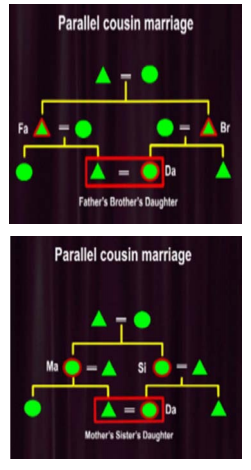
Usually in a community, Anthropology of Preferential Marriages where cross-cousin marriage is allowed, parallel-cousin marriage is forbidden. A man maintains formal as well as respect full relationship with his female parallel-cousin. Joking relationship prevails only among the cross-cousin. Significance of joking relationship lies in the possibility of marriage, whereas respectful relationship indicates rigidity of the incest taboo. In most of the societies of the world parallel-cousin marriage is prohibited.
3.Uncle-Nice Marriage
This is the Anthropology of Preferential Marriages in some societies , here one man marries his sister daughter . In this marriages two generational persons unite , mostly occurred in South India states.
4.LEVIRATE (Latin-Levir means husband’s brother):
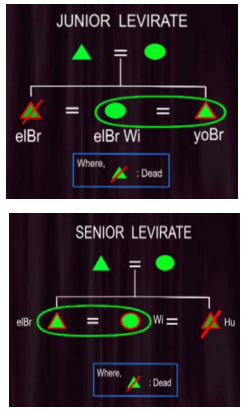
When a widow marries her brother-in-law (deceased husband’s brother) this system of remarriage is known as Levirate. This is practised by the natives of Australia, the Biblical Hebrews, the Incas, the Muslims of India, the Kukis, the Lushais, the Nagas, the Karbis, the Vedas etc. In patrilineal societies, after the death of a man, his heir is his brother who not only succeeds to his status and responsibilities, also inherits all the possession of the deceased brother, including his wife or wives. Levirate consists of two types, Junior Levirate and Senior Levirate.
Junior Levirate: When the younger brother marries the wife of his deceased elder brother, it is known as junior levirate. Anthropology of Preferential MarriagesThis is found to have been practised by Australians; the Biblical Hebrews, the Incas, the Muslims of India the Kukis, the Lushais, the Nagas, the Karbis and the Veddas etc.
Senior Levirate: When marriage takes place between the widow and elder brother of the deceased husband, it is called Senior Levirate. The Bhumijas of Orissa, the Hos, the Panions (south India), the Kirghiz, the Turks, the Mongloids etc. practise this system of marriage.
The custom of Levirate is regarded more as a duty than as a right. The nearest relative is obliged to care for the widow left with children, land and herd. In some societies the children of the new couple are regarded socially as the children of the dead man.
Note : Niyoga in Mahabharatha and Manusmriti in ancient Hindu society.
5.SORORATE: (Latin, soror means sister):
In sororate a bereaved husband marries his deceased wife’s sister. That is, a girl marries her deceased sister’s husband. In some cases it is mandatory and in others, it is performed on permissive basis. Like Levirate, Sororate is also of two type in Anthropology of Preferential Marriages
(i) Senior sororate and
(ii) Junior sororate.
Senior sororate: When the bereaved husband marries his deceased wife’s elder sister, it is called Senior Sororate and it is very limited in its distribution.
Junior sororate: When the bereaved husband marries his deceased wife’s younger sister, the system of marriage is called the Junior Sororate, which is prevalent in many parts of the world. Hindus, Muslims, and many tribes of India are found to practise sororate.
It is practised by virtually every tribe of North America outside the Pueblo area and is found widely distributed throughout the world.
Sororate is sometimes mistaken for Sororal Polygyny. Under the true sororate a man is married to one sister at a time. But, in sororal polygyny a man is not required to wait for the death of his wife to marry her younger sister. He asks her hand when she comes of marriageable age. In this way he can marry several sisters at a time. High rate of bride price generally leads to difficulties in securing mates, which results in sororate marriage. Younger sister of the deceased girl is given to her husband as a compensation for his loss. Both levirate and sororate signify interfamilial obligation and cordiality.
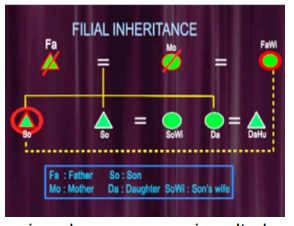
6.FILIAL INHERITANCE:
When a brother or a son is permitted to inherit the secondary wives of the dead man, it is called Filial Inheritance. The Incas are found to have observed this custom. In case of the son, he generally inherits the wives of his dead father other than his uterine mother. This is practised by the Sema Nagas. Filial inheritance is possible only where there is polygamous marriage. It also helps to keep the woman in the family. In this context we should know that, in a few societies son was found to inherit father’s all wives, except his own mother. This is known as filial widow inheritance. Example of this remarriage is found among the medieval Mongols. The Sema Nagas also exhibits the same practice.