Anthropology is a comparative and integrated discipline. Anthropological
research examines all the societies, simple and complex. Anthropological
research has two purposes:
to collect and record descriptive data about a particular society and
culture. Also called ethnography.
to do a comparative study of different cultures (cross-cultural
comparison). Also called ethnology.
In comparative approach, a research anthropologist studies a culture or society
at two different point of time. Recognizing that the cultural system of a
people is constantly changing, anthropologist have divided studies into two
parts:
studies that describe a culture at one period in time (synchronic study).
studies that describes the changes in culture of a people over time
(diachronic study).
In the earlier sections we have discussed how anthropologists collect data on
society and culture using fieldwork method and conduct ethnographic studies.
However, anthropologists are not interested in merely describing particular
cultural systems and the range of variability they display. They are also
interested in attempting to explain why these differences exist. In other
words, anthropologists are interested in making generalizations of cultural
systems. And generalizations cannot be made based on the study of a single
society. For this type of research anthropologists use the comparative method
to study generalizations among many societies in a systematic way.
Comparative method is the method of the comparison between different
societies, groups or social institutions. The objective of this method is to
investigate whether and why the societies under observation are similar or
different in certain aspects.
Ethnology is a branch of social cultural anthropology that conducts research
on comparative study of different cultures. Cross-cultural comparison refers
to the method of studying cultural phenomena across cultures of the identical
period. In this particular branch, a researcher collects descriptive data from
different societies and then analyzes, interprets, and compares the results of
ethnography. These data are used to compare and contrast and to make
generalizations about society and culture.
The history of cross-cultural comparison dates back to the late 19th century
when E B Tylor and LH Morgan who developed unilineal evolution theory
also called cultural evolution (the idea that cultures evolved in a progressive
manner, from simple to complex). In anthropology this is the first systematic
ethnological theory explain diversity among peoples of the world. However,
there were some serious methodological problems in this early comparative
research which resulted in the abandonment of this approach. Later this
approach was modified by G. P. Murdock who stated that Culture and its
peculiarities cannot be adequately understood simply by studying single
cultures. Cultures should be compared with one another in order to interpret
the similarities and differences across various cultures.
Historical Approach
Historical approach refers to studying a phenomenon in historical sequence
and hence it facilitates comparison across time. Franz Boas, “the father of
American anthropology,” is the founder of historical approach. Boas pointed
at the limitations of comparative method and suggested using comparisons
within a small well-defined geographical area. Historical method is primarily
concerned with the past and attempts to trace the past as a means of
understanding the present.
History is the study of the past and nobody can negate history. Boas was of
the notion that each and every culture has its own separate past and each
culture is “one of a kind”— that is, different from all others. Each society
and culture has its own particular set of circumstances such as geography,
climate, resources and particular cultural borrowing. Because each culture
was affected by almost everything that had happened to it in the past, and
because different things had happened to different cultures, each culture is
unique. Evans Prichard has also emphasized on the importance historical
approach in anthropology. He argued that that functioning of society cannot
be understood without understanding its history. Hence, if anybody wants to
study the origin and development of society and culture and how its social
institutions have evolved, a historical approach is the only option.
The historical method have been definitely influenced by principles of
biological evolution. This method studies social institutions in the background
of whole human history. History of Human Marriage written by Westermark
presents an excellent example of study in historical method. This excellent
piece of work describes the gradual evolution of the institution of marriage.
In the early 20th Century American historical approach, which was a reaction
to the deductive approach, began under the leadership of Franz Boas.
According to Boas, anthropology was on the wrong path. He was of the
view that rather than dreaming of large, all-encompassing theories to explain
why particular societies are the way they are, Boas want to put the discipline
on a sound inductive footing; that is, Boas planned to start by collecting
specific data and then move on to develop general theories (Ferraro and
Andreatta, 2010).
In this way in anthropological research deductive and inductive approach
developed. The main differences between the deductive and inductive
approach is given.
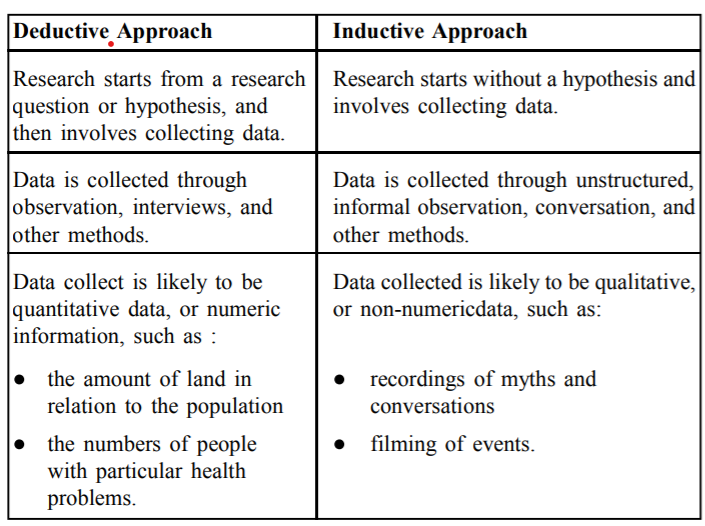
Most anthropologists, combine deductive and inductive approaches and
quantitative and qualitative data to varying degrees.
“In the early years, ethnographers were interested in exploring entire cultures.
Taking an inductive approach, they generally were not concerned about
arriving with a relatively narrow predefined research topic. Instead, the goal
was to explore the people, their culture, and their homelands and what had
previously been written about them. The focus of the study was allowed to
emerge gradually during their time in the field. Often, this approach to
ethnography resulted in rather general ethnographic descriptions. Today,
anthropologists are increasingly taking a more deductive approach to
ethnographic research. Rather than arriving at the field site with only general
ideas about the goals of the study, they tend to select a particular problem
before arriving and then let that problem guide their research” (Nelson,
2018).
Can you be more specific about the content of your article? After reading it, I still have some doubts. Hope you can help me.