Individuals may believe that they can directly contact the supernatural, but almost all societies also have part-time or full-time religious or magical practitioners. Research suggests there are four major types of practitioners: shamans, sorcerers or witches, mediums, and priests. As we shall see, the number of types of practitioners in a society seems to vary with degree of cultural complex.
The Shaman
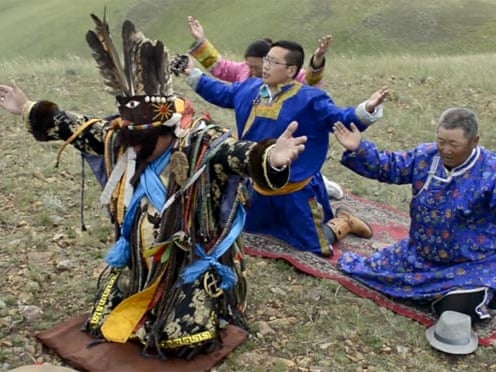
The word shaman may come from a language that was spoken in eastern Siberia. The shaman is usually a part-time male specialist who has fairly high status in his community and is often involved in healing. More generally, the shaman deals with the spirits to try to get their help or to keep them from causing harm. Here we focus on the methods shamans use to help others. Shamans are usually male. Here, female shamans in Korea perform a healing ritual.
The shaman enters into a trance, or some other altered state of consciousness, and then journeys to other worlds to get help from guardians or other spirits. Dreams may be used to provide insight or as a way for shamans to commune with spirits. People may seek help for practical matters, such as where to get food resources or whether to relocate, but solving a health problem is most often the goal of the shaman. Shamans may also bring news from spirits, such as a warning about an impending disaster . Someone may receive a “call” to the role of shaman in recovering from an illness, through a vision quest, or in a dream. Shamans-in-training may enhance the vividness of their imagery by using hallucinogens, sleep or food deprivation, or engaging in extensive physical activity such as dancing. An important part
of the process of being a shaman is learning to control the imagery and the spirit powers. Shamanistic training can take several years under the guidance of a master shaman.
Priests
Priests are generally full-time male specialists who officiate at public events. They have very high status and are thought to be able to relate to superior or high gods who are beyond the ordinary person’s control. In most societies with priests, the people who get to be priests obtain their offices through inheritance or political appointment. Priests are sometimes distinguished from other people by special clothing or a different hairstyle. The training of a priest can be vigorous and long, including fasting, praying, and physical labor, as well as learning the dogma and the ritual of his religion. Priests in the United States complete four years of theological school and sometimes serve first as apprentices under established priests. Priests do not receive a fee for their services but are supported by donations from parishioners or followers. Priests often have some political power as a result of their office—the chief priest is sometimes also the head of state or is a close adviser to the chief of state— and their material well-being is a direct reflection of their position in the priestly hierarchy.
The dependence on memorized ritual both marks and protects the priest. If a shaman repeatedly fails to effect a cure, he will probably lose his following, for he has obviously lost the support of the spirits. But if a priest performs his ritual perfectly and the gods choose not to respond, the priest will usually retain his position and the ritual will preserve its assumed effectiveness. The nonresponse of the gods will be explained in terms of the people’s unworthiness of supernatural favor.
Sorcerers and Witches
In contrast with shamans, who have fairly high status, sorcerers and witches of both sexes tend to have very low social and economic status in their societies. Suspected sorcerers and witches are usually feared because they are thought to know how to invoke the supernatural to cause illness, injury, and death. Because sorcerers use materials for their magic, evidence of sorcery can be found, and suspected sorcerers are often killed for their malevolent activities. Because witchcraft supposedly is accomplished by thought and emotion alone, it may be harder to prove that someone is a witch, but the difficulty of proving witchcraft has not prevented people from accusing and killing others for being witches.
Mediums
Mediums tend to be females. These part-time practitioners are asked to heal and divine while in possession trances—that is, when they are thought to be possessed by spirits. Mediums are described as having tremors, convulsions, seizures, and temporary amnesia
Practitioners and Social Complexity :More complex societies tend to have more types of religious or magical practitioners. If a society has only one type of practitioner, it is almost always a shaman; such societies tend to be nomadic or seminomadic food collectors. Societies with two types of practitioners (usually shaman healers and priests) have agriculture. Those with three types of practitioners are agriculturalists or pastoralists with political integration beyond the community (the additional practitioner type tends to be either a sorcerer or witch or a medium). Finally, societies with all four types of practitioners have agriculture, political integration beyond the community, and social classes