The Structure of DNA
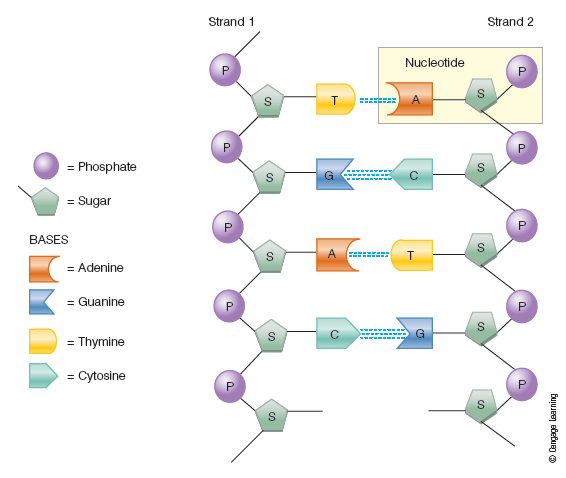
DNA is the very basis of life because it directs all cellular activities. So if we want to understand these activities and how traits are inherited, we must know something about the structure and function of DNA. The exact physical and chemical properties of DNA were unknown until 1953, when, at the University of Cambridge, in England, an American researcher named James Watson and three British scientists, Francis Crick, Maurice Wilkins, and Rosalind Franklin, developed a structural and functional model of DNA (Watson and Crick, 1953a, b). It’s impossible to overstate the importance of this achievement because it completely revolutionized the fields of biology and medicine and forever altered our understanding of biological and evolutionary mechanisms . The DNA molecule is composed of two chains of even smaller units called nucleotides. A nucleotide, in turn, is made up of three components: a sugar molecule (deoxyribose), a phosphate group (a molecule composed of phosphorus and oxygen), and one of four nitrogenous bases . In DNA, nucleotides are stacked on top of one another to form a chain that is bonded by its bases to another nucleotide chain. Together the two chains twist to form a spiral, or helical shape. Thus, the DNA molecule is double-stranded and is described as forming a double helix that resembles a twisted ladder. If we follow the twisted ladder analogy, the sugars and phosphates represent the two sides while the bases and the bonds that join them form the rungs. The four bases are the key to how DNA works. These bases are adenine, guanine, thymine, and cytosine, usually referred to by their initial letters: A, G, T, and C. When the double helix is formed, one type of base is able to pair, or bond, with only one other type: A can pair only with T, and G can pair only with C. This specificity is absolutely essential to the DNA molecule’s ability to replicate, or make an exact copy of itself.
DNA Replication
Cells multiply by dividing to make exact copies of themselves . This, in turn, enables organisms to grow and injured tissues to heal. There are two kinds of cell division. In the simpler form, a cell divides one time to produce two “daughter” cells, each of which receives a full set of genetic material. This is important, because a cell can’t function properly without the right amount of DNA. But before a cell can divide, its DNA must replicate.
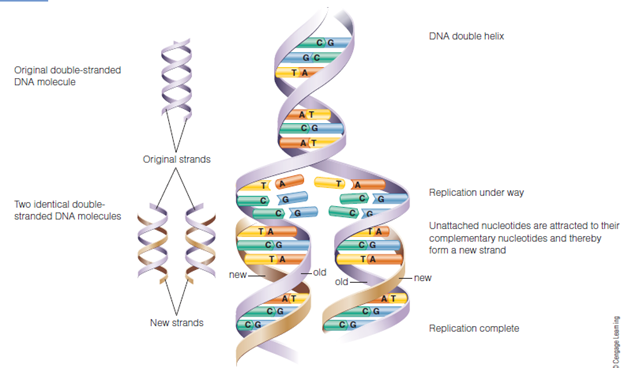
Replication begins when enzymes (DNA polymerase) break the bonds between bases throughout the DNA molecule, separating the two previously joined strands of nucleotides and leaving their bases exposed . These exposed bases then attract unattached DNA nucleotides that have been made by DNA elsewhere in the cell nucleus. Because each base can pair with only one other, the attraction between bases occurs in a complementary way. This means that the two previously joined parental nucleotide chains serve as models, or templates, for forming new strands of nucleotides. As each new strand is formed, its bases are joined to the bases of an original strand. When the process is complete, there are two doubles tranded DNA molecules exactly like the original one. Importantly, each newly formed molecule consists of one original nucleotide chain joined to a newly formed chain.