Definition:
“An organized group of statuses and roles that directs and controls the personal behavior of relatives in a human society is called kinship system”
Types of kinship systems:
In 1925 Leslie Spier published his typology of American Indian kinship systems.* His typology takes the form of eight classes, viz.
- Omaha.
- Crow.
- Salish.
- Acoma.
- Yuman.
- Mackenzie Basin.
- Iroquois.
- Eskimo.
In his big 1949 book George Peter Murdock used Spier’s classification as the basis for a typology based upon cousin terminology.† Murdock subsumed the Salish, Acoma, Yuman, and Mackenzie Basin classes as his Hawaiian class. Murdock also added a Sudanese class. Murdock’s typology is listed below, along with his own description of the terms used for cousins by male Ego in each.
Hawaiian System:
Where a consistent unilocal mode of post marital residence is absentor has been abandoned, generational (Hawaiian> rather than lineal (Eskimo) kinship classification may be found. societies with Hawaiian terminology, are most often either bilaterally or ambilineally organized. NO terminological distinctions are made between relatives on the paternal and maternal sides. Hawaiian terminology is often found in societies with extended families and/or corporate ambilineal descent groups (Textor 1967) – it is very likely that Hawaiian nomenclature is especially suited to situations in which there are important cognatically organized corporate groups larger and more inclusive than the nuclear family(e.g., bilaterally organized extended families and/or descent groups). The fact that Ego does not terminologically distinguish between his parents their siblings, or between his own siblings and his cousins (except in terms of sex), may indicate that any of these relative may also be members of important corporate groups to which Ego belongs.
The terms of reference that comprise any system of kinship nomenclature are clearly not accidental; terminologies exhibit an internal logic and consistency, and reflect characteristics of the societies in which they are found. We have seen that the kinds of groups present in society may influence the type of nomenclature that will be adopted. Some scholars have suggested that other factors may exert an influence on kinship terminology.

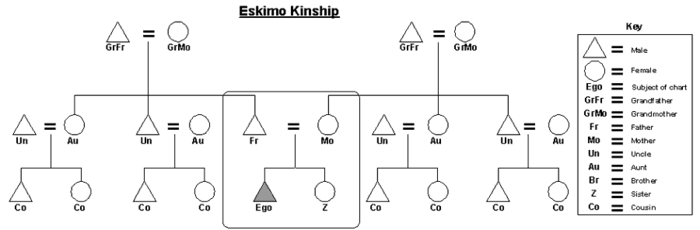
Eskimo System:
Lineal (Eskimo) terminology usually signals the presence of some form of cognatic kinship. Although most bilateral or ambilineal societies do not make use of Eskimo terminology, societies that do are usually either bilateral or ambilineal in organization we commonly find Eskimo terminology where people do not adhere to a strict unilocal rule of post marital residence and where emphasis is placed on the nuclear family rather than on the extended family or descent group.
As the above figure indicates, the members of Ego’s nuclear family are distinguished from all other relatives. Nonlinear relatives on both the maternal and paternal sides are classed together with distinctions among them being made only in terms of sex and generation; The manner of classifying relatives suggests that Ego considers himself equally related to all nonlineal relatives – a suggestion of bilaterality. Lineal systems are most commonly found in either very simple society in which nuclear families comprise the major exploitative units, or in very complex societies, like our own where economic forces encourage a similar emphasis on the nuclear household (Textor 1967).
Iroquois System:
These groups one of either the patrilineal or matrilineal variety. When we examine the way in which relatives are classified in an Iroquois system kinship terms reflect a basic distinction between people who are members of Ego’s descent group and people belonging to other descent groups. The fact that one term groups Fa with FaBr , and the fact that FaBrChi are classed with siblings may indicate that the members of each class of relatives have something in common. In a patrilineal society they are all members (distinguished by generation) of Ego’s patrilineal descent group. Mother and her sister (with whom she is grouped terminologically) are members of another descent group, the children of MoSi are grouped with siblings since Ego classes their Mo with his own. In a matrilineal system the fact that Mo and Mosi are terminologically grouped reflects their membership in a common matrilineal descent group, and since they are so grouped it follows that their children (i.e. T Ego’s siblings and his matrilateral parallel cousins) are also classed together. The fact that father and his brothers are terminologically grouped may reflect their membership in a common descent group, and since the offspring of one’s FaBr are the children of a “father”, they are terminologically equated with siblings.

Crow and Omaha Systems:
Where unilineal descent groups play a major role in mediating access to the means or the fruits of production, or where descent groups are especially important for other reasons, we often find this reflected in kinship terminology. Omaha terminology signals the presence of strong and highly functional patrilineal descent groups while Crow suggests the presence of strong matrilineal descent groups.

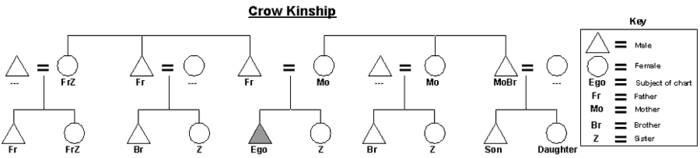
If a society has Omaha terminology one can safely guess that -it is also patrilineal but if a society is patrilineal it need not classify relatives in terms of an Omaha system. Societies with this system of kinship nomenclature are most likely to be matrilineal even though most matrilineal societies do not have Crow kinship systems.
In both Omaha and Crow societies, Ego is especially concerned about the members of his own descent group – people with whom he shares certain obligations, rights, and privileges and with whom his interactions are especially frequent and important, Because his relations with members of the descent group of his in-marrying parent are less frequent and less vital , the fine terminological distinctions made between members of his own descent group need not be made with respect to the embers of this other descent group. For Ego it is important only that these people are members of the descent group of an in-marrying parent , and this is reflected by the terms of reference that Ego employs with respect to them,
In both systems all same-sex members of the in-marrying parent’s descent group are equated, regardless of generation, the fact that, in an Omaha system Ego refers to his MoBrsoDa by a term appropriate-to mother does not indicate confusion on his part-he is not mistaking what may be child-in arms for his own parent. The term “mother” simply indicates a female of his Fawi’s descent group. Similarly, in the Crow system. Ego is not confusing MOHU with FaSiDaSo because he refers to both with a term appropriate to father. The term “father” may simply reflect the fact that both individuals are males of Ego’s MoHu ’s descent group.
The systemic quality of kinship nomenclature can be made readily apparent through a few examples, why are BrChi in Omaha referred to by terms appropriate to son and daughter? Or how do these children refer to Ego? Since they use the term for father (Ego is their FaBr), Ego must reciprocate by referring to them as son and daughter. Why does Ego refer to his SiChi as nephew and niece? Since they refer to him as MoBr (or uncle), he must refer to them by the reciprocal of uncle. Ego refers to his Fasi Chi by the same terras for similar reasons, since these children refer to Ego’s father by a term appropriate to MoBr, and because the children of aMoBr are invariably also referred to as MoBr and Mo, Ego (being their MoBr) must refer to them as nephew and niece, In the Crow system we find a similar internal consistency. Why does Ego in Crow refer to his MoBrchi as son and daughter? He does so because his mother is their Fasi; and the children of a FaSi in Crow are referred to as father or father’s sister. Since they refer to him with a term appropriate to father, he must refer to them with terms appropriate to father, he must refer to them with terms appropriate to offspring.
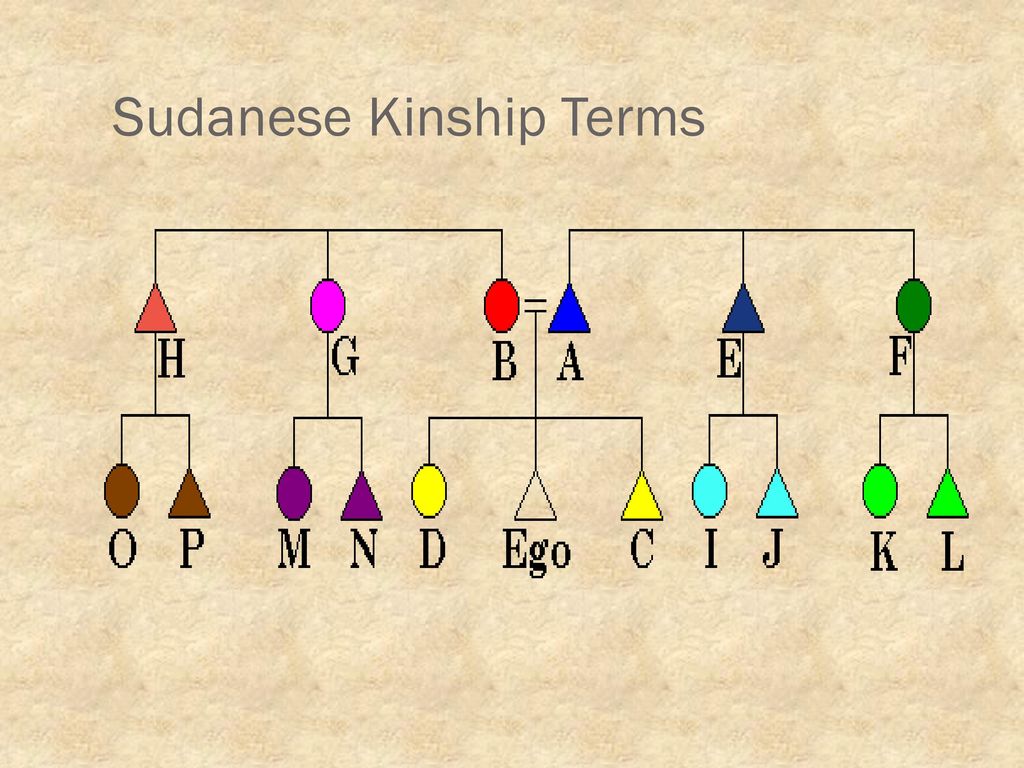
Sudanese System:
All uncles’ aunts and cousins are referred to by different terms – different kinship statuses are not terminologically classed together, in other words collateral relatives are distinguished (“bifurcated”) from lineal relatives as well as from each other.
Although most patrilineal societies do not employ a Sudanese system of kinship terminology, societies that do are usually patrilineal , we have yet to discover why this type of terminology is so often associated with patrilineal descent and we have yet to determine the factors that might dispose a patrilineal society to adopt a Sudanese system of kinship classification rather than an Omaha or Iroquois system.