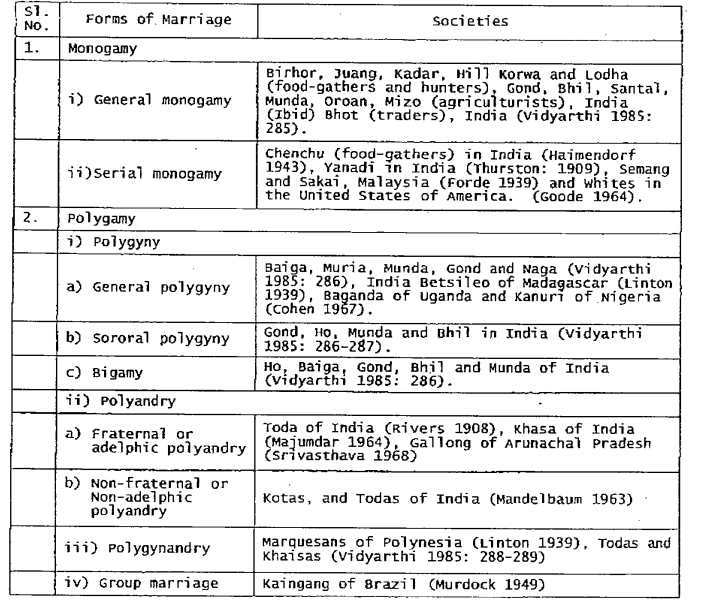
Polyandry in human societies is another major form of polygamy. Polyandry(poly = many; andry = husbands) is a sub-form of polygamy in which a woman marries two or more men at a time. polyandry may be two kinds: fraternal or adelphic polyandry or non-fraternal or non-adelphic polyandry in human societies
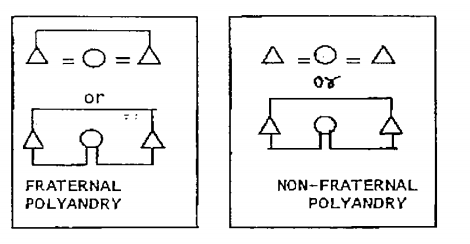
George Peter Murdock’s “World Ethnographic Sample” included only four societies (less than 1 percent of the total) in which polyandry, or the marriage of several men to one woman, was practiced polyandry in human societies. When the husbands are brothers we call it fraternal polyandry; if they are not brothers, it is nonfraternal polyandry. Some Tibetans, the Toda of India, and the Sinhalese of Sri Lanka have practiced fraternal polyandry. Among some Tibetans who practice fraternal polyandry, biological paternity seems to be of no particular concern; there is no attempt to link children biologically to a particular brother, and all children are treated the same.
One possible explanation for the practice of polyandry is a shortage of women. The Toda practiced female infanticide; the Sinhalese had a shortage of women but denied the practice of female infanticide. A correlation between shortage of women and polyandry would account for why polyandry is so rare in the ethnographic record; an excess of men is rare cross-culturally.
Another possible explanation is that polyandry is an adaptive response to severely limited resources. Melvyn Goldstein studied Tibetans who live in the northwestern corner of Nepal, above 12,000 feet in elevation. Cultivable land is extremely scarce there, with most families having less than an acre. The people say they practice fraternal polyandry to prevent the division of a family’s farm and animals. Instead of dividing up their land among them and each taking a wife, brothers preserve the family farm by sharing a wife.
Although not recognized by the Tibetans, their practice of polyandry minimizes population growth. There are as many women as men of marriageable age. But about 30 percent of the women do not marry, and although these women do have some children, they have far fewer than married women. Thus, the practice of polyandry minimizes the number of mouths to feed and therefore maximizes the standard of living of the polyandrous family. In contrast, if the Tibetans practiced monogamy and almost all women married, the birth rate would be much higher and there would be more mouths to feed with the severely limited resources. Polyandry in human societies is still customary in some Tibetan communities, although monogamous marriages actually outnumber polyandrous marriages. This is because a set of brothers may start off being married to one woman, but younger brothers may later opt to marry separately and form their own households. Also, some households have only one son or daughter and polyandrous marriages are not possible. Family wealth increases the likelihood of a young brother leaving, but this mostly happens when the polyandrous household lacks agricultural fields, herds, and opportunities for trade.