Content:
- Introduction
- Methods followed by Tylor
- Determinants of evolution
- Theory of cultural evolution based on technology and religion
- Deducting laws or principles governing evolution
- Merits of Tylor theory
- Limitations of Tylor theory
Introduction
Sir Edward Burnett Tylor (1832 – 1917). A British anthropologist, the founder of cultural anthropology . He discounted the degeneration theory. Tylor formulated the concept of culture and provided a most influential definition of culture: “Culture or civilization is that complex whole which includes knowledge, belief, art, morals, law, custom and any other capabilities and habits acquired by man as a member of society.” He also elaborated the concept of cultural “survivals.” His major contributions were in the field of religion and mythology, and he cited magic, astrology, and witchcraft as clues to primitive religion. In Tylor’s best known works, Primitive Culture (1871) and Researches in the early history of mankind and the development of Civilization (1865), he attempted to illuminate the complicated aspects of religious and magical phenomena. It was an impressive and well-reasoned analysis of primitive psychology and far more general in application than anything which had been earlier suggested. Tylor correlates the three levels of social evolution to types of religion: savages practicing animism, barbarians practicing polytheism, and civilized people practicing monotheism. Another notable accomplishments of Tylor were introduction of statistical method , concept of survival and experimental archaeology in anthropology.
Comparative Method
According to Tylor, cultural evolution can be studied with the help of comparative method or the method of historical reconstruction for presenting the history of human culture in a historical way. It is a method which employs contemporary primitive cultures and peasant cultures to early stages of cultural evolution . Thus it infers Past from the present.
The steps of this method are as follows.
- Firstly, look into and classify the present-day cultures into primitive , peasant and civilized one
- Secondly , arrange these cultures into an evolutionary schema with savagery at the bottom, barbarism in the middle and civilization at the top. The earliest human society was like animal society. In course of time it came to have an ordered way of life to begin the Savagery life. The Savage societies were similar to that of primitive societies, some primitive societies which had better opportunities marched ahead and became Barbarian societies the rest remained at the savages. Among barbarians some had opportunities to be civilized. thus the arrangement of cultures at the bottom the barbarism culture in the middle of the civilized at the top gives a picturization of three- staged-cultural-evolution
- Thirdly, detect the survival that means one can establish the previous stages of a particular culture on the basis of relics of the first stage continuing in the present stage also identify the parallels that helps establishment of the operation of psychic unity of mankind
- Finally, discover the laws governing the cultural evolution that means on the basis of reconstructed picture of the history of human culture find out the law governing the evolution of human culture.
Determinants of evolution
E.B. Tylor identified both external and internal factor as determinants of cultural evolution
Internal are inherent factors
- Psychic unity of mankind
- Human perfectibility
- Influences of great men , ideas as a prime mover
- Individuals as determinants
- Environmental conditions
- Economic conditions
- Social conditions
External factors including
- War
- Cultural contact
- Borrowing or diffusion
Theory of cultural evolution
On the basis of his comparative studies, contemporary primitives and archaeological records , Tyler gave a schema of of evolution of cultures (Theory of Cultural Evolution) in his two books The researches in early history of mankind and development of civilization (1865) and Primitive Culture (1871)
Tyler defined the stages of evolution of culture into savagery, barbarism and civilization using the criteria of technology and religion.
- According to him savagery began with subsistence on wild plants and utilisation of some stone tools . In this stage the earliest form of religion namely animism appeared. The first religion had developed into Ancestor Worship which in turn give way to worship of natural spirit.
- The next stage of barbarism commenced with domestication of plants and animals leading to formation of agriculture , uses of metals , permanent villages and to some extent construction of small towns. In this stage people professed polytheism , the worship of many gods. In fact the social , economic and political achievements of humans at this stage had drawn them to have belief in multiple gods.
- The final stage is civilization it emerged with the invention of alphabet and art of writing. It is characterized by progress in terms of advancing industrial technology , increasingly enlightened politics , Even ever-expanding economy , monogamy, under rational thinking in every spear of activity . Tyler saw his contemporary England as the representative of civilization that has progressed far other than and therefore more cultured. Corresponding to this stage human conceived of a high God and this gave rise to the final stage of belief in monotheism or one high god.
| Stages of evolution | Technology | Religion |
| Civilization | Art of writing | Monotheism |
| Barbarism | Agriculture , use of metals , villages and small towns | Polytheism |
| Savagery | Subsistance on wild plants and utilisation of stone tools | Worship of nature Ancestor worship Animism |
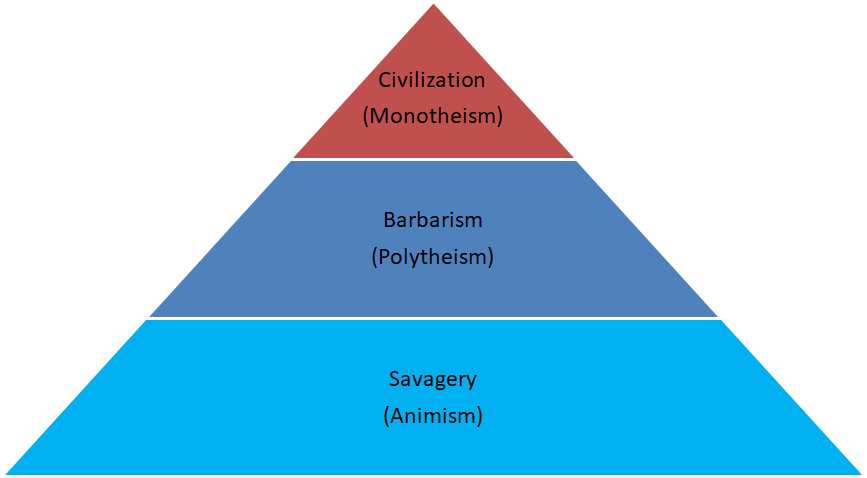
Laws or principles of evolution proposed by E.B Tylor
According to Tyler the following principles governing cultural evolution.
- Human culture is uniform everywhere it has its own laws.
- He maintained that culture evolved from the simple to the complex
- Culture evolves in a unilineal way , stage by stage. The direction of cultural evolution is always from savagery to civilization through barbarism
- Similarities in the culture are caused by psychic unity of mankind i.e. the basic similarities in the mental framework of all peoples. That’s Why different societies often find the same solutions to the same problems independently.
- There is a differential evolution but cultural diversity does not occupy a significant place in unilineal evolution.
- Modern primitives are not primeval . Therefore contemporary primitive far removed from our ancestral cultures.
- In the higher stage of culture some residues of the primitive stages can be seen which are termed as Cultural survival and which reminded us about the earliest stages of culture
- It is possible for some societies to skip stages.
- The differential rate of evolution caused by the education factor, the societies that received education earlier reached civilization .
- Most of the changes caused by internal forces and independently evolved. he also ruled that some diffusion also responsible for cultural change
Merits of Tylor theory
- Tylor’s theory introduced Anthropology as a science in 1884
- It developed the concept of culture , he said that culture and the race must not be confused in studying the life way of culture
- It distinguishes sub duration of culture which we called today as aspects and shares their useful in studying the culture
- it established the principles of continuity and orderly development of culture
- It not only compares and analyse the cultures of the the universe and also provided rich material to cultural anthropology
- It identified the skipping of evolutionary stages
- It gave the concept of Survival to understand the early stages of Civilization
- Tylor introduced statistics in Anthropology
- Tylor introduced a new branding in archaeology , namely experimental archaeology
- He introduced the concept of animism as the earliest form of religion ; explain origins of myths ; origin of avoidance and origin of technology
Limitations:
The limitations of cultural evolution proposed by Tylor theory were as follows
- Cultural evolution was founded on the questionable assumption of psychic unity of mankind but there is no evidence to support this assumption. He failed to provide an explanation to why two environments may be similar but their cultures may be different or two environments may be dissimilar but their cultures are similar. the principle of psychic unity of mankind does not support this fact. According to evolution , everywhere there shall be similar cultures but there are different cultures in similar environments.
- He did not provided evidence of uniform characteristics representing the evolutionary stages
- Cultural evolution made no attempt to analyse innovation, it ignored the significance fact of diffusion of cultures
- Cultural evolutionists said that simpler societies have greater potential and evolved societies have less potential for absorption of innovation. In reality this is otherwise
- Even though Tylor had given undue importance to the role of innovation. He had accepted the key role of diffusion also when it said that cultures develops by skipping stages
- He was an armchair anthropologist who was not involved in field work traditions.
- He was highly ethnocentric that he glorified his own Victorian society as the highest evolved i.e civilization.
- He failed to provide an explanation why some societies regressed and even extinct, why other societies progressed and reached civilization .
Short Answer
Theory of Cultural survivals
A term ascribed to Tylor was his theory of “survivals”. His definition of survivals is processes, customs, and opinions, and so forth, which have been carried on by force of habit into a new state of society different from that in which they had their original home, and they thus remain as proofs and examples of an older condition of culture out of which a newer has been evolved. — Tylor
The making of pottery is an example of a survival in the sense used by Tylor. Earlier peoples made their cooking pots out of clay; today we generally make them out of metal because it is more durable, but we still prefer dishes made of clay.
“Survivals” can include outdated practices, such as the European practice of bloodletting, which lasted long after the medical theories on which it was based had faded from use and been replaced by more modern techniques. Critics argued that he identified the term but provided an insufficient reason as to why survivals continue. Tylor’s meme-like concept of survivals explains the characteristics of a culture that are linked to earlier stages of human culture.
• Studying survivals assists ethnographers in reconstructing earlier cultural characteristics and possibly reconstructing the evolution of culture.