DNA sequencing is a process of determining or identifying the order of nucleotides present in a DNA sequence.”
Nitrogenous bases, sugar and phosphate are three ingredients of the DNA in which Adenine, Thymine, Cytosine and Guanine are bases. A functional piece of DNA is known as a gene that encodes proteins. For understanding the structure and function of a gene, It is very important to study its nucleotide sequence. DNA sequencing serves this purpose. In a sequential manner, the long chain of DNA is read by the sequencer machine.
History of DNA sequencing:
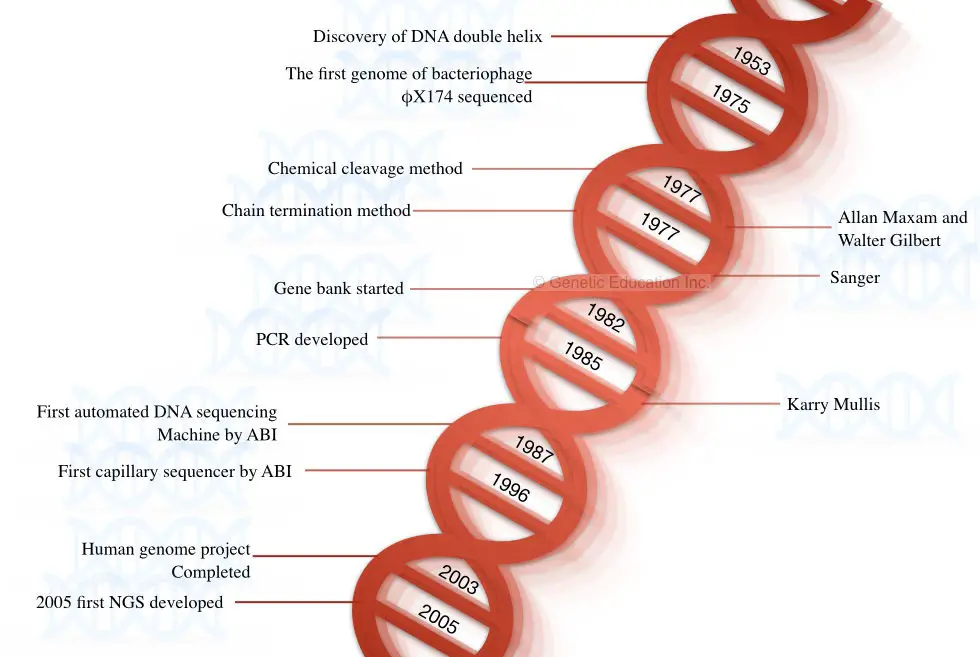
The story of DNA begins when Watson and Crick discovered the structure of DNA in the year 1953. In 1964, Richard Holley who performed the sequencing of the tRNA was the first attempt to sequence the nucleic acid. Using the technique of Holley and Walter Fieser, they sequenced the genome of bacteriophage MS2 (RNA sequencing). The sequenced molecules were RNA, Yet DNA sequencing was not performed. In the year 1977, Fredrick Sanger postulated the first method for sequencing the DNA, named a chain termination method. In the same year, the chemical method of DNA sequencing was explained by Allan Maxam and Walter Gilbert. The genome of bacteriophage X174 was sequenced in the same year using the chemical degradation method. Because of the lack of automation, Both the methods (chemical degradation and chain termination) were tedious and time-consuming. The first semi-automated DNA method was developed by Lorey and Smith in the year 1986. Later on, in the year 1987, the Applied Biosystem had developed a fully automated machine-controlled DNA sequencing method. After the development of fully automated machines, the era of the 2000s become a golden period for sequencing platforms. Furthermore, in 1996, Applied Biosystem developed another innovative sequencing platform known as capillary DNA sequencing. After that, the human genome project was completed by using the combination of these methods in the year 2003.
A fast, accurate, reliable, and highly efficient next-generation sequencing platform was postulated in the year 2005 by Solexa/Illumina. Some of the milestone into the DNA sequencing is shown in the figure below,
What is DNA sequencing?
Studying the allelic variation is not enough in some cases, further, using the polymerase chain reaction-like methods, new polymorphism can’t be identified. Overcome the present problem the DNA sequencing method was evolved.
Definition:
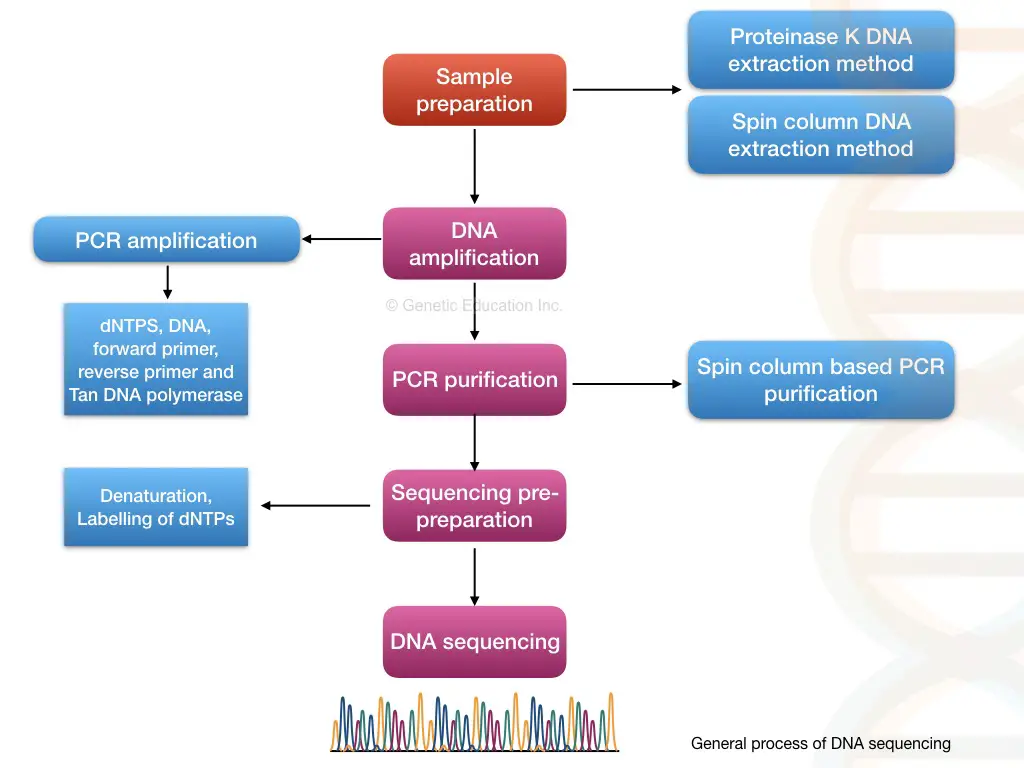
“A laboratory technique employed to known the correct DNA sequence by the sequential chemical reaction is known as DNA sequencing.” laboratory processing and computational analysis both are key processes in DNA sequencing. Once the chemical reaction is completed, the machine-generated data are sent to the computer lab. In the process, the amplification done by each nucleotide is recorded in the form of signals which are collected by the machine and analyzed on the computer. This is the basic mechanism, the nucleotides are either radio or fluorescent-labeled.
Different methods of DNA sequencing:
Various methods of DNA sequencing are explained here.
- Maxam and Gilbert method
- Chain termination method
- semiautomated method
- automated method
- Pyrosequencing
- The whole-genome shotgun sequencing method
- Clone by the clone sequencing method
- Next-generation sequencing method
Applications of DNA sequencing : In medical science, DNA sequencing can be used in the identification of genes responsible for hereditary disorders. New mutation can also be detected with the help of the DNA sequencing. In forensic science, it is used for parental verification, criminal investigation and identification of individuals through any of the available samples such as hair, nail, blood or tissue. In the agriculture industry, the identification of GMO species can be possible with the help of DNA sequencing methods. Any minor variations in the plant genome can be detected with the help of DNA sequencing. It is used to construct maps such as whole chromosomal maps, restriction digestion maps, and genome maps. Open reading frames, non-open reading frames and protein-coding DNA sequences can be identified by the present method. DNA sequencing is used in exon/ intron, repeat sequence and tandem repeat identification and detection. Furthermore, the present method is employed in gene manipulation and gene editing. New variations in nature can also be determined through sequencing. Metagenomic studies are nowadays possible by sequencing methods such as pyrosequencing. It is further used in the Microbial identification and study of the new bacterial species. The sequencing technique advances microbial identification by eliminating the traditional and time-consuming culturing methods. Nowadays microbial identification and characterization have become more rapidly and accurately done using sequencing. By comparing the sequence of the target microbes with the available data, scientists can identify new mutations and new strains. The sequencing techniques specifically, the NGS has a great application in oncology and cancer studies. various cancer-causing genes are identified and characterized by the present method. The advancement in evolutionary studies is only possible because of DNA sequencing. By comparing various genes and sequences, an evolutionary map can be generated. Also, new variations through evolution can be encountered. sequencing helps in studying the asymptomatic high-risk population, prior to the occurrence of disease. And thus preventive steps can be taken earlier.
Limitations of DNA sequencing : A sequencing platform is a computer algorithm-based assistive technique that relies on computational data processing. For that, a huge, high-speed supercomputer is required. Also, several sequences like tandem repeats, repetitive DNA, fragmented genes, and other duplicated regions can not be studied properly. The chance of errors in the pre-sample processing can cause big economical loss, these two are the major limitations of the DNA sequencing methods.
Conclusion: Scopes of DNA sequencing in various fields are infinite. The biggest hope of it is its use in the diagnosis of multigenic genetic disorders. The present method can be a useful tool for prenatal and preimplantation genetic studies. In the latest scientific trends, the development of gene therapies and the concept of personalized medicines can not be fulfilled without NGS-like robust techniques. However, more optimization and advancements are required to reduce the cots, time-duration and error rate in the present genetic technology.