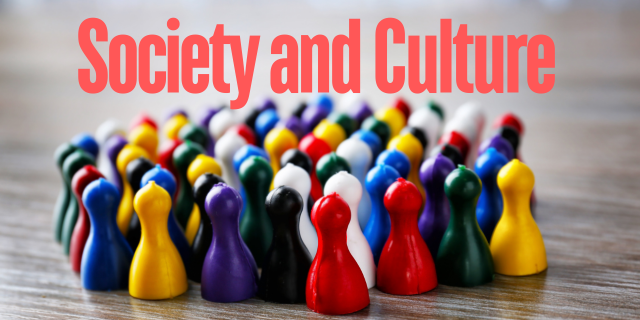
In Culture and Society, Culture is the sum total of learned, shared and socially transmitted behaviour that includes ideas, values, and customs of groups of people. A fairly large number of people living in the same territory constitute a society. Members of a society share a common language, which facilitates day-to-day exchanges with others and participate in a common culture.
Nadel in his work says it is necessary to make a distinction between “Culture” from its companion term “society.” According to him culture is the way of life of the people; while a society is an organised, interacting aggregate of individuals who follow a given way of life. In simple terms a society is composed of people; the way they behave is their culture. (Nadel, S.F. 2006).
Since the time of Boas, culture became a tool for understanding and describing the exotic society. Anthropological study on cultural relativism allows a comparison of culture without assuming evolutionary hierarchies. It means that every culture has in its own rights to be different and does not stand for the purpose of other culture. In other words, all cultures express validity in their perspective of the world. Thus, it could be in-appropriate to judge cannibalism activity among society even if we use universal notion on violence. What we can do is try to understand the reason and rationalise such activity.
Early notion of culture was popularised among Anthropologist in order to understand homogeneous societies. In the modern world the relationship between culture and society is a complex one. Culture is produced and reproduced within the society and society acts in certain way in a culture. But how does culture work in the complex societies? Early Anthropologists used culture as the set of practical and contingent significations, while postmodernists use it to mark the domain of signifying practices.
According to Pertierra, (2004) society can be seen as the collection of individual members pursuing their interest in the context of formal rules administered by specialists and implemented by the state. It was also a constant state of self constitution, whose members are engaged in individual life projects marked by purposive and value rationality. Society consists of individuals mostly unknown to one another but nevertheless linked through abstract categories such as class, nation, or gender. In this case society assumed as the real place or arena, an institution in which individuals play their roles in order to achieve their different objectives. When we see the relation between society and culture, society and culture are two elements that are complementing each other. In Culture and Society, Society expresses itself through culture. We can associate the group of people or society from the culture they practice, such as Asian society is characterized by Asian culture, or
Javanese society with its Javanese culture.
Furthermore, culture is manifested in the socio economic structures as frames for the organisation of social relationship, it is embedded both in the material setting and the social institutions of society. Culture and Society Material experiences are organised and group relations are structured through culture. But culture has also the medium through which the social world is experienced, interpreted and understood. In this sense,
culture is something more basic than ideological superstructure. Culture is produced in a given society within the framework set by the socio-economic structure. The cultural process perpetually occurs among the different groups and classes in a society and also affects social structure (Erna Herawati 2006)