Pastoralists are the people who have strong relationship with herding for their livelihood. Most of the pastoralists are inhabited in the places where potential for crop cultivation is limited due to the lack of rainfall, steep terrain or extreme temperature like desert, etc. They are semi-nomadic or nomadic in nature due the search of water, fodder, and pasture for grazing their herds. They have different
types of livestock like sheep, goats, cattle, horse, yak and camels in Central Asia, Buffalo in South Asia, llamas and alpacas in South America, and reindeer in the Pale arctic region. Close association with their animals is the most important characteristic of pastoralist community. At the same time, the pastoralist identity is also based on their strong association with their livestock that shape key elements of their social and ritual life. So, pastoralism is a highly complicated activity that needs to hold the balance amongst human population, animal population and natural resources.
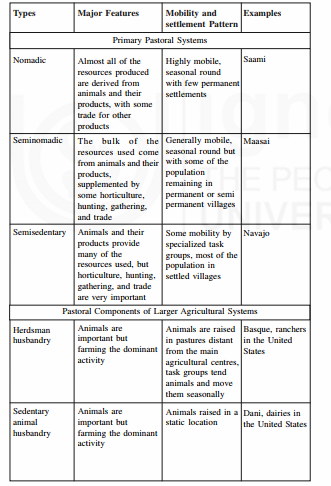
The Basic Types of Pastoralism defined by Sutton Mark Q and Anderson E.N, 2010, in their book entitle “Introduction to Cultural Ecology” is as follows: