What is Family ?
Murdock defined that the nuclear family as “a social group characterized by common residential, economic co-operation and reproduction. It includes adults of both sexes at least two of whom ” maintain a socially approved – sexual relationship and one or more children, own or adopted of the sexually cohabitating adults” distinct and strongly functional group in every society, and that it is universal because everywhere it performs four functions essential to human life: a sexual function, a reproductive function, an economic function and an educational or enculturating function.
Household and Family
Many a times there is confusion between the term family and household. So let’s first try to understand the term household and what it comprises of. Household has been defined by Haviland (2003) as the basic residential unit where economic production, consumption, inheritance, child rearing and shelter are organised and implemented. The members of a household at times share a common hearth. Let’s take the example of the Mundurucu of the Amazon who organise themselves around a household. They have a unique system by which all men and boys above 13 years of age live together whereas all the women and children below 13 years of age live together (Haviland, 2003). Herein, we see that household is an extention of family, a family can be a household but a household need not be a family. To make this statement clear let’s take another example from the present day situation. We see a lot of students moving out of their native place and settling in some other city or going abroad for higher education. These students usually on a shoe string budget like to share accommodation with fellow students. Thus, two to three students take up residence and start sharing space and eating together. This makes them share a hearth but they are not necessarily members of the same family but belong to different families.
Domestic Group
In order to study any social institution in a holistic manner, it is important to consider it ecologically, economically, demographically, psychologically and physiologically which affects its size and composition. Domestic group is rooted in environmental, biological, psychological substratum. Domestic group refers to resource owning groups. Member of domestic group pool together and contributes their part of labor and do various kinds of production activity based on division of labor specifically on age, gender and position/status of member. They also have political functions, they train individual completely so that individuals can enter politico-jural domain. Since they are resource owning group, domestic group acts as production unit. Domestic group members are engaged in harnessing the resources that group have and involve in economic production. This is the reason that definitions of family overlap with domestic group. A domestic group comprised of labor, urban and economic production, once these resources are harvested, it is divided among different consumption unit. These units often have separate kitchen, separate residential units and may have different consumption units. Example: polygynous societies. Consumption unit of production act as a unit of reproduction. Say, husband and wife are still young and giving birth to offsprings, but when wife attains menopause or husband becomes older, incapable of reproduction then they look for consumption units.
Meyer Fortes said domestic groups are essentially householding and housekeeping group which organize to provide material resource and cultural resources which are needed to maintain and raise or bring up its members. They undergo cyclical developments. These cycles are always in process. This is particularly known as developmental cycle of domestic group which covers the life of an individual and the unfolding of group dynamics. He further said that every domestic group passes through three phases in the developmental cycle of domestic group:
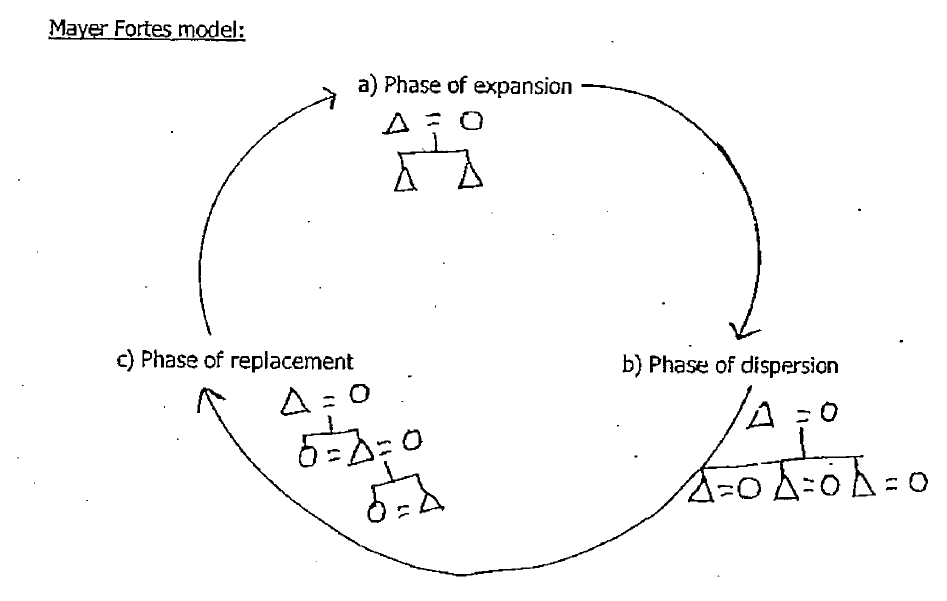
i. Phase of expansion– it starts with marriage and further expands by birth of first child and it continues to expand till the birth of last child. This phase is dependent on fertility of wife/woman and physiological factors like wife’s menopause and husband’s inability to procreate. This determines the length of expansion, span and duration.
ii. Phase of dispersion– it starts with marriage of first/eldest child and it continues till the marriage of last/youngest child. In Patrilineal system, sons generally set up a new household, new unit of production & consumption of his own domestic group. In some domestic groups, youngest son stays with father and gets property-land/house, etc.
iii. Phase of replacement- it starts with ageing of parents and continues till their death with a passage of time, parents become old and has no stamina to perform any physical activity. They rely on their children they requests them to represent and perform their function. In this process parents no longer take part in economic unit, thus their authority/power declines slowly. Children grow in autonomous manner and take decisions. Children replace parents/head of the family and then undergo the phase of expansion.
These 3 phases does not necessarily follow the same sequence of phases. Some groups may skip phase of expansion, couples who are unable to procreate. Domestic group is like human factory which shapes, polishes, nurtures the child/individual. Life of an individual pass through four phases of life