Religion and economy are inter-related functionally, but the magnitude of these relationships varies, Economic and religious changes arise from multiple factors. Their functions are mutual, so that economic ideals influence and adjust themselves to religious concepts and vice-versa.
A.Religion and economic production
Economic production deals with the procedures and conditions under which goods and services needed by human societies are made available. Production includes the making of artifacts and other items of material culture, and the production of food through hunting, fishing, collecting, farming, cattle breeding and industry.
Possible evidence about the relation of religion to economic production goes back to the Paleolithic age. On the walls of caves frequented by the early hunters are formal paintings of food producing animals, Often they were pierced by arrows but the common interpretation is that this was done to increase the food supply by supernatural means.
The actual links between economics and religion may be explained with the help of examples.
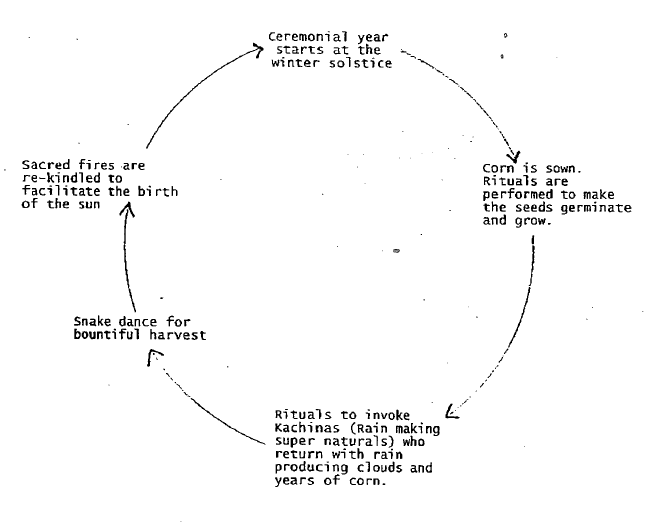
a) Ruth Benedict has shown how religion regulates the production system among the Hopi Red Indians:
Hopi and Zuni rituals are carried out for the explicit purpose of producing rain and thus to insure or to increase agricultural production. Moreover, the different ceremonies connected with the agricultural cycle tend to systematize and regulate the work. The Hopi ceremonial year begins at the winter solstice, when a ritual is held to insure the return of the sun. After the corn is sown , the next ritual is held to make the seeds germinate and grow. Later, a very important ceremony invokes the ancestors and kachinas (powerful supernatural beings) who return with rain clouds and years of corn, the kachina dance produce rain , and the kachinas remain until the first green ears of corn appear. The Hopi snake dance is held to ensure a bountiful harvest, while in the last ceremony of the year the saved fires are rekindled in order to facilitate the later re-birth of the sun. The various rituals also make the agricultural stages of sowing , sprouting, ripening and harvesting.
b) Malinowski shows how production cycle of to Briand Islanders in terms of horticultural activity are inter timed with several complexes of rituals.
The reason is officially opened by a big ceremonial performance, which consecrates the garden plots. Rites accompany every stage of the production process – burning the scrub , clearing , planting, weeding and harvesting. The religious leader ritually assists the plants in sprouting , budding , busting into leaf climbing, forming the foliage and producing edible yams . The garden magician regulates the whole system and ritually -compels people to apply themselves to certain tasks at appointed time. Other production processes such as canoe-building or deep-sea fishing are also regulated by ritual.
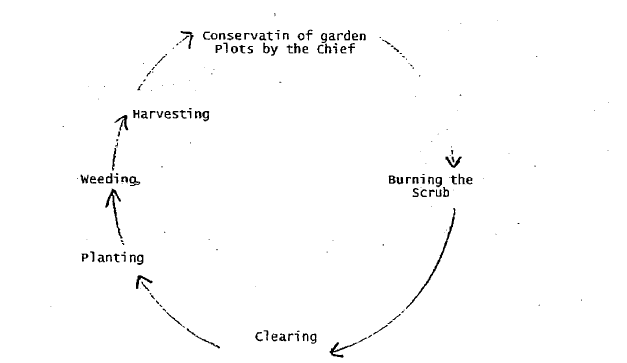
Malinowski feels that by its influence in ordering, systematizing and regulating work magic is economically invaluable for the natives.
c) Williamson describes the connections between religion and economic activity in Society islands.
On the Society Islands, religious observances connected with deep-sea fishing not only function to increase the catch, but also have direct effects on family behaviour as well. A fisherman is not supposed to quarrel with his wife and daughters before setting out to sea, for this would anger the Gods and also endanger his life. The Wives, daughters or sweet hearts of the fishermen must observe sexual taboos during their absence or suffer supernatural punishment. Clearly, this prohibition further helped to ease the minds of the absent fishermen, so that they could concentrate better upon their dangerous work.
In the Marquiesan islands, religion is connected with the fishing activities. Professional fishermen keep special sacred places, which women can never enter. Here they keep their fishing gear as well as the sacred images and ritual paraphernalia connected with their trade, Fishing thus becomes a semi-religious occupation and also a male prerogative.
d) Herskovits describes the Dahomien rituals and economic production.
In the African kingdom of Dahomey, ritual not only structures the agricultural cycle but also determines the selection of the plots to be cultivated. A Dahomean farmer will take a soil sample from the possible cultivation site to a diviner who just determines whether the gods will permit this plot of land to be used. when the answer is favorable, the farmer returns to the field and moulds a human head from the soil, using cocurie shells to represent his eyes. After having made offerings of palm oil and chicken blood, he returns to the diviner, who now identifies the guardian spirit of the field, From then on , sacrifice has to be made to the deity at the beginning of every four day week. These procedures serve two purposes:
- The supernatural establishment of correct choice will guarantee ownership of a plot and its legal use , thus minimizing quarrels over land rights.
- The regularity of the prescribed sacrifices compel the cultivator to be present on the land quite frequently , and the whole process thus becomes a sacred contract between farmers and spirits, each doing their part to make production successful .
B.Religion and Economic Distribution:
Religion and economic distribution are well integrated in different types of societies.
The distribution in hunting and gathering societies does not favour wealth differences. The religious specialists in the form of Shamans and diviners receive some material rewards for their services, The remunerations are often minimal So, they do not give rise to wealth differences for example, among the Bushmen and the Amasalik Eskimos, there are shamans. Likewise, Cheynne Red Indians also have a number of shamans. All these societies are band oriented ones. They are egalitarian. As such they do not favour wealth inequalities; They spend most of their time in the actual production of food, Under such conditions, very few surplus goods are produced , consumption is immediate. The nominal material rewards received by the shamans are so small or minimal that they never allow them to rise economically above others ,
- The Amasalik Eskimo shaman receives a small pocket of meat as minimal fee.
- Among the Cheyenne Red Indians , the shaman receives all the tongues of hunted animals and two antelopes.
On the other hand, in horticultural societies the remuneration are often much higher. The religious practices in such societies favour wealth differences. For example, (i ) Among the Trobriand islanders , magicians receive substantial fees. (ii) Among the Navaho Red Indians, the singers who preside over curing rights , receive 5 to 500 $ from his clients. On an average, a Navaho spends 20% of his income on ceremonial doctor’s bills.
In agricultural societies, there are full time religious specialists. They are fully supported by the people for they make their living by devoting their working time to religious services, Support and maintenance of full time religious specialists is accomplished in a variety of ways. Local communities make regular payments to diviners , specialists in charge of shrines , religious buildings, specialists dealing with communal ritual duties and priests who are associated with a large number of sacred structures.
Sometimes these religious specialists are also partially or totally supported by the state kings rely upon diviners and priests.
C.Religion and Consumption:
Consumption refers not merely to the ways in which goods are – used up, but also the role, which property and wealth in the lines of their consumers. Comfort, security, prestige, status,, power, pride and pleasure are but some of the intangible benefits of ownership and consumption.
1.In the nomadic hunting and gathering societies, where mobility is essential, material property is a burden and the most useful items are carried out. On the other hand in sedentary groups, the problem of transportation is less pressing. The social structure and value system may be organized along lines of status equality. Differential wealth is undesirable; and the culture provides means for liquidating property that might otherwise upset the economic status balance quite frequently, this siphoning off of extra goods takes the form of ritual consumption .
Eg:- i) Zuni Red Indians have a cultural ethos that favours social equality. This value concept permeates all institutions including economy , individual wealth is balanced in lengthy and expensive rituals.
Potlatch of Kwakiutl Red Indians possesses property in the form of engraved copper shields, blankets, mats, canoes and slaves. But such property did not confer prestige or status. This only came from names and mobility, titles and myths, songs, dances that went with them. The glory and power of names and titles attained and increased not by the accumulation of wealth, but by its public destruction in a potlatch. The greater the destruction the greater the prestige of the rank of the giver of the potlatch and the higher his ranking in society.
2.The religious nature of liquidation of property is much more obvious in the many known instances in which goods are destroyed or considered unfit for further use after the death of their power , Nearly everywhere a few material items of personal property are buried with the dead . Eg:-
- i ) Eskimo – Slaughtered all the huskies (dog) of a man at his grave.
- ii) Kazaks – Buried the favorite horse of a man.
- iii) Crow Indian – Destroyed most of the family property.
- iv) Dahomey – Performed 25 costly rituals to make the dead attain the sacred status. The material goods include hundreds of chicken , numerous goats , rams and ducks and quantities of palm oil , corn flour , beans and rum , full sized shelters of bamboo, many lengths of white cloth as well as drums , pots and money . Although a number of these items re-enter the re-distributive channels , many are simply destroyed.