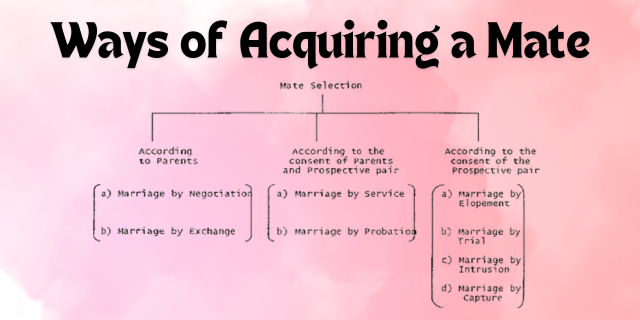
The forms and sub-forms of acquiring a mate
The ways of acquiring a mate refers to the characteristic manner in which a spouse is selected, it is the procedure or method of finding or obtaining a wife or husband, To be precise it may be called the manner of mate choice or spouse selection.
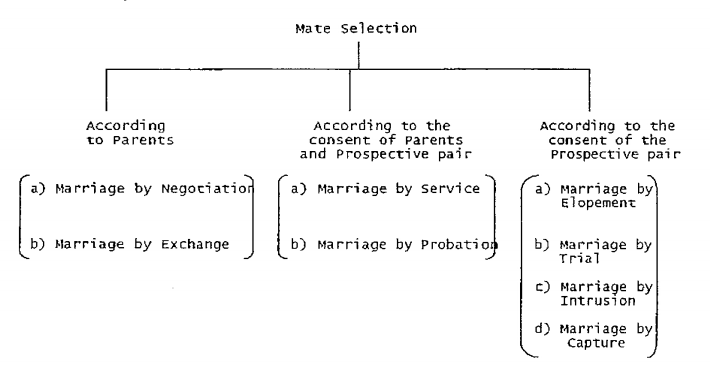
The mate choice or acquiring a mate may be classified into three broad forms: negotiated mate choice, commonly known as arranged marriage, where the consent of the parents is necessary; partial free mate choice where parents’ approval is necessary; total free mate choice by one or both of the potential spouses; and absolutely free mate choice where the consent of the parents is not necessary.
These three broad forms of choosing a mate appear in several sub forms. The ways of acquiring negotiated mate choice appears in the form of mate selection by service, negotiation and by exchange. The partial free mate choice appears in the form of mate selection by capture, by intrusion and by trial, absolutely free mate choice occurs in the form of mate selection by elopement, We will now discuss these different sub-forms of acquiring a mate in detail.
1.Acquiring a mate by negotiations
Acquiring a mate by negotiation is quite common in all types of societies. It can be sound in simple societies like the Andamanese of Andaman islands, chenchus of Andhra Pradesh, Ituri of Congo region in Africa, Siwai of Solomon Islands, and the Aboriginals of Australia and in complex societies like the Chinese, Hindus, Japanese, Europeans and Americans.
Obtaining a spouse by negotiation involves long procedure. Depending upon the custom, either the boy’s parents or the girl * s parents put forward the proposals and start the negotiations. Go-betweens are frequently used during negotiations. A go-between has more information about a wider network of families than any one family can have, Furthermore, by using a go-between, either the family of the girl or the family of the boy does not lose face if its proposals are rejected by the other party.
Several considerations enter into mate selection by negotiation. Generally speaking, a family or kin group may choose a spouse for its child from any one or more of the following four considerations.
- The first consideration is the payment of bride-price, dowry or the exchange of gifts
- A second consideration for acquiring a mate by negotiation is the reputation of the potential spouse’s parents and kin group. Ways of acquiring The reputation may be in terms of social status or it may be in terms of personal qualities that lead to pleasant affinal ties.
- A third consideration for acquiring a mate by negotiation is perpetuation of marriage arrangements such as those resulting from the obligations of a cross-cousin or a parallel cousin.
- A fourth consideration for acquiring a mate by negotiation is sororate or levirate obligations. According to the levirate or sororate obligations an individual has to choose a widowed sister-in-law or wife’s sister as his mate.
After concluding the negotiations on the basis of any one or more of these four considerations, a formal announcement is made about the acceptance of the proposals, about the various procedures to be followed for bringing the boy and the girl together into marital union at a future date. The ways of acquiring Thus mate selection by negotiation involves making the proposals and starting and conducting the negotiations on the basis of a number of considerations and an arrangement regarding the customary procedure to be followed for uniting the boy and the girl.
2. Ways of Acquiring a mate by exchange:
Acquiring, a mate by exchange is similar to mate selection by negotiation in which bride-price is substituted by exchange of women who are either sisters or female relatives of the grooms, Hate selection by exchange involves the following considerations.
- The first consideration is continuation of inter-family alliances by exchange daughters or sisters. Ways of acquiring Exchange of women is a significant way of establishing a bond between individuals and groups. Quite apart from what is exchanged, the act of exchange itself creates social solidarity.
- The second consideration is obviating the difficulty of paying the bride price. If there are only a few nubile females in any society, women acquire a security value which frequently implies the need for compensation. This difficulty can be overcome by exchanging women between the families.
Mate choice by exchange occurs in many societies. Among the tribal societies of Australia and Melanesia families desirous of establishing an alliance exchange females, in these societies a man gives his sister to one who gives in returns his sister to the former. Among the Tiv of Nigeria women are exchanged between two families or kin groups involved in a marriage. Mate selection by exchange occurs in several tribes like the Muria Gonds and Baiga of Chhattisgarh, and the Bagata, the Koya and the Savaras of Andhra Pradesh, Mate choice by exchange occurs in complex societies such as the Chinese, the Hindus and the Arabs. Take my sister ‘and give me sister is the formula which the Arabs follow even today.
3.Acquiring a mate by service:
Acquiring a mate by service is actually mate selection by negotiation in which bride-service takes the place of or supplements the bride-price. Bride-service or suitor service refers to the work that the groom does for his bride’s family for a variable length of time either before, or during or after marriage is finalized. Mate selection by service occurs in many societies such as the Chukchee of Siberia, the kaska Red Indians of Western Canada, the Ojibwa Red Indians of United States, the Siriono Red Indians of Bolivia, the Lepchas of Sikkim, the Subanun of Philippines, the Muria Gonds of Chhattisgarh, and the many peasant societies in china and India.
In mate selection by service, the boy’s family negotiates with the girl ’s family after making its proposals known to the girl’s family. Ways of acquiring During negotiations both the families come to an arrangement on the amount of service or work that the boy has to do to the girl’s parents, as a substitute for or as a supplement to bride-price, In some societies like the Chuck Chee of Siberia and Muria Gonds of Chhattisgarh, a man has a choice between paying bride-price as well as doing bride-service. Ways of acquiring In some other societies like the Kaska Red Indians of western Canada Lepchas of Sikkim and Subanum of Philippines a man has to pay bride-price as well as do bride service
Several considerations go into mate selection by bride-service.
- The first consideration is the duration that one has to serve the bride’ s family. The period of service may be a few weeks, a few months or several years. Among the Lepchas of Sikkim it may vary from a few weeks to a few years. Ways of acquiring Among the Kaska Red Indians of western Canada it may vary from two months and two years, Among the Winnebago and Hidatsa Red Indians of North America, the Chuckchee of Siberia and the Subanum of Philippines, the Gonds and Baigas of Chhattisgarh and the Bagata and savaras of Andhra Pradeshthe bride-service may last for two to three years.
- The second consideration is the time when one has to commence his service to the bride’s family, It may be either before or during or after the marriage is finalized. In some societies like the Gonds and Baigas of Madhya Pradesh , the Bagatas and Savaras of Andhra Pradesh the grooms serve the bride’s family before marriage is finalized. In some societies like the Lepchas of Sikkim and Kaska Red Indians of Western Canada, the groom may serve the bride’s family either before the marriage is finalized or during the period of finalization of marriage, In other societies like the Eskimo, Hidatsa, Winnebago and Bushmen, the Groom offers his services to the bride’s family only after his marriage.
- The third consideration is the nature or kind of services that one has to offer to the bride’s family The nature of bride’s service varies from one society to another, It may involve small chores or full time labour from a few weeks to several years. Among the North American Eskimo, a boy can fulfill his service obligation by simply catching a seal for his in-laws, Among the Winnebago, the bride-service involves tasks such as hunting, fishing and minor services for in-laws. Among the Bushmen of Kalahari desert a man serves his parents and their dependents by hunting for them, He continues this service until his wife bears him three children. Since Bushmen marry little girls and have to wait until they mature to live with them, they sometimes have to serve the bride’s parents to ten years or more.
- The fourth consideration is concerned with the nature of relationship between the boy and girl during the period of service tenure of the boy. in some societies like the Gonds, Baiga, Bagata and Savara, the boy and the girl are expected to behave as strangers until the boy completes his tenure of service and there after marries the girl , in some societies like the Winnebago Red Indians and Chuckhee the groom during his period of service is allowed to have intimate life with the bride, In some other societies like the Bushmen of Kalahari Desert , the girl is usually child and the boy cannot have conjugal life until the child bride comes of age. For about four to five years of his ten or more than ten years period of service, he cannot have sexual relations with his wife. But once his wife comes of age, he can have conjugal life to beget three children by his wife in order to complete the period of his service to his in-laws
4.Acquiring a mate by probation:
Acquiring a mate by probation involves the consent of the girl’s parents besides the consent of the girl herself. For example, among the Kukis of Manipur, when a boy is fond of girls, the girl’s parents permit the boy to live with the girl in their house for several weeks and try to understand each other. if the boy and the girl find each other’s temperament to be suitable and compatible, the parents of the girl decide to give their daughter in marriage to the boy. if the boy and the girl find each other’s temperament unsuitable and incompatible, they separate and the boy pays cash compensation to the girl’s parents.
5.Acquiring a mate by capture:
Acquiring a mate by capture can be found in many parts of the world. capture may be physical capture or ceremonial capture, in physical capture, a boy adopts a procedure whereby he carried away the girl by force and marries her. In ceremonial capture a boy adopts a procedure whereby he surprises the girl by making her forehead with a symbol that is tantamount to marriage.
Physical capture takes place in three situations. In one situation a boy seizes a girl from an enemy camp or village; take her away as a feminine prize and marry her. Among the Yanomamo or Venezuela and Northern Brazil, men of one village abduct women Venezuela and Northern Brazil, men of one village abduct women from other villages and take them as their spouses. Among Nagas of Nagaland and Arunachal Pradesh, there will be raids by one village on another, during such raids men capture women and accept them as wives.
Physical capture may take place in a different situation. A boy who loved a girl bout could not
Get his love reciprocated by the girl ventures to take away the girl by force and marry her. That means the kidnapping takes place without the consent of the girl. This kind of physical capture occurs among the Bagatas and Savaras of Andhra Pradesh, the Ho of Jharkhand and the Bhils of Rajasthan.
Physical capture may also take place in still a different situation. If a boy and a girl who loved each other but failed to get married, the boy may, with the support of the girl’s relatives, take away the girl by force and marry her. That means, the capture takes place with the connivance of the girl and with the consent of her relatives. Among the Muria Gonds of Chattisgarh, the capture takes place often at the request of the parents of the girl. Remaining unmarried for too long does not reflect any credit on a nubile woman and her parents often request her cross-cousin to take her away. The girl * s parents pretend to resist the efforts of the boy when he carries away the girl .The girl also pretends that she is being captured by the boy.
Ceremonial capture is not as complicated as the physical capture. Among the Kharia and the Birhor of Jharkhand, a man desirous of marrying a girl whom he cannot acquire by a more straightforward method would get her by applying vermilion mixed with oil to her forehead.
This act of the boy is regarded as equivalent to his marriage with the girl.
Why people get a wife by capture? One reason is the scarcity of women. For example, the Nagas practiced female infanticide because of the fear of raids by the enemies. Due to this reason often they had to get a mate from enemy groups. Another reason is that physical capture is cheap and adventuresome, if risky. For example, the No has to pay a heavy bride price if a mate is to be chosen by negotiation. Hence, capturing a woman is considered as the best solution to avoid payment of heavy bride-price. A third reason is the inability of parents to arrange the marriage to their daughters in time. For example, if the Muria Gonds of Chhattisgarh do not have the marriage of their daughter in time, they encourage her cross-cousin to take her away.
6.Acquiring a mate by intrusion:
Acquiring a mate by intrusion can be found only a small number of societies. A girl forces a boy to accept her as his spouse. It may occur in the following two situations.
A girl may force a boy she is fond of but who is unwilling to accept her as his mate, to marry her. For example, among the Birhor and Ho of Jharkhand, a over- fond girl is actually subject to insulting and harsh treatment, often beaten, turned out and refused food , but she refuses to abandon her intensions, and finally is accepted as one of those impossible girls before whose obstinate will one has to yield.
Mate selection by intrusion may happen if a woman tries to assert herself and secure a rightful status for her when the man designs to ignore his responsibility. For example, among the Kamars of Madhya Pradesh a woman becoming pregnant in a casual romantic intrigue intrudes into the man’s house and does not abandon her efforts until she is accepted as the legal wife of the man.
7.Acquiring a mate by trial:
Acquiring a mate by trials highlights how a young man has to prove his qualities of courage and bravery for choosing a mate of his choice. For example, among the Bhils of Rajasthan, during the noli festival, young men and women dance round a pole or a tree to the top of which a coconut and a piece of jaggery are tied. The women make an inner ring of dancers while the men an * outer ring. The trial of strength begins when a young man from the outer circle of men dancers reaches and climbs the pole or tree to eat jaggery and break open the coconut. The women dancers may resist the young man’s efforts by pulling him down, by striking him with broomsticks, by tearing his clothes and hair. if the young man overcomes the resistance given by the women dancers, and succeeds in reaching the top of the pole or tree and eats the jaggery and breaks open the coconut there he has the right to select any one of the women dancers as his mate and take her away immediately.
8.Acquiring a mate by elopement:
Acquiring a mate by elopement is an approved means by which determined individuals choose their own mates. Mate selection by elopement occurs among the Fiji and Oceania, Gusii of Kenya, Iban of Borneo, Cheyenne Red Indians and Ojibwa Red Indians of United States, Kaingang Red Indians of Brazil. Kurnai of Australia, Kwoma and Mundugumor of New Guinea, Samoa of Polynesia, Siwai of Solomon Islands, Subanum of Philippines, Murngin of Australia, Muria Goods of Chattisgarh, Bagata, Savara, Khond and other tribes of Andhra Pradesh and many other societies, Mate selection by elopement takes place in every known society.
Why should people choose a mate by elopement? When familial or social disapproval blocks a fervently desired marriage, or when a planned marriage, with a distasteful partner is about to be forced on the unwilling one elopement is a way out.
What is the pattern of elopement? Elopement usually involves running off then waiting for some days, months or even one or two years and hoping that the marriage will finally be approved, Generally speaking, the indulgent elders always receive back the over-fond eloped pair and allow them to live as wife and husband (Stephens: 1963).
Also include :
- Levirate
- Sarorate
- Familial Inheritance
Tribal Migration & Marriage
As mentioned in a report Migration of Tribal Women: Its Socioeconomic Effects – An in-depth Study
of Chhattisgarh, Jharkhand, M.P and Orissa submitted to Planning Commission India, by Society for
Regional Research and Analysis reveals, the census data may not fully reflect seasonal or circulatory
migration, estimated to be upto 10 million by the National Commission on Rural Labor. Seasonal
migrants are usually Scheduled Castes, Tribals and Backward Classes and other highly impoverished
sections who go out to work during harvesting seasons or in construction sites, in brick kilns, salt
mines, etc. The important observations of these official figures indicate that (i) They tend to
underestimate short term movements and thus underestimate or miss seasonal and circular migration
which, according to recent village studies account for the bulk of migratory movements for work, (ii)
Women’s migration is not adequately captured because the surveys ask for only one reason for
migration which is stated as marriage and the secondary reason finding work at the destination may not
be mentioned, (iii) They do not capture migration streams that are illegal or border on illegality i.e.
trafficking for work and various forms of child labour, (iv) The census of India reported 12.66 million
working children but according to the estimates of agencies working against child labour there are
roughly 25-30 million child workers in India (ITUC 2007) and Human Rights Watch says that more than 100 million could be working because so many are out of education, (v) They do not capture
adequately the movement of Scheduled Tribes and Scheduled Castes people mainly because these
groups are engaged in short term migration. (vi) The relationship between poverty and migration.
Village studies show high levels of migration amongst the poor (not the poorest), official statistics
showed that migration is higher among better off groups because they cover mainly permanent
migration which has a higher representation of people from more affluent and better educated
backgrounds5
.
Tribal society is largely egalitarian and tribal women have been equal partners with tribal men in the
contribution to household economy. Quite often their women do more physical labour in their
agricultural fields and forest than that of the tribal men. Tribal women have usually enjoyed a higher
social status in their own communities than Indian women in general. Some of the tribes in subHimalayan regions like Khasis of Meghalaya are matriarchal. Tribals were mostly engaged in various
occupations like hunting, fishing, gathering of forest products, shifting cultivation to settled
agriculture, rural crafts and artisans, but this somehow have been changed due to migration. A very
few tribal groups are engaged in non-agricultural activities as mendicants, bards, pastoralists leading a
semi-nomadic to nomadic life. Besides routine household work, the tribal women work in the
agricultural fields, and forests. The tribals have a negative energy balance, high morbidity rate, and low
child survival rate. The tribal believe in many taboos and superstitions and still remain deprived of the
benefits from the existing development and welfare programmes as they have moved to a different
place6
.
Migration for variety of reasons is an age old practice but it is increasing at a faster pace over the last
decade. India as a nation has seen a high migration rate in recent years. According to the National
Census of India (2001) 30% of the population or 307 million peaople were migrants. Of these, nearly a
third had migrated during the previous decade. National Census and the National Sample Survey
(NSS) use definitions of migration that are not employment related. The definitions are based upon
change in birthplace and change in last usual place of residence. Secondly the main reason for
migration and thus miss secondary reasons which are often work related particularly in the case of
women, third they count migrant stocks and not flows which are actually more important for policy
and finally, they seriously underestimate categories of work that employ migrant workers. There were
65.4 million female migrants and 32.8 million male migrants. However a majority (42.4 million) of
female migrants had not migrated for work and had cited marriage as the main reason for the change in
residence. Among males, the most important reason for migration was ‘Work/Employment’ cited by
12.3 million male migrants. Rural to rural migration still dominated and accounted for 53.3 million;
Rural to urban migration: 20.5 million Urban to rural migration: 6.2 million and Urban to urban
migration: 14.3 million. Interstate migration has grown by 53.6%. The total number of inter-state
migrants was 42.3 million. Uttar Pradesh (-2.6 million) and Bihar (-1.7 million) were the two states
with the largest net out migration. The number of migrants during period 1991-2001 increased by
about 22%. Apart from women migrating due to marriage, employment is the main reason for
migration.
Impact on Marriage
Due to the tread of modernization in these tribal villages, the tribals’ perceptions, thoughts, food habits,
daily lifestyles, dresses, festivals, rules and rituals, culture, etc., are all disappearing due to the impact
of modernization. As modernization has entered tribal lifestyle, there is a chance to lose the traditions
and tribal uniqueness in the long run, if the present scenario prevails. Tribal religious customs and
traditions are clearly not easily definable as Islam and Buddhism or any other religion, (Chaudhuri,
1965). Yet at the same time it is not so easy to distinguish between tribal culture and certain type of
popular Hindu practices. Hinduism is of course not the only ideological force which has brought about
fundamental changes in tribal cultures, as Christian missionaries have also been active in tribal areas,
as a result of which a majority of the tribals have been converted to Christianity. The controversy here
lies in how these indigenous people will merge with the homogenous Indian society, the so called
advanced Indian society with its linguistic religious and caste division which has been never uniform.
And it is hard to define where these indigenous groups can be integrated.
Due to advent of modernization many of the tribals have forgotten their age-old tradition like dance,
music, songs, folk-tale, their own dialect and many more traditions, the traditional cultural rules
governing their society like the rules of marriage, which their children and their future generations
should preserve their religious customs and traditions or become modernized in every aspect which can
result in vanishing many of their traditional practices. Therefore in a way modernization has brought
along with it both positive and negative changes. It is very important for a nation to preserve its culture
and tradition for overall growth of the country (Anburaja & Nandagopalan, 2012).
As the impact of migration, it has been observed that large number of educated, uneducated and
illiterate tribal women from Jharkhand, Chhattisgarh, Orissa and West Bengal migrate to different parts
of the country and metropolitan cities like Delhi, Mumbai, Kolkata in search of gainful
employment/casual labour in the unorganized/ organized sector and as household maids for their
livelihood. They are often exploited physically and sexually.
It has been found that change in relationship with different family members was noticed in the tribal
families having migrant women. Changes have been marked in the cultural process like various rituals, social institutions, social relationships, etc. because of acculturations induced through migration. Some
bad impacts that have been reported are in the form of exploitations, adultery, contacting with sexually
transmitted diseases, etc. The tribal migrants experienced many, of the specific cases of exploitation by
the person/agency, landlords exploitation placement agency at the place of work, and they are also
faced with physical abuse, sexual exploitation, separation from the spouse etc.
As mentioned in a Report7
, the important observations of these official figures indicate that (i) They
tend to underestimate short term movements and thus underestimate or miss seasonal and circular
migration which, according to recent village studies account for the bulk of migratory movements for
work, (ii) Women’s migration is not adequately captured because the surveys ask for only one reason
for migration which is stated as marriage and the secondary reason finding work at the destination may
not be mentioned, (iii) They do not capture migration streams that are illegal or border on illegality i.e.
trafficking for work and various forms of child labour. Tribals are being alienated from their land and
forest due to the ongoing deforestation for hydro-electric power projects, industrial growth and mining
activities. The natural resources are being exploited in a way, which leads to a process of gradual
displacement and denying the basic right of livelihood to the tribals. Historically, disadvantaged
communities such as the Scheduled Castes, Scheduled Tribes and Other Backward Castes (OBCs) are
heavily represented in migration. The process of social mobility has given a high status to the tribal
migrants. The implementation of development schemes for the tribals by different government
departments has created a favourable ground for the immobile tribal population to undertake out
migration to big cities.