Introduction Socio-Cultural Anthropology:
Social-cultural anthropology is a relatively young branch. It sprouted in 1948, grew between 1950s and 1960s and bloomed in 1970s. Right from its emergence, the scope of social-cultural anthropology is universal but it has grown in size in the past four decades as it came to have new themes and new branches.
History of Socio-Cultural Anthropology:
Social anthropology in England and cultural anthropology in USA became duplicating sciences for both proved to be dealing with culture as well as society. Analytically both made a distinction between society and culture and gave a priority to one over the other depending upon the academic lineage they belonged to but operationally both studied culture as well as society because culture and society were so much interwined together that a study of one automatically involved a study of the other (Vogel: 1975).
Social anthropology and cultural anthropology had similar aims. Both tried to understand how human beings live, how do they manage their environment, how do they express their bonds of co-operation and conflict, and how do they keep on changing their natural, cultural and social environments. To understand these aspects the dichotomy of culture and society looked nothing but superficial and it did not lead to a separation of one branch in contradistinction to the other (Titiev: 1959; Harris 1975; Howard 1989; SeymorSmith: 1993)
In 1940s, social anthropology and cultural anthropology proved themselves to be similar in their aims, themes and theories, except in their emphasis. And numerous scholars in Britain, USA, France and other countries wished for the integration of the two branches into a single study dealing with human societies as well as cultures. As a result, in 1948 A.L.Kroeber took the lead and merged the two branches into one, calling the resultant one as “sociocultural anthropology” and defining It as “a study of culture and society which are distinguishable yet inseparable” (Kroeber: 1948).
Widened Scope:
Right from its emergence as a branch of anthropology, social-cultural anthropology maintains universal scope.
- In tune with its universal scope, Gopala Sarana (1970) defines it as “the study of relations and patterns of life among all societies as seen through the institutions and groups such as marriage, family , kinship, economic activities, political life, religious beliefs and practices, folklore, mythology, symbols and soon”,
- Michael C.Howard (1989) also emphasizes the universal scope of social-cultural anthropology when he defined it as a study of social, symbolic and material lives of humans”.
- Conred Philip Kottak (1993) says that social-cultural anthropology studies “society and culture, describing and explaining social and cultural similarities and differences and while considering diversity in time and space and it distinguishes between the universal, generalized, and the particular cultural and social features of humans.
- Marvin Harris (1999), while explaining the position of social- cultural anthropology in modern context, is emphatic of its universal scope and its universal, holistic, comparative and relativistic approach in studying human life.
Branches:
To deal with its subject-matter social-cultural anthropology has two main branches, namely ethnography and ethnology–
- Ethnography is a descriptive account of a culture or society existing at a particular point of time. It is an outcome of filled-work. It is ideographic.
- Ethnology examines and compares the results of ethnography, the descriptions of different societies and cultures, it identifies and explains social-cultural uniformities and differences in terms of universal, general and specific features of human cultures as societies. Ethnology cultivates every aspect of culture or society as a specialization. Such specializations are labeled as topical specializations. Ethnology also cultivates area-specializations, each dealing with the cultures and societies existing in a specific ethnological zone. All these specializations are oriented towards theory building about the life ways of humans (Garbarino: 1977).
Research Strategy:
For dealing with such vast scope, social-cultural anthropology uses a research strategy in terms six approaches:
- (a) field-work approach (the processor collecting the data from the field with the help of ‘participant observation’ and ‘going native temporarily);
- (b) holistic approach (views that the parts and whole are interrelated and that we can only understand the parts to the extent we understand the whole and how the various pats fit into it);
- (c) comparative approach (compares different cultures and societies to know the unity in diversity in terms of universal , general and specific features of culture and societies and to derive the regularities, the principles or the laws governing the social-cultural behavior of humans);
- (d) systems and processes approach (breaking the social-cultural system into simpler systems and studying each in isolation and studying all in relation to each other in order to obtain a comprehensive understanding of the whole social-cultural system);
- (c) Emic and etic approach (focuses on an integrated understanding of social-cultural phenomena in terms of folk view and scientist’s view);
- (d) case study approach (focuses on in-depth study of specific Individuals, groups, communities and events in order to have complete understanding of the cases studied).
The ultimate aim of such a research strategy is to build theory centering round the specific themes of study and to apply the data, perspectives, theory, and methods to identify, assess and solve contemporary social problems.
Relevance
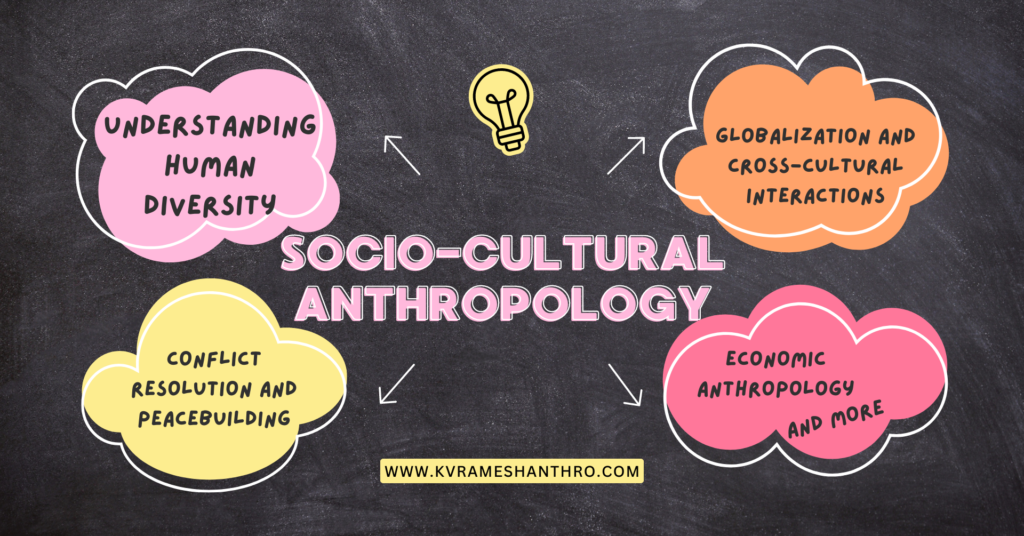
Socio-cultural anthropology is highly relevant in today’s world for various reasons, spanning from academic to practical applications. Here are several key points that highlight its significance:
- Understanding Human Diversity:
- Cultural Practices and Beliefs: Socio-cultural anthropology helps us understand the vast array of cultural practices and beliefs that exist across different societies. This knowledge fosters greater appreciation and respect for cultural diversity.
- Social Structures: By examining how societies organize themselves, anthropologists can reveal the underlying principles that guide social interaction and community life.
- Globalization and Cross-Cultural Interactions:
- Cultural Adaptation: In a globalized world, understanding how cultures adapt to new influences is crucial. Socio-cultural anthropology provides insights into how globalization affects cultural identities and practices.
- Intercultural Communication: Effective communication across cultures is increasingly important in international business, diplomacy, and global governance. Anthropologists’ insights into cultural nuances can improve intercultural communication and reduce misunderstandings.
- Policy and Development:
- Informed Policy-Making: Anthropologists often work with governments and NGOs to create policies that are culturally sensitive and effective. Their ethnographic research can highlight the needs and perspectives of marginalized communities.
- Sustainable Development: Understanding local cultures and social dynamics is essential for implementing development projects that are sustainable and beneficial to the target communities.
- Health and Medicine:
- Medical Anthropology: This subfield explores how cultural beliefs and practices influence health behaviors and medical systems. It helps in designing health interventions that are culturally appropriate and more likely to be accepted by the community.
- Pandemic Response: During health crises, anthropologists can provide crucial insights into community responses, helping to design effective public health campaigns and interventions.
- Conflict Resolution and Peacebuilding:
- Cultural Sensitivity: In conflict zones, understanding the cultural context can aid in peace-building efforts and conflict resolution. Anthropologists’ work can contribute to creating strategies that are culturally sensitive and more likely to succeed.
- Social Cohesion: Anthropological research can identify sources of social tension and cohesion within communities, providing a basis for initiatives aimed at fostering social harmony.
- Migration and Displacement:
- Migration Studies: Anthropologists study the experiences of migrants and refugees, offering insights into the challenges they face and the ways they adapt to new environments. This can inform policies and support programs.
- Cultural Integration: Understanding the cultural backgrounds of migrants helps in designing integration programs that respect their cultural identities while promoting social cohesion in host societies.
- Education and Curriculum Development:
- Inclusive Education: Insights from socio-cultural anthropology can be used to develop educational curricula that are inclusive of diverse cultural perspectives, promoting a more comprehensive understanding of the world among students.
- Educational Anthropology: This subfield examines how cultural beliefs and practices influence educational systems and learning processes, informing the development of more effective and culturally relevant educational strategies.
- Economic Anthropology:
- Market Systems: Anthropologists study different economic systems and practices, providing a broader understanding of how markets function in various cultural contexts. This can inform economic policy and business strategies.
- Consumption Patterns: By examining how cultural factors influence consumption, anthropologists can offer insights into consumer behavior that are valuable for businesses and marketers.
In essence, socio-cultural anthropology provides a deep and nuanced understanding of human societies, which is invaluable for addressing contemporary global challenges. Its relevance spans multiple sectors, including education, health, policy-making, economic development, and intercultural relations, making it an essential field of study in an increasingly interconnected world.